
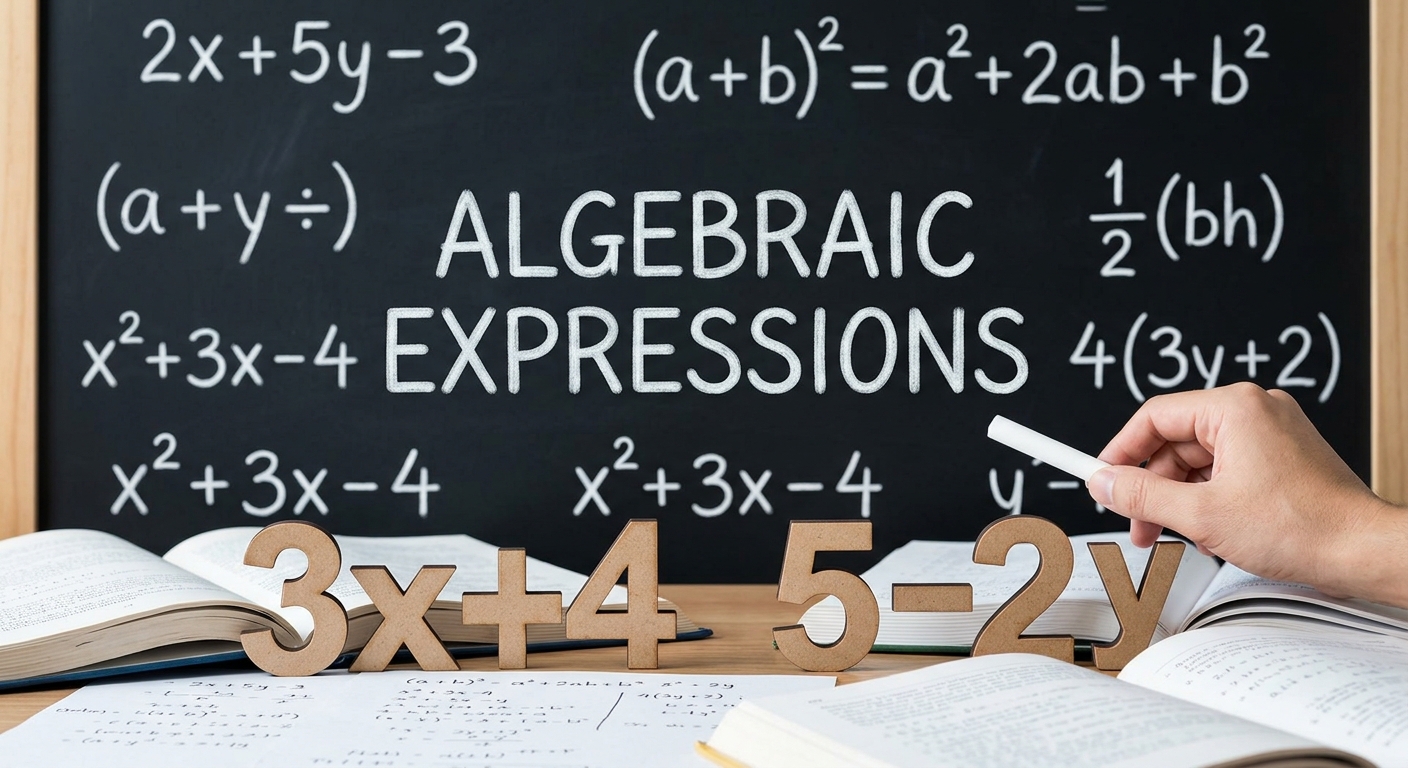
What Is An Algebraic Expression? Parts, Examples And Practice
The short version
- An algebraic expression is a math phrase made of numbers, variables (letters like x), and operations, such as 3x + 5. It has no equals sign.
- An equation sets two expressions equal (3x + 5 = 20), so you can solve it. An expression can only be evaluated or simplified.
- To evaluate one, swap each variable for its value and follow the order of operations: 3x + 5 with x = 4 is 3 × 4 + 5 = 17.
- To simplify one, combine like terms and use the distributive property: 5x + 3 – 2x + 8 becomes 3x + 11.
- Kids who get stuck here usually have a gap in an older skill, most often negative numbers, order of operations, or fractions.
An algebraic expression is a combination of numbers, variables, and operation signs (+, -, ×, ÷, exponents) that stands for a value, like 2x + 7 or 4a2 – 3b. It doesn’t contain an equals sign, so there’s nothing to “solve.” You either plug in values to find what it equals, or you rewrite it in a simpler form.
Kids usually meet these around sixth grade and keep using them in every algebra class after that.
The parts of an algebraic expression
Every expression is built from a few named pieces. Take 4x2 – 3x + 7.
| Part | What it means | In 4x2 – 3x + 7 |
|---|---|---|
| Variable | A letter that stands for an unknown or changing number | x |
| Term | A chunk separated by + or – signs | 4x2, -3x, and 7 (three terms) |
| Coefficient | The number multiplied by a variable | 4 and -3 |
| Constant | A term with no variable, so its value never changes | 7 |
| Exponent | How many times a factor is multiplied by itself | the 2 in x2 |
| Operators | The signs that tell you what to do | – and +, plus the hidden × between 4 and x2 |
Two details trip kids up. First, the sign in front of a term belongs to that term, so the coefficient of the middle term is -3, not 3. Second, a variable with no number in front has a coefficient of 1. In x + 9, the coefficient of x is 1. In -y, it’s -1.
Numerical vs algebraic expressions
A numerical expression uses only numbers, like 8 + 6 ÷ 2. An algebraic expression includes at least one variable, like 8 + 6 ÷ n. The rules for working with them are the same. The variable just means the value depends on what number n turns out to be.
Algebraic expression vs equation
An equation has an equals sign. An expression doesn’t.
| Expression | Equation | |
|---|---|---|
| Example | 3x + 5 | 3x + 5 = 20 |
| Equals sign? | No | Yes |
| What it is | A phrase, like “three times a number, plus five” | A full sentence that makes a claim |
| What you do with it | Evaluate or simplify | Solve for the variable |
| Answer looks like | A number (17) or a simpler expression | A value, x = 5 |
At the kitchen table: “my age plus three” names an amount (expression). “My age plus three is fifteen” makes a claim you can check and solve (equation).
How to evaluate an algebraic expression
Evaluating means finding the number an expression equals for specific values of its variables. There are three steps.
- Rewrite the expression with each variable replaced by its value. Put parentheses around each value, especially negative ones.
- Follow the order of operations: parentheses, exponents, multiplication and division left to right, then addition and subtraction left to right.
- Check the sign of your answer.
Example 1: one variable
Evaluate 3x + 5 when x = 4.
3(4) + 5
= 12 + 5
= 17
Example 2: two variables and an exponent
Evaluate 2a2 – 3b when a = 3 and b = 5.
2(3)2 – 3(5)
= 2(9) – 15
= 18 – 15
= 3
Notice the exponent comes first. A kid who multiplies 2 × 3 and then squares gets 36 – 15 = 21, which is wrong.
Example 3: a negative value
Evaluate x2 – 4x + 1 when x = -2.
(-2)2 – 4(-2) + 1
= 4 + 8 + 1
= 13
The parentheses do the heavy lifting here. (-2)2 is 4, because a negative times a negative is positive. And -4 times -2 is +8. Skip the parentheses and it’s easy to end up with -4 – 8 + 1 = -11.
How to simplify an expression
Simplifying means rewriting it shorter while keeping it equal for every value of the variable. You’ll mostly combine like terms and distribute.
Combining like terms
Like terms have the same variable raised to the same power. 5x and -2x are like terms. 5x and 5x2 are not. Constants (plain numbers) are like terms with each other.
Simplify 5x + 3 – 2x + 8.
Group the x terms: 5x – 2x = 3x
Group the constants: 3 + 8 = 11
Result: 3x + 11
A quick check: pick any value, say x = 2. The original gives 10 + 3 – 4 + 8 = 17. The simplified version gives 6 + 11 = 17. They match, so the simplifying worked.
Using the distributive property
When a number sits outside parentheses, multiply it by every term inside.
Simplify 4(2y – 3) + 5y.
Distribute: 4 × 2y = 8y and 4 × (-3) = -12
Now you have 8y – 12 + 5y
Combine like terms: 13y – 12
Simplify 3(x + 2) – (x – 4).
Distribute the 3: 3x + 6
The minus sign in front of (x – 4) acts like -1, so it becomes -x + 4
Now: 3x + 6 – x + 4
Combine: 2x + 10
Writing expressions from words
These phrases cover most homework translations. We’ll use n for “a number.”
| Words | Algebraic expression |
|---|---|
| 5 more than a number | n + 5 |
| 5 less than a number | n – 5 |
| A number decreased by 5 | n – 5 |
| Twice a number | 2n |
| The quotient of a number and 3 | n ÷ 3, or n/3 |
| The product of 7 and a number, minus 2 | 7n – 2 |
| The square of a number | n2 |
| Half the sum of a number and 6 | (n + 6) ÷ 2 |
“Less than” is the phrase that bites. “5 less than a number” means you start with the number and take 5 away, so it’s n – 5. The order flips from how the words read. Try it with real numbers: 5 less than 12 is 7, and 12 – 5 = 7.
Common mistakes
- Adding unlike terms. 3x + 4 is already simplified. It isn’t 7x. You can’t add a number of x’s to a plain number, the same way 3 apples plus 4 dollars isn’t 7 of anything.
- Distributing to only the first term. 2(x + 5) is 2x + 10, not 2x + 5.
- Dropping the negative sign. In 6 – 2x, the term is -2x. When kids rearrange terms, the minus has to travel with the 2x.
- Squaring a negative without parentheses. If x = -3, then x2 = (-3)2 = 9, not -9.
- Treating 4x as 4 + x. A number next to a variable means multiply. If x = 5, then 4x = 20, not 45 and not 9.
- Reversing “less than.” “3 less than y” is y – 3.
Practice problems
- Evaluate 6x – 4 when x = 3.
- In 5m2 – m + 9, list the terms, the coefficients, and the constant.
- Is 4y + 1 = 9 an expression or an equation? What about 4y + 1?
- Simplify 7a + 2b – 3a + 5b.
- Write an algebraic expression for “8 less than 3 times a number.”
- Simplify 2(3x – 5) + 4x.
- Evaluate 3p2 – 2p when p = -3.
- Simplify 5(x + 2) – 3(x – 1).
Answers
- 6(3) – 4 = 18 – 4 = 14
- Terms: 5m2, -m, and 9. Coefficients: 5 and -1. Constant: 9.
- 4y + 1 = 9 is an equation (it has an equals sign). 4y + 1 is an expression.
- 4a + 7b
- 3n – 8
- 6x – 10 + 4x = 10x – 10
- 3(-3)2 – 2(-3) = 3(9) + 6 = 27 + 6 = 33
- 5x + 10 – 3x + 3 = 2x + 13
If your kid is stuck on algebraic expressions
When a child can’t simplify or evaluate an algebraic expression, look closely at the mistakes. They usually point to an older skill. If they’re getting 4 + 8 + 1 wrong because (-2)2 came out as -4, that’s an integer gap from sixth or seventh grade. If they multiply before squaring, that’s order of operations from fifth grade. If “half the sum of a number and 6″ freezes them, it’s often weak fraction sense from even earlier.
We see this pattern constantly, and we wrote about it in Struggling With Algebra? The Real Problem Is Usually Fourth Grade Fractions. If you’re not sure which earlier skills should already be solid, our grade-by-grade skills guide lays out what kids are expected to know before algebra shows up, and these 12 signs by grade level can help you tell a one-off bad night from a real gap.
More worksheets on expressions rarely fix this. Go back to the missing skill, practice it until it’s automatic, then return to algebra.
Frequently asked questions
What is an example of an algebraic expression?
Any combination of numbers, variables, and operations with no equals sign counts. 2x + 7, 5ab, n/4 – 1, and x2 – 9 are all algebraic expressions.
What is the difference between an expression and an equation?
An equation has an equals sign and states that two things are the same, like 2x + 7 = 15. An expression has no equals sign, like 2x + 7. You solve equations. You evaluate or simplify expressions.
Is a single number or letter an algebraic expression?
Yes. A single variable like x, or a single term like 9y, is a valid expression with one term. A lone number like 12 is a numerical expression, since it has no variable.
What are like terms in an algebraic expression?
Terms with exactly the same variables raised to the same powers. 3x and -8x are like terms. 3x and 3y aren’t, and neither are 3x and 3x2.
What grade learns algebraic expressions?
Most US schools introduce writing and evaluating expressions in sixth grade, then add simplifying with the distributive property in sixth and seventh grade. By Algebra 1, kids use them in nearly every problem.
Find the actual gap
If algebraic expressions keep going sideways at homework time, it helps to know which earlier skill is missing instead of guessing. Math Anon starts with a short adaptive assessment that zeroes in on the exact gaps and gives you a written report you can read in a few minutes.
From there your kid gets about 20 minutes of targeted daily practice on those skills, and you get a progress report every week. The assessment is $49, and that full amount is credited back on the first month. Start the assessment or see pricing.





