
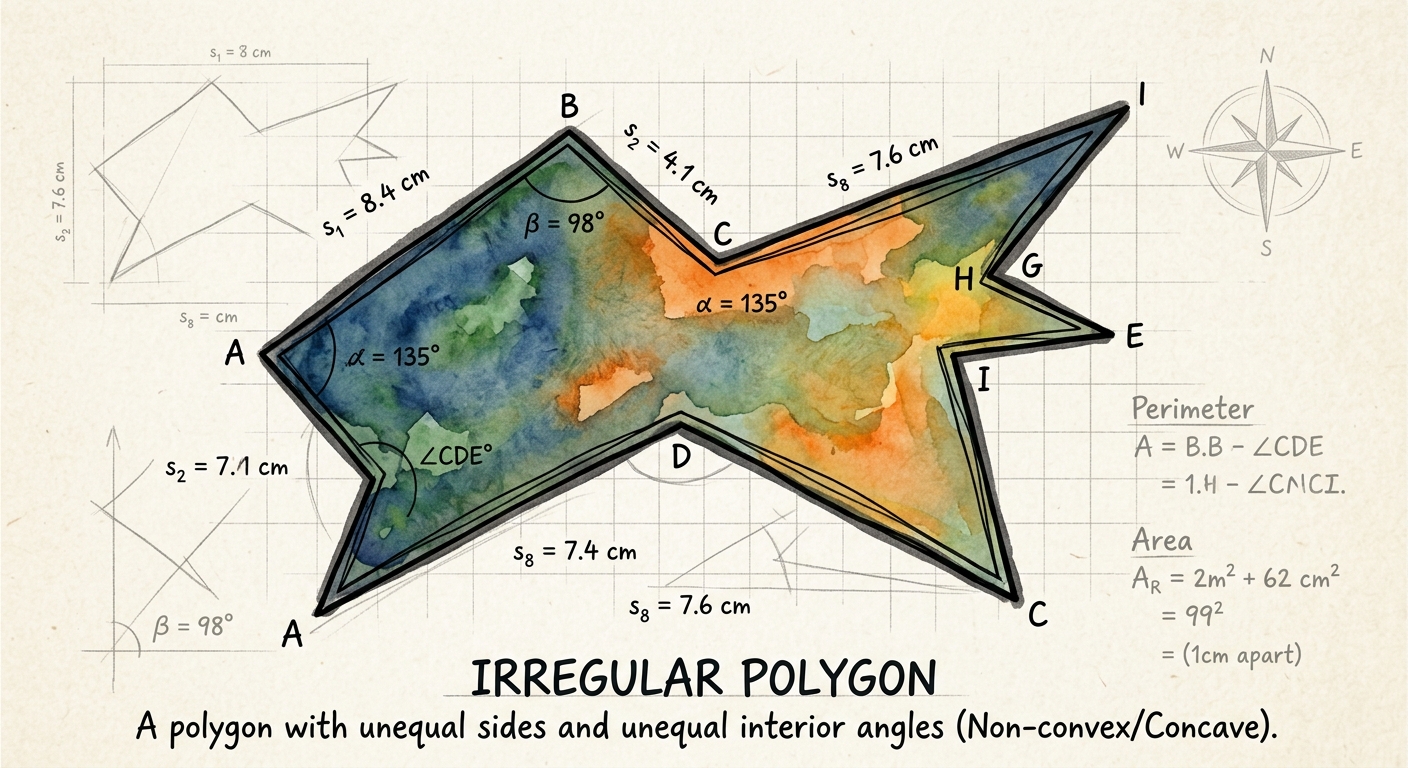
Irregular Polygon: Definition, Examples And Regular Vs Irregular
The short version
- An irregular polygon is a polygon whose sides aren’t all the same length, or whose angles aren’t all the same size, or both.
- A regular polygon has to pass two tests: every side equal and every angle equal. Fail either one and it’s irregular.
- Rectangles, rhombuses, kites, trapezoids, right triangles and scalene triangles are all irregular polygons.
- The angle sum formula (n – 2) × 180° works for irregular polygons too. What you can’t do is split that total evenly.
- For perimeter, add every side. For area, cut the shape into rectangles and triangles.
An irregular polygon is a closed, flat shape with straight sides where the sides aren’t all equal, the angles aren’t all equal, or neither is. A rectangle is a good example: its four angles are all 90°, but two sides are longer than the other two, so it’s irregular. A square passes both tests, so it’s regular.
Most polygons you meet in real life are irregular. Below we’ll cover the two-part test, a table of regular and irregular examples, convex and concave shapes, how to find angles, perimeter and area, the common mistakes, and practice problems with answers.
Regular vs irregular polygons: the two-part test
First, a polygon is any closed 2D shape made of straight line segments that only meet at their ends. Circles don’t count (they’re curved), and neither does a shape with a gap.
To decide regular or irregular, ask two questions:
- Are all the sides the same length?
- Are all the angles the same size?
Two yeses make it regular. Anything else makes it irregular. The trap is that one yes isn’t enough. A rhombus has four equal sides, but its angles might be 60°, 120°, 60° and 120°. That’s irregular.
Triangles are a special case
In a triangle, equal sides force equal angles, and the other way around. So the only regular triangle is the equilateral triangle, with three 60° angles. Every other triangle is irregular: isosceles, scalene, right, obtuse, all of them.
From four sides up, the two tests split apart. A shape can have all equal angles and unequal sides (a rectangle), or all equal sides and unequal angles (a rhombus).
Irregular polygon examples
| Sides | Name | Regular version | Irregular examples |
|---|---|---|---|
| 3 | Triangle | Equilateral triangle | Scalene, isosceles, right triangle |
| 4 | Quadrilateral | Square | Rectangle, rhombus, kite, trapezoid, parallelogram |
| 5 | Pentagon | Regular pentagon | A house shape (square with a triangle roof) |
| 6 | Hexagon | Honeycomb cell | An L-shaped room outline |
| 8 | Octagon | Stop sign | A stop sign stretched wider than it is tall |
Everyday irregular polygons are everywhere: the outline of a floor plan, a home plate in baseball (five sides, not all equal), a kite, and a lot of the shapes in a tangram set.
Convex and concave irregular polygons
Irregular polygons come in two kinds, and this is the part most explanations skip.
- Convex: every interior angle is less than 180°, and the shape bulges outward everywhere. A rectangle and a kite are convex.
- Concave: at least one interior angle is more than 180°, so part of the shape caves in. An arrowhead or an L shape is concave.
A quick test: if you can draw a straight line between two points inside the shape and part of the line goes outside, it’s concave.
Every regular polygon is convex. So any concave polygon is automatically irregular. You don’t even need to measure.
Angles in an irregular polygon
The interior angles of any polygon with n sides add up to (n – 2) × 180°. That’s true for regular and irregular polygons alike.
| Sides (n) | Angle sum | Each angle if regular |
|---|---|---|
| 3 | 180° | 60° |
| 4 | 360° | 90° |
| 5 | 540° | 108° |
| 6 | 720° | 120° |
| 8 | 1,080° | 135° |
The last column only works for regular polygons. In an irregular polygon, the angles share the total unevenly, so you find a missing one by subtracting.
Worked example 1: missing angle in an irregular pentagon
An irregular pentagon has angles of 100°, 120°, 95° and 110°. Find the fifth.
Angle sum: (5 – 2) × 180 = 540°
Known angles: 100 + 120 + 95 + 110 = 425°
Missing angle: 540 – 425 = 115°
Worked example 2: concave quadrilateral
An arrowhead shape has angles of 30°, 30° and 40°. Find the fourth.
Angle sum: 360°
30 + 30 + 40 = 100
360 – 100 = 260°
That 260° angle is the reflex angle where the arrowhead caves in. It’s bigger than 180°, which is exactly what makes the shape concave.
Perimeter and area of an irregular polygon
With a regular polygon, you can multiply one side by the number of sides. With an irregular polygon, you add every side one at a time. For area, split the shape into pieces you already know how to find.
Worked example 3: an L shape
Start with a rectangle 10 m wide and 8 m tall. Cut a 4 m by 3 m rectangle out of the top right corner. The result is an irregular hexagon.
Perimeter. Walk around it: bottom 10, left side 8, top 10 – 4 = 6, down 3, across 4, right side 8 – 3 = 5.
10 + 8 + 6 + 3 + 4 + 5 = 36 m
Area. Big rectangle minus the cutout.
10 × 8 = 80
4 × 3 = 12
80 – 12 = 68 m²
A kid who forgets to work out the two missing side lengths (6 and 5) will come up short on perimeter every time. Label every side before adding.
Worked example 4: a house shape
A pentagon is made of a 12 by 5 rectangle with a triangle on top. The triangle’s base is 12 and its height is 4.
Rectangle: 12 × 5 = 60
Triangle: ½ × 12 × 4 = 24
Total area: 60 + 24 = 84 square units
Common mistakes with irregular polygons
- Checking only the sides. A rhombus has equal sides but can still be irregular. Check the angles too.
- Checking only the angles. A rectangle has four 90° angles, and it’s still irregular.
- Thinking “irregular” means “weird looking.” A plain rectangle or a neat isosceles triangle is irregular. It’s a precise math word with a fixed test, and how tidy the shape looks has nothing to do with it.
- Dividing the angle sum evenly. 540 ÷ 5 = 108 is only correct for a regular pentagon.
- Calling a circle an irregular polygon. Curves disqualify a shape from being any polygon.
- Skipping unlabeled sides. In L shapes and steps, some side lengths have to be worked out before you add.
Practice problems
- Is a 4 by 6 rectangle regular or irregular?
- Is a square regular or irregular?
- An irregular pentagon has sides of 3, 5, 4, 6 and 7 cm. Find its perimeter.
- What do the interior angles of any hexagon add up to?
- An irregular quadrilateral has angles of 85°, 95° and 110°. Find the fourth angle.
- An irregular hexagon has five angles of 130°, 110°, 140°, 100° and 135°. Find the sixth.
- Find the area of a shape made from a 9 by 6 rectangle with a 3 by 2 rectangle cut out of one corner.
- Can an irregular polygon have all its angles equal? Give an example.
Answers
- Irregular. The angles are all 90°, but the sides aren’t equal.
- Regular. Four equal sides and four 90° angles.
- 25 cm (3 + 5 + 4 + 6 + 7)
- 720°. (6 – 2) × 180 = 720.
- 70°. 360 – (85 + 95 + 110) = 360 – 290 = 70.
- 105°. 130 + 110 + 140 + 100 + 135 = 615, and 720 – 615 = 105.
- 48 square units. 9 × 6 = 54, 3 × 2 = 6, and 54 – 6 = 48.
- Yes. Any rectangle that isn’t a square has four equal angles and unequal sides.
If your child is stuck on polygons
Classifying shapes by their sides and angles is a grade 3 to 5 skill, and polygon angle sums usually arrive in middle school. When a kid can’t sort regular from irregular, it’s often vocabulary or angle sense: they can’t yet judge whether an angle is 90° or recognize equal sides from tick marks. When area of irregular shapes is the problem, the gap tends to be multiplication, subtraction with multiple steps, or not knowing how to find the area of a triangle.
Angle relationships help here too, and our post on supplementary angles covers the 180° idea that polygon angle sums rest on. To see where shape skills sit by grade, check our guide to math skills by grade level. If this is one of several topics going badly, our list of signs a child is behind in math is worth a read.
Frequently asked questions
What is an irregular polygon?
A polygon where the sides aren’t all equal, the angles aren’t all equal, or both. Only a shape with every side and every angle equal is regular.
Is a rectangle an irregular polygon?
Yes, unless it’s a square. A rectangle’s angles are all 90°, but its length and width are different, so it fails the equal sides test.
Is a rhombus regular or irregular?
Irregular, unless its angles are all 90°. Then it’s a square, which is regular.
Is a triangle a regular or irregular polygon?
Only the equilateral triangle is regular. Every other triangle, including isosceles and right triangles, is irregular.
Can an irregular polygon have equal sides?
Yes. A rhombus with 60° and 120° angles has four equal sides and is still irregular, because its angles differ.
How do you find the area of an irregular polygon?
Split it into rectangles and triangles, find each area, and add them. For shapes with a piece missing, find the big area and subtract the cutout.
Find the actual gap
A kid who gets the irregular polygon definition but can’t find the area or a missing angle usually has a hole in an earlier skill, like triangle area or multi-step subtraction. Math Anon’s short adaptive assessment finds those holes and writes up exactly what’s missing.
From there it’s about 20 minutes a day of practice on only those skills, with a progress report sent to you weekly. The assessment is $49, credited back in full on your first month. Start the assessment or see pricing.





