
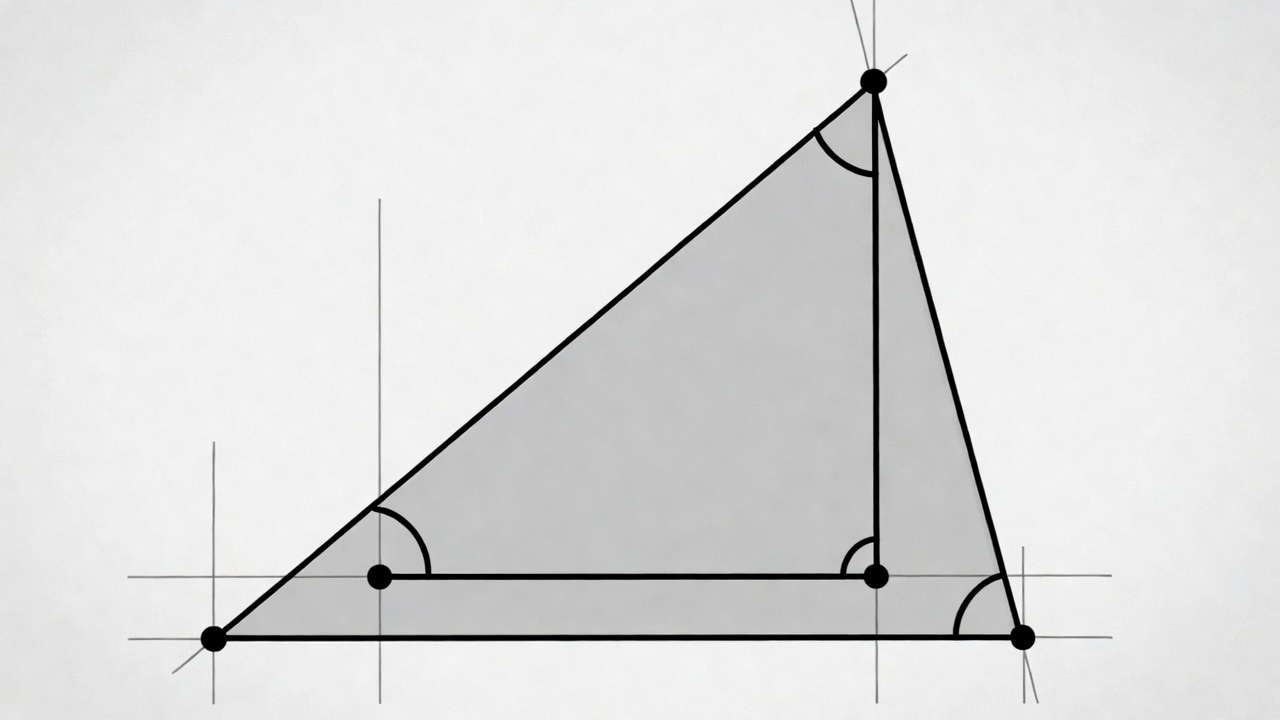
What Is A Scalene Triangle? Definition, Types And Examples
The short version
- A scalene triangle has three sides of different lengths. Because the sides are all different, the three angles are all different too.
- Scalene triangles can be acute, right or obtuse. A 3-4-5 right triangle is scalene.
- If two angles match, the triangle is isosceles, not scalene. Checking the angles is often faster than measuring sides.
- Perimeter is the three sides added. Area is ½ × base × height, where the height is measured straight up from the base.
A scalene triangle is a triangle where no two sides are the same length. Since equal sides always sit across from equal angles, a scalene triangle also has three different angles. A triangle with sides of 5 cm, 7 cm and 9 cm is scalene. So is a triangle with angles of 40°, 65° and 75°.
The name comes from a Greek word meaning “uneven.” Most triangles you’d draw by hand without trying are scalene, which is why it’s worth knowing how to spot one, classify it, and work out its perimeter and area. That’s what this guide covers, with practice problems and answers at the end.
Scalene vs isosceles vs equilateral
Triangles are sorted by their sides into three groups. Every triangle fits exactly one.
| Type | Equal sides | Equal angles | Lines of symmetry | Example sides |
|---|---|---|---|---|
| Equilateral | All 3 | All 3 (each 60°) | 3 | 6, 6, 6 |
| Isosceles | At least 2 | At least 2 | 1 (or 3 if equilateral) | 5, 5, 8 |
| Scalene | None | None | 0 | 4, 6, 7 |
A scalene triangle has no line of symmetry. You can’t fold it in half and have the two halves match, and that’s a nice hands-on test for younger kids with paper cutouts.
One small note: many textbooks define isosceles as “at least two equal sides,” which makes every equilateral triangle a special isosceles triangle. A scalene triangle is never isosceles or equilateral.
Types of scalene triangles
Triangles also get sorted by their angles, and a scalene triangle can land in any of the three angle groups.
- Acute scalene: every angle is less than 90°. Example: angles of 50°, 60° and 70°.
- Right scalene: one angle is exactly 90°. Example: the 3-4-5 triangle, or angles of 30°, 60° and 90°.
- Obtuse scalene: one angle is more than 90°. Example: angles of 20°, 35° and 125°.
So “scalene right triangle” and “obtuse scalene triangle” are both real, correct names. The first word describes the angles, the second the sides, or the other way around.
How to tell if a triangle is scalene
From the side lengths
Check that all three lengths are different. Then make sure the sides can actually form a triangle: the two shorter sides have to add up to more than the longest side. That’s called the triangle inequality.
Example 1: Sides of 5, 7 and 9 cm.
All three are different.
5 + 7 = 12, which is more than 9, so it’s a real triangle.
Answer: scalene.
Example 2: Sides of 3, 4 and 8 cm.
All different, but 3 + 4 = 7, which is less than 8.
The two short sides can’t reach each other. There’s no triangle at all.
From the angles
The angles in a triangle always add to 180°. Find the missing one, then check whether any two match.
Example 3: Two angles are 47° and 68°.
180 – 47 – 68 = 65
The angles are 47°, 65° and 68°. All different, so the triangle is scalene. All are under 90°, so it’s an acute scalene triangle.
Example 4: Two angles are 35° and 110°.
180 – 35 – 110 = 35
The angles are 35°, 35° and 110°. Two match, so this one is isosceles, even though the two angles you were given were different. This is a favorite trick question.
Perimeter and area of a scalene triangle
Perimeter
Add the three sides. There’s no shortcut, since no sides repeat.
Example 5: Sides of 6 m, 8 m and 11 m.
6 + 8 + 11 = 25 m
Area with base and height
Area = ½ × base × height. The height has to be perpendicular to the base, measured from the opposite corner. In a scalene triangle the height is almost never one of the sides, unless it’s a right triangle.
Example 6: A right scalene triangle with legs 3 cm and 4 cm (hypotenuse 5 cm).
The legs are perpendicular, so one is the base and the other is the height.
½ × 3 × 4 = 6 cm²
Example 7: A scalene triangle with a base of 10 in and a height of 7 in.
½ × 10 × 7 = 35 in²
In an obtuse scalene triangle, the height can fall outside the triangle, and you have to extend the base with a dotted line to draw it. That surprises a lot of students.
Area with only the three sides (Heron’s formula)
If you know all three sides but no height, high school students can use Heron’s formula. Find s, half the perimeter, then area = √(s(s – a)(s – b)(s – c)).
Example 8: Sides of 13, 14 and 15.
s = (13 + 14 + 15) ÷ 2 = 21
Area = √(21 × 8 × 7 × 6) = √7,056 = 84 square units
Common mistakes
- Judging by eye. Two sides can look equal and be 6.8 and 7. Go by the labeled numbers, not the drawing.
- Checking only the given angles. As in Example 4, the missing angle can match one of the given ones.
- Thinking a right triangle can’t be scalene. Most right triangles are scalene. Only the 45-45-90 one is isosceles.
- Using a slanted side as the height. The height has to meet the base at a right angle.
- Skipping the triangle inequality. Three different numbers don’t always make a triangle.
Practice problems
- Classify the triangle with sides 4, 4 and 6.
- Classify the triangle with sides 6, 10 and 12.
- A triangle has angles of 30°, 60° and 90°. Classify it by sides and by angles.
- A triangle has angles of 50°, 50° and 80°. Is it scalene?
- Two angles of a triangle are 35° and 110°. Is it scalene?
- Find the perimeter of a scalene triangle with sides 7.5 cm, 9 cm and 12 cm.
- Can sides of 2, 5 and 9 form a scalene triangle?
- A right triangle has legs of 5 and 12. Find the hypotenuse, the perimeter and the area. Is it scalene?
Answers
- Isosceles, because two sides are 4.
- Scalene. All sides are different, and 6 + 10 = 16 is more than 12.
- Scalene (all angles different) and right (one angle is 90°).
- No. Two angles match, so it’s isosceles.
- No. The third angle is 180 – 35 – 110 = 35°, so two angles match and it’s isosceles.
- 7.5 + 9 + 12 = 28.5 cm.
- No. 2 + 5 = 7, which is less than 9, so no triangle is possible.
- Hypotenuse: √(5² + 12²) = √(25 + 144) = √169 = 13. Perimeter: 5 + 12 + 13 = 30. Area: ½ × 5 × 12 = 30 square units. Yes, it’s scalene, since 5, 12 and 13 are all different.
If your kid is stuck on triangles
Naming a scalene triangle is vocabulary. When kids struggle with triangle classification, the gap is usually in the skills around the name: measuring sides with a ruler, reading a protractor, or knowing that the angles in a triangle add to 180°. The angle part connects straight to supplementary angles, since both come down to working with 180.
For older students, area trouble often traces back to multiplying by ½, which is fraction work, and Heron’s formula leans on square roots. Our math skills by grade level guide shows when these are expected. If you’re seeing mistakes across several topics, a proper math assessment is the fastest way to see which older skill is behind them.
Frequently asked questions
What is a scalene triangle in simple words?
A triangle with three different side lengths. None of its sides match, and none of its angles match either.
Can a scalene triangle have a right angle?
Yes. A triangle with sides 3, 4 and 5 is a right scalene triangle. So is any 30-60-90 triangle.
Can a scalene triangle be equilateral or isosceles?
No. Equilateral triangles have three equal sides and isosceles triangles have at least two. Scalene has none.
Does a scalene triangle have any lines of symmetry?
No. With every side a different length, there’s no way to fold it so the halves match.
What grade learns about scalene triangles?
Most kids learn the names scalene, isosceles and equilateral in about fourth or fifth grade, when they start classifying shapes. Area and the triangle inequality come in middle school.
Find the actual gap
If triangle homework keeps going sideways, it helps to know whether the problem is the geometry or something older like measuring or fractions. Math Anon starts with a short adaptive assessment that finds exactly which skills are missing and sends you a written report.
Then your child practices just those skills for about 20 minutes a day, and you get a progress report every week to see how it’s going. The assessment costs $49 and gets credited back in full on the first month. Start the assessment, or see our pricing.
Related reading
- Supplementary Angles, Explained
- Math Skills By Grade Level: What Your Child Should Know
- Mind The Gap: A Parent’s Guide To Math Assessment For Kids
- Is My Child Behind In Math? 12 Signs By Grade Level
- Names Of Shapes: Polygon Names, Quadrilaterals And 3D Shapes
- Triangle Angle Sum Theorem: How To Find Any Missing Angle





