
Triangle Angle Sum Theorem: How To Find Any Missing Angle
The short version
- The triangle angle sum theorem says the three interior angles of any triangle add up to 180°.
- To find a missing angle, subtract the two known angles from 180. With angles of 48° and 67°, the third is 180 – 48 – 67 = 65°.
- For “solve for x” problems, add the three angle expressions, set the total equal to 180, and solve. Then plug x back in to get each angle.
- The exterior angle theorem is the companion rule: an exterior angle equals the sum of the two interior angles that aren’t next to it.
The triangle angle sum theorem states that the interior angles of every triangle add up to exactly 180 degrees. It doesn’t matter if the triangle is tiny or huge, skinny or wide. So if you know two angles, the third is 180 minus their sum.
Most homework on this topic comes in two flavors: find the missing angle, and solve for x when the angles are written as expressions. We’ll walk through both, prove why the theorem is true, cover the exterior angle theorem, and give you practice problems with worked answers.
What the triangle angle sum theorem says
For any triangle with angles A, B, and C:
A + B + C = 180°
That one equation gives you a lot of facts about specific triangle types:
| Triangle type | What the theorem tells you |
|---|---|
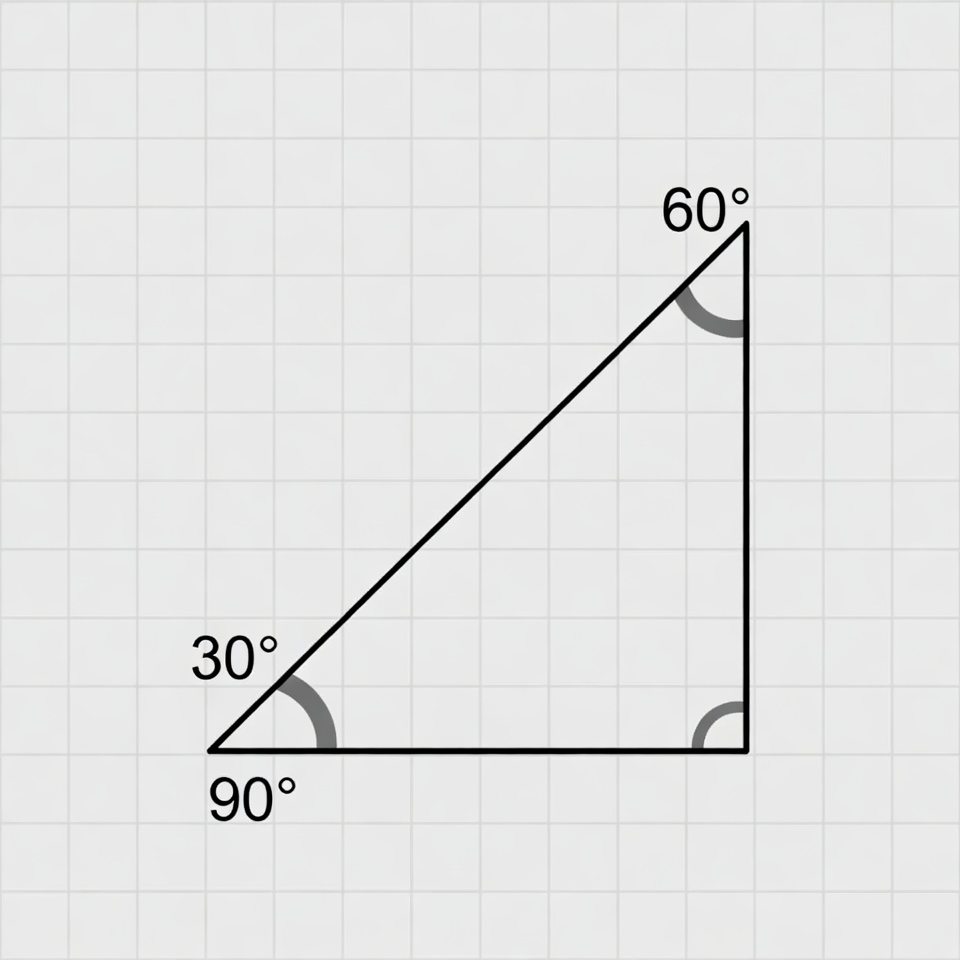
| Right triangle | One angle is 90°, so the other two add to 90°. |
| Equilateral | All three angles are equal, so each is 180 ÷ 3 = 60°. |
| Isosceles | The two base angles are equal. If the top angle is 40°, each base angle is (180 – 40) ÷ 2 = 70°. |
| Obtuse | Only one angle can be over 90°, because two of them would already pass 180°. |
Why the angles always add to 180°
Here’s the proof most geometry classes use. Take triangle ABC. Through the top corner B, draw a line parallel to the bottom side AC.
Now there are three angles sitting side by side along that new line at point B: one on the left, the triangle’s own angle B in the middle, and one on the right. Together they make a straight line, so they add to 180°.
Because the new line is parallel to AC, the angle on the left matches angle A (they’re alternate interior angles), and the angle on the right matches angle C for the same reason. Swap them in, and you get A + B + C = 180°.
The key fact underneath is that a straight line measures 180°. That’s the same idea behind supplementary angles, which is why kids who are solid on supplementary angles usually find this theorem easy.
A hands-on version: cut out any paper triangle, tear off the three corners, and line up the points. The corners always form a straight line.
How to find a missing angle
- Add the two angles you know.
- Subtract that sum from 180.
- Check: all three should add to 180.
Worked example 1
A triangle has angles of 48° and 67°.
48 + 67 = 115
180 – 115 = 65°
Check: 48 + 67 + 65 = 180.
Worked example 2: right triangle
A right triangle has an angle of 34°.
The right angle is 90°, so 90 + 34 = 124.
180 – 124 = 56°
Solving for x with the triangle angle sum theorem
This is the kind of problem students search for answers to. Once you’ve done a couple, they all follow the same four steps:
- Add all three angle expressions.
- Set the sum equal to 180.
- Solve for x.
- Plug x back in to get each angle, and check that they add to 180.
Worked example 3
The angles are x, 2x, and 3x.
x + 2x + 3x = 180
6x = 180
x = 30
Angles: 30°, 60°, 90°. Check: 30 + 60 + 90 = 180.
Worked example 4
The angles are (2x + 10), (3x – 5), and (x + 25).
Add the x terms: 2x + 3x + x = 6x
Add the numbers: 10 – 5 + 25 = 30
6x + 30 = 180
6x = 150
x = 25
Angles: 2(25) + 10 = 60°, 3(25) – 5 = 70°, 25 + 25 = 50°.
Check: 60 + 70 + 50 = 180.
Many problems stop at “x = 25,” but some ask for the angle measures. Read the question twice. A kid who writes 25 when the question asked for the largest angle (70°) loses the point even though the algebra was right.
The exterior angle theorem
Extend one side of a triangle past a corner. The angle between that extension and the next side is an exterior angle. The two interior angles that aren’t touching it are called the remote interior angles.
Exterior angle theorem: an exterior angle equals the sum of the two remote interior angles.
It follows straight from the angle sum theorem. The exterior angle and the interior angle next to it form a straight line, so they add to 180°. The three interior angles also add to 180°. Take away the shared interior angle from both, and what’s left must match.
Worked example 5
The remote interior angles are 45° and 72°.
Exterior angle = 45 + 72 = 117°
Check the long way: the adjacent interior angle is 180 – 117 = 63°, and 45 + 72 + 63 = 180.
Worked example 6: solve for x
The exterior angle is (4x + 6). The remote interior angles are (x + 20) and (2x + 14).
4x + 6 = (x + 20) + (2x + 14)
4x + 6 = 3x + 34
x = 28
Exterior angle: 4(28) + 6 = 118°. Remote angles: 48° and 70°. Check: 48 + 70 = 118.
One more fact that shows up on tests: if you take one exterior angle at each corner, the three exterior angles always add to 360°.
Common mistakes
- Using 360 instead of 180. 360° is for quadrilaterals and for a full turn. Triangles are 180°.
- Stopping at x. If the question asks for an angle, plug x back in.
- Dropping a negative when combining. In (3x – 5), the -5 has to be subtracted when you add up the constants.
- Adding the wrong angles for an exterior angle. Use the two interior angles that are not next to the exterior angle.
- Forgetting the hidden 90°. A small square in the corner of a diagram means a right angle, even if “90” isn’t written.
Practice problems
- Two angles of a triangle are 52° and 71°. Find the third.
- A right triangle has an angle of 18°. Find the other acute angle.
- What does each angle of an equilateral triangle measure?
- An isosceles triangle has base angles of 35° each. Find the top angle.
- The remote interior angles of a triangle are 38° and 94°. Find the exterior angle.
- A triangle’s angles are x, (x + 15), and (2x – 7). Find x and all three angles.
- An exterior angle is (5x – 12). Its remote interior angles are (2x + 5) and (x + 29). Find x and the exterior angle.
- Can a triangle have angles of 95° and 90°? Explain.
Answers
- 180 – 52 – 71 = 57°
- 180 – 90 – 18 = 72°
- 180 ÷ 3 = 60°
- 180 – 35 – 35 = 110°
- 38 + 94 = 132°
- x + x + 15 + 2x – 7 = 180, so 4x + 8 = 180, 4x = 172, x = 43. Angles: 43°, 58°, 79°. Check: 43 + 58 + 79 = 180.
- 5x – 12 = 3x + 34, so 2x = 46 and x = 23. Exterior angle: 5(23) – 12 = 103°. Check: 2(23) + 5 = 51 and 23 + 29 = 52, and 51 + 52 = 103.
- No. 95 + 90 = 185, which is already more than 180, leaving nothing for the third angle.
If your kid is stuck on triangle angles
The theorem itself is one sentence. When kids get these wrong, it’s usually one of two older skills. For simple missing-angle problems, it’s often angle basics: not knowing that a straight line is 180° or that a square corner means 90°. Our post on supplementary angles covers the straight-line idea this theorem depends on.
For solve-for-x problems, the gap is almost always algebra: combining like terms with negatives and solving two-step equations. If the geometry makes sense but the answers keep coming out wrong, look at the algebra. We explain how those gaps build up in struggling with algebra. And if you’re seeing trouble in more than one unit, these signs your child is behind in math will help you judge how wide it goes.
Frequently asked questions
What is the triangle angle sum theorem?
It’s the rule that the three interior angles of any triangle add up to 180°.
How do you solve angle sum theorem problems with x?
Add the three angle expressions, set the total equal to 180, and solve for x. Then substitute x back in to find each angle. If your online course wants a specific angle, give that angle, since x on its own won’t be marked right.
What’s the difference between the angle sum theorem and the exterior angle theorem?
The angle sum theorem is about the three inside angles adding to 180°. The exterior angle theorem says an outside angle equals the sum of the two inside angles farthest from it.
Can a triangle have two right angles?
No. Two right angles already total 180°, which leaves 0° for the third angle, and a triangle can’t have a 0° angle.
Do the exterior angles of a triangle add to 180?
No. Taking one exterior angle at each corner, they add to 360°.
Find the actual gap
If triangle problems keep going wrong, the missing piece is often older than geometry: straight-line angles, integer rules, or two-step equations. Math Anon starts with a short adaptive assessment that finds exactly which skills your child is missing and gives you a written report.
From there, it’s about 20 minutes a day of practice aimed at those gaps, plus a progress report each week. The assessment is $49, and you get it credited back in full on the first month. Start the assessment or see pricing.





