
What Is A Quadrilateral? Types, Angles And Area
The short version
- A quadrilateral is any closed, flat shape with four straight sides and four corners.
- The four angles always add up to 360 degrees, no matter how stretched or lopsided the shape looks.
- Squares, rectangles, rhombuses, parallelograms, trapezoids and kites are all quadrilaterals, and they sit in a family tree where the special ones inherit from the general ones.
- A square is a rectangle and a rhombus and a parallelogram, all at once. That’s the part kids miss on tests.
- Each type has its own area formula, but they all trace back to base × height.
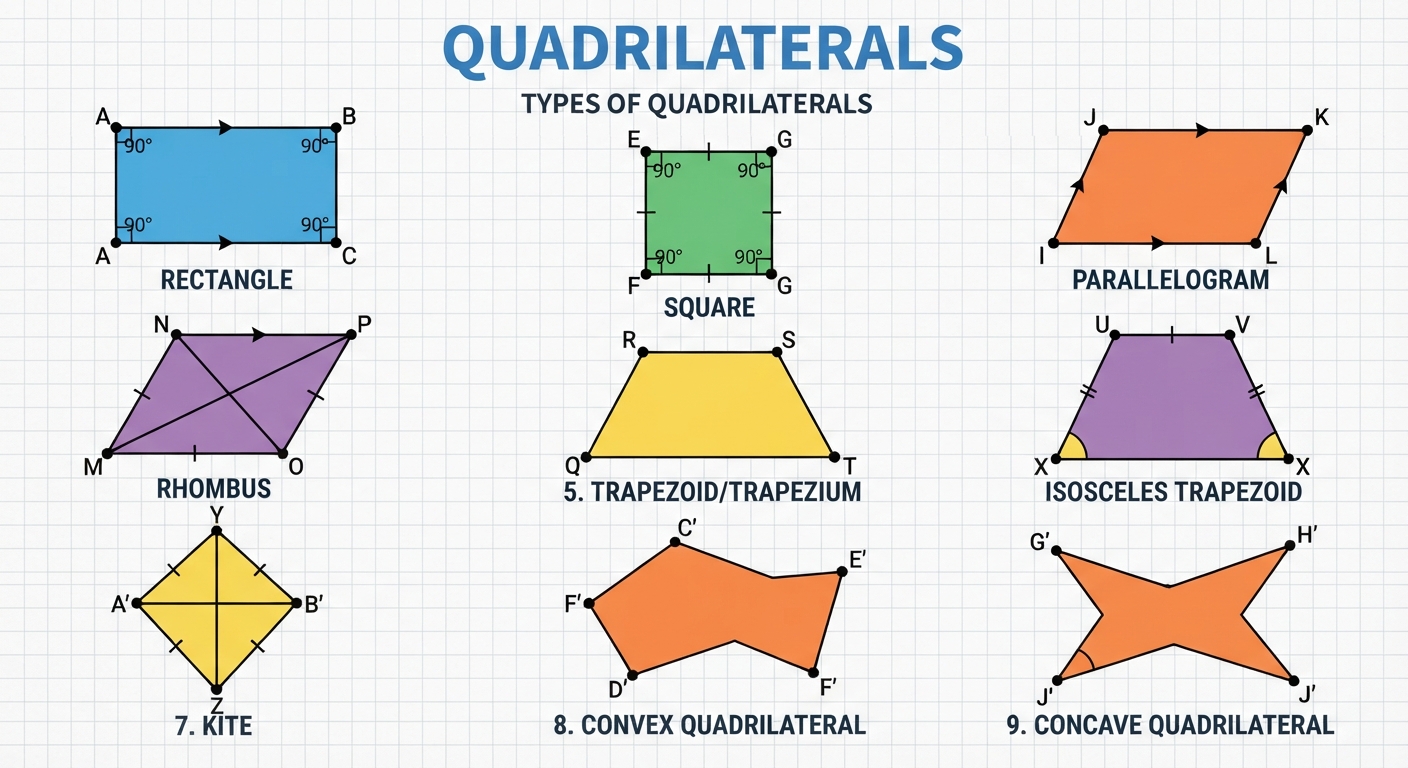
A quadrilateral is a closed shape with four straight sides, four corners and four angles. “Quad” means four and “lateral” means side, so the name is a description. If you can draw it without lifting the pencil, the sides are straight, and there are exactly four of them, it counts.
That includes shapes kids expect, like squares and rectangles, and shapes they don’t, like a lopsided four sided blob with no parallel sides and no equal angles. There’s no requirement that anything be equal or parallel. Four straight sides, closed up, and you’re done.
The rule that never changes: 360 degrees
Every quadrilateral, without exception, has interior angles that add to 360 degrees. Squash it, stretch it, tilt one corner, and the total stays put.
Here’s why. Draw one diagonal from a corner to the opposite corner. That splits the shape into two triangles. Each triangle’s angles add to 180 degrees, and 180 + 180 = 360. The diagonal didn’t add or remove any angle, it just reorganized them.
Worked example: find the missing angle
A four sided garden bed has angles of 100, 85 and 70 degrees. What’s the fourth?
Add the three you know: 100 + 85 + 70 = 255
Subtract from the total: 360 – 255 = 105
The fourth angle is 105 degrees.
Check it: 100 + 85 + 70 + 105 = 360. Correct.
The quadrilateral family tree
This table is the thing most classes rush. The shapes aren’t a flat list of six unrelated options. They nest.
| Shape | Sides | Angles | Parallel sides | It’s also a |
|---|---|---|---|---|
| Trapezoid | No rule | No rule | At least one pair | Quadrilateral |
| Kite | Two pairs of equal sides, next to each other | One pair of equal angles | None required | Quadrilateral |
| Parallelogram | Opposite sides equal | Opposite angles equal | Two pairs | Trapezoid |
| Rectangle | Opposite sides equal | All four are 90 degrees | Two pairs | Parallelogram |
| Rhombus | All four equal | Opposite angles equal | Two pairs | Parallelogram, kite |
| Square | All four equal | All four are 90 degrees | Two pairs | Rectangle, rhombus, parallelogram |
Read the last column slowly with your child. A square is a rectangle whose sides happen to all match. It’s also a rhombus whose angles happen to be right angles. Every square is a rectangle, but most rectangles aren’t squares, the same way every thumb is a finger but not every finger is a thumb.
One warning about trapezoids. Some textbooks define a trapezoid as having exactly one pair of parallel sides, which would keep parallelograms out of the family. Others say at least one pair, which lets them in. Check which version your child’s class uses before you argue with a worksheet.
Area and perimeter of each quadrilateral
Perimeter is easy everywhere: add up the four sides. Area takes a formula, and they’re more alike than they look.
| Shape | Area formula | Example |
|---|---|---|
| Square | side × side | Side 6: 6 × 6 = 36 |
| Rectangle | length × width | 9 by 4: 9 × 4 = 36 |
| Parallelogram | base × height | Base 14, height 6: 84 |
| Trapezoid | average of the two bases × height | Bases 8 and 12, height 5: 50 |
| Rhombus or kite | (diagonal 1 × diagonal 2) ÷ 2 | Diagonals 6 and 10: 30 |
The height in a parallelogram or trapezoid is the straight up and down distance between the parallel sides, not the slanted side. Kids grab the slanted side constantly, and every answer comes out too big.
Worked example: area of a trapezoid
Bases are 8 cm and 12 cm, height is 5 cm.
Average the bases: (8 + 12) ÷ 2 = 20 ÷ 2 = 10
Multiply by the height: 10 × 5 = 50
Area = 50 square cm
Worked example: area of a rhombus
The diagonals measure 6 in and 10 in.
Multiply the diagonals: 6 × 10 = 60
Cut it in half: 60 ÷ 2 = 30
Area = 30 square in
A rhombus is also a parallelogram, so base × height works too, as long as you have the height.
Common mistakes with quadrilaterals
Saying a square isn’t a rectangle. It is. A rectangle needs four right angles and opposite sides equal, and a square has both.
Using the slanted side as the height. Height is perpendicular to the base. On a leaning parallelogram, that line sits inside the shape, not along its edge.
Thinking a rotated square is a diamond. Turning a shape doesn’t change what it is. A square tipped 45 degrees is still a square.
Assuming four sides means four equal sides. A quadrilateral has no equal side requirement at all.
Adding to 180 instead of 360. Triangles get 180. Four sided shapes get double that.
Forgetting the second diagonal. The rhombus and kite formula needs both diagonals, then a divide by 2.
Practice problems
1. Three angles of a quadrilateral are 90, 90 and 75 degrees. Find the fourth.
2. Find the area of a rectangle that is 9 cm by 4 cm.
3. Find the perimeter of a rhombus with a side length of 9 m.
4. Find the area of a parallelogram with base 14 ft and height 6 ft.
5. A trapezoid has bases of 5 in and 9 in and a height of 4 in. Find the area.
6. A kite has diagonals of 12 cm and 7 cm. Find the area.
7. Two angles of a quadrilateral are equal. The other two measure 100 and 120 degrees. How big is each equal angle?
8. True or false: every parallelogram is a rectangle.
Answers
1. 90 + 90 + 75 = 255, and 360 – 255 = 105 degrees.
2. 9 × 4 = 36 square cm.
3. All four sides are 9, so 9 × 4 = 36 m.
4. 14 × 6 = 84 square ft.
5. (5 + 9) ÷ 2 = 7, then 7 × 4 = 28 square in.
6. 12 × 7 = 84, then 84 ÷ 2 = 42 square cm.
7. 100 + 120 = 220, and 360 – 220 = 140. Split between the two equal angles: 140 ÷ 2 = 70 degrees each. Check: 70 + 70 + 100 + 120 = 360.
8. False. A rectangle needs four right angles. A parallelogram that leans over has none, so it isn’t a rectangle. The relationship only runs the other way.
What it means if your kid is stuck here
Quadrilateral trouble almost always splits into two different problems, and they need different fixes.
If your child can name the shapes but bombs the questions about which shape is also which, the gap is classification, not geometry. They’re memorizing six separate pictures instead of seeing a hierarchy. Ask them to draw one shape that is a rectangle and a rhombus at the same time. If they can’t, start there.
If they know the family tree but get the area wrong, the gap is arithmetic. Watch for the mid step. A trapezoid problem asks a kid to add, divide by 2, then multiply, and a child who is shaky on multi step work loses the thread partway through, usually well before geometry class started. Is My Child Behind In Math? 12 Signs By Grade Level covers what that looks like at each age, and Math Skills By Grade Level: What Your Child Should Know shows which shape and measurement skills should already be locked in. If angle work in particular is the sore spot, Supplementary Angles, Explained covers the angle rules that show up alongside this one.
Frequently asked questions
What are quadrilaterals in simple words?
Flat shapes with four straight sides that connect up into a closed loop. A notebook, a kite, a slice of pizza box lid, a road sign shaped like a diamond. All four sided, all quadrilaterals.
Do all four sided shapes have angles that add to 360?
Yes, as long as the shape is flat and the sides don’t cross each other. Even a badly drawn one with no equal sides adds to 360.
Is a circle a quadrilateral?
No. A circle has no straight sides and no corners. Every side of a four sided shape has to be a straight segment.
What’s the difference between a rhombus and a parallelogram?
A rhombus has all four sides the same length. A parallelogram only needs opposite sides to match. So every rhombus is a parallelogram, and a parallelogram with two long sides and two short ones is not a rhombus.
What grade do kids learn about quadrilaterals?
Naming them starts around second and third grade. Classifying them by properties lands in third through fifth. Area formulas and the 360 degree rule usually show up in fifth and sixth.
Find the actual gap
When a geometry unit goes badly, the cause is often sitting two or three grades back in multiplication or fractions, and no amount of shape drilling touches it. Math Anon begins with a short adaptive assessment that shifts difficulty as your child works, then sends you a written report naming the specific skills that came up short.
Then it’s about 20 minutes a day of practice aimed at those skills, plus a weekly report so you can watch the list shrink. Start the assessment costs $49, which is credited back in full on your first month. The pricing page has the details.





