
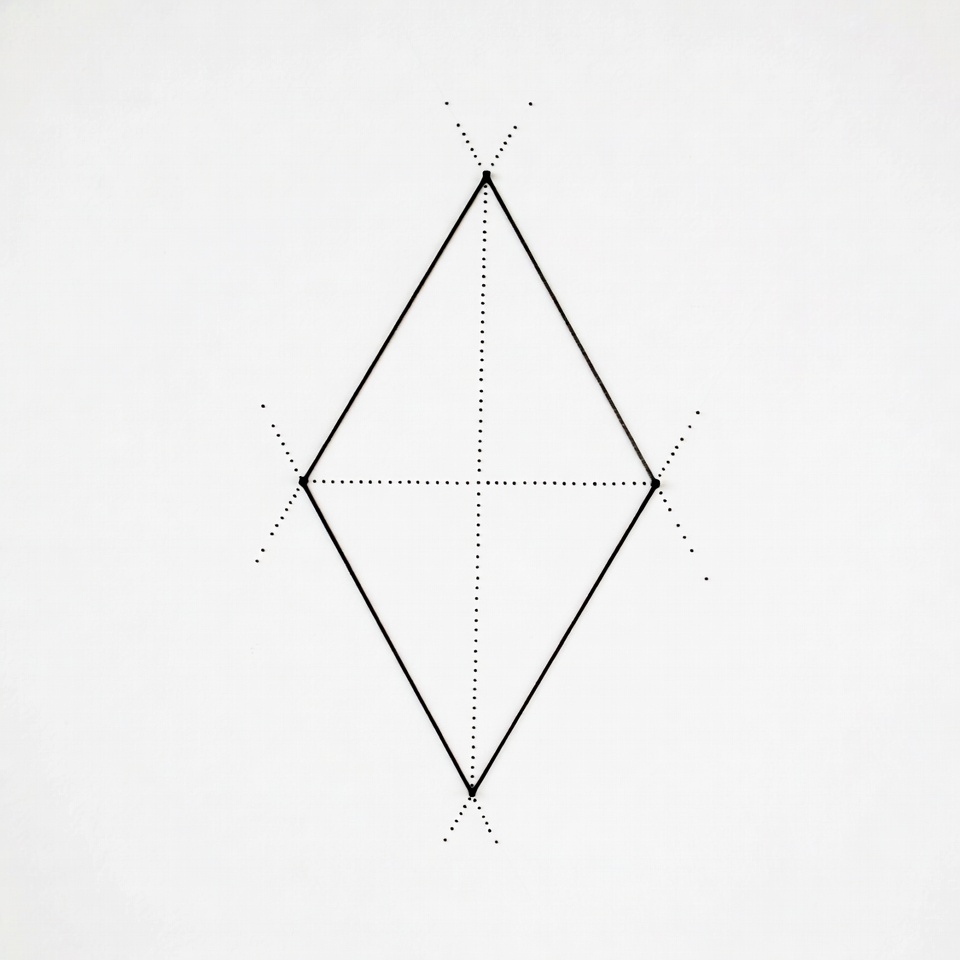
What Is A Rhombus? Sides, Diagonals And Area
The short version
- A rhombus is a quadrilateral with four equal sides, opposite sides parallel and opposite angles equal. A slanted square, basically.
- Its diagonals cross at right angles, cut each other exactly in half, and each one splits the corner angles it passes through into two equal parts.
- Area works two ways: base × height, or (diagonal 1 × diagonal 2) ÷ 2. Perimeter is always 4 × side.
- Every square is a rhombus. Most rhombuses are not squares, because a rhombus doesn’t need right angles.
- Half of each diagonal forms the legs of a right triangle whose hypotenuse is a side, so you can find the side from the diagonals and the other way around.
A rhombus is a four sided flat shape where all four sides are the same length. Opposite sides run parallel, opposite angles are equal, and the two diagonals meet at 90 degrees and bisect each other. That makes a rhombus a special kind of parallelogram, and it makes a square a special kind of rhombus.
The plural is rhombuses or rhombi; both are accepted. Some older textbooks call it a diamond, which is the shape on a playing card and the outline of a baseball infield.
What makes a shape a rhombus
One test settles it: four straight sides, all the same length, in a closed shape. Everything else follows from that.
- All four sides are equal.
- Opposite sides are parallel.
- Opposite angles are equal.
- Angles next to each other add to 180 degrees, so they’re supplementary.
- All four angles add to 360 degrees.
- The diagonals bisect each other.
- The diagonals are perpendicular.
- Each diagonal bisects the two angles it runs into.
Those supplementary pairs are how most angle questions get solved. If one angle in a rhombus is 110 degrees, the angle across from it is also 110, and the other two are 180 – 110 = 70 degrees each. Check the total: 110 + 110 + 70 + 70 = 360. Supplementary Angles, Explained covers why that pairing keeps showing up in geometry.
Rhombus vs square vs parallelogram vs kite
These four shapes overlap, and the overlap is what makes true or false questions on tests tricky.
| Shape | Sides | Angles | Diagonals |
|---|---|---|---|
| Rhombus | All four equal | Opposite equal, not always 90 | Perpendicular, bisect each other |
| Square | All four equal | All exactly 90 | Perpendicular, equal, bisect each other |
| Parallelogram | Opposite pairs equal | Opposite equal | Bisect each other, usually not perpendicular |
| Kite | Two adjacent pairs equal | One pair of opposite angles equal | Perpendicular, only one gets bisected |
Read it as a family tree. Every square is a rhombus and also a rectangle. Every rhombus is a parallelogram and also a kite. Going the other way fails: a parallelogram with sides of 5 and 8 isn’t a rhombus, and a rhombus tilted to 60 degrees isn’t a square.
The one difference worth memorizing: a square is a rhombus that got its corners squared off. Add right angles to a rhombus and you have a square.
The diagonals of a rhombus
The diagonals are where most of the useful math lives. They cross at the center, each cutting the other in half, and they meet at 90 degrees. That splits the rhombus into four identical right triangles.
Each of those right triangles has legs equal to half of one diagonal and half of the other, with a side of the rhombus as the hypotenuse. So the Pythagorean theorem connects the diagonals to the side length:
(half of d1)² + (half of d2)² = side²
Worked example. A rhombus has diagonals of 12 cm and 16 cm. Find the side length.
Half of 12 = 6
Half of 16 = 8
6² + 8² = 36 + 64 = 100
side = √100 = 10 cm
Perimeter = 4 × 10 = 40 cm.
The diagonals also bisect the corner angles. In a rhombus with a 110 degree angle, the diagonal through that corner splits it into two 55 degree angles. That’s why the diagonals of a square land exactly on 45 degrees.
Perimeter and area of a rhombus
Perimeter
All four sides match, so P = 4s. A rhombus with 9 cm sides has a perimeter of 4 × 9 = 36 cm. A rhombus with a 52 inch perimeter has sides of 52 ÷ 4 = 13 inches.
Area using the diagonals
Area = (d1 × d2) ÷ 2
With diagonals of 12 cm and 16 cm:
12 × 16 = 192
192 ÷ 2 = 96 square cm.
This formula works because the rhombus fits inside a rectangle built on its diagonals, filling exactly half of it. The same rule covers kites, since they also have perpendicular diagonals.
Area using base and height
Area = base × height
Here height means the perpendicular distance between two parallel sides, not the length of a slanted side. A rhombus with a 12 m base and a 7 m height has an area of 12 × 7 = 84 square m.
The two formulas have to agree. Take the rhombus from above: side 10 cm, area 96 square cm.
96 = 10 × height
height = 96 ÷ 10 = 9.6 cm.
Notice the height (9.6 cm) is shorter than the side (10 cm). That gap is the tilt, and it’s why using a side as the height gives an answer that’s too big.
Common mistakes with a rhombus
Using a side as the height. The height is the straight up distance between parallel sides. Only in a square do the two match.
Forgetting to divide by 2. The diagonal formula is (d1 × d2) ÷ 2. Skipping the division gives the area of the surrounding rectangle, double the real answer.
Using half diagonals in the area formula. Plug in the full diagonals. If a problem gives you 6 and 8 as halves, double them to 12 and 16 first.
Saying the diagonals are equal. They cross at right angles and bisect each other, but they’re different lengths unless the shape is a square.
Thinking a rhombus must sit tilted. A rhombus drawn upright with right angles is still a rhombus. It’s just also a square.
Practice problems
- A rhombus has sides of 9 cm. What is its perimeter?
- One angle of a rhombus measures 65 degrees. Find the other three angles.
- Find the area of a rhombus whose diagonals measure 14 inches and 10 inches.
- A rhombus has a base of 12 m and a height of 7 m. Find its area.
- True or false: every square is a rhombus, and every rhombus is a square.
- A rhombus has diagonals of 18 cm and 24 cm. Find the side length and the perimeter.
- A rhombus has an area of 60 square feet and one diagonal of 10 feet. Find the other diagonal.
- A rhombus has diagonals of 16 cm and 30 cm. Find its area, its side length, and its height rounded to the nearest tenth.
Answers
1. 36 cm, since 4 × 9 = 36.
2. 65, 115 and 115 degrees. The opposite angle matches at 65, and each neighbor is 180 – 65 = 115. Total: 65 + 65 + 115 + 115 = 360.
3. 70 square inches. (14 × 10) ÷ 2 = 140 ÷ 2 = 70.
4. 84 square m, since 12 × 7 = 84.
5. The first is true, the second is false. A square meets every rhombus condition, but a rhombus only becomes a square when its angles are 90 degrees.
6. Side 15 cm, perimeter 60 cm. Half diagonals are 9 and 12, and 9² + 12² = 81 + 144 = 225, so the side is √225 = 15. Then 4 × 15 = 60.
7. 12 feet. From 60 = (10 × d) ÷ 2, multiply both sides by 2 to get 120 = 10 × d, so d = 12.
8. Area 240 square cm, side 17 cm, height about 14.1 cm. Area is (16 × 30) ÷ 2 = 240. Half diagonals are 8 and 15, and 8² + 15² = 64 + 225 = 289, so the side is √289 = 17. Then 240 ÷ 17 = 14.117…, which rounds to 14.1.
What it means if your child is stuck on this
A rhombus is not a hard shape. When problems about one go wrong, the trouble is almost always one layer down. The diagonal questions need the Pythagorean theorem and square roots. The area questions need multiplication and division. The angle questions need the idea that 180 minus an angle gives its partner.
The other gap is vocabulary that looks like arithmetic but isn’t. Words like bisect, perpendicular, parallel, adjacent and supplementary carry the whole question. A kid who reads “the diagonals bisect each other” and pictures nothing will guess, get it wrong, and decide geometry is not for them.
Worth checking before you assume the shape is the problem: can your child square a number, find a square root, and solve 180 – x = 65 without stalling? If any of those wobble, that’s the real assignment. Is My Child Behind In Math? 12 Signs By Grade Level lists the signals, and Math Skills By Grade Level: What Your Child Should Know shows where shape work is supposed to land.
Frequently asked questions
What is a rhombus in simple terms?
A rhombus is a flat shape with four straight sides that are all the same length, with opposite sides parallel. Picture a square that got pushed over to one side.
Is a rhombus a square?
Not usually. A rhombus becomes a square only when all four of its angles measure 90 degrees. Every square counts as a rhombus, but most rhombuses are tilted and are not squares.
Is a rhombus a parallelogram?
Yes, always. A parallelogram needs opposite sides parallel and equal, and a rhombus has that plus all four sides equal. So a rhombus is a parallelogram with extra rules, and the reverse is not true.
What is the area of a rhombus?
Use (d1 × d2) ÷ 2 when you know the diagonals, or base × height when you know the height. Both give the same number for the same shape.
Do the diagonals of a rhombus bisect the angles?
Yes. Each diagonal splits the two corner angles it touches into two equal halves. A 110 degree corner becomes two 55 degree angles.
What is a rhombus used for in real life?
Diamond road signs, argyle patterns on socks and sweaters, kite frames, floor and backsplash tiles, the card suit, and the layout of a baseball infield.
Find the actual gap
Geometry is usually where older gaps finally surface, because a single rhombus problem quietly asks for multiplication, division, squares, square roots and equation solving all at once. Math Anon begins with a short adaptive assessment that adjusts as your child works, then hands you a written report naming the skills that are missing instead of a letter grade. Start the assessment and you’ll have the list in hand.
From there the plan is about 20 minutes of targeted daily practice on those specific skills, plus a progress report each week so you can see movement. The assessment is $49 and we credit every dollar back on your first month. Our pricing page covers the rest, and Mind The Gap: A Parent’s Guide To Math Assessment For Kids explains how the process works.





