
Types Of Triangles: By Sides And By Angles
The short version
- There are six types of triangles: three named by side length (equilateral, isosceles, scalene) and three named by angle (acute, right, obtuse).
- Every triangle gets one label from each group, so a full name looks like “right scalene” or “obtuse isosceles.”
- All three angles always add to 180 degrees, which means no triangle can have two right angles or two obtuse angles.
- An equilateral triangle is always acute, with three 60 degree angles. It’s the only combination that’s locked in.
- Three side lengths only make a triangle if the two shorter ones add up to more than the longest one.
The types of triangles split along two questions asked at the same time: how many sides match, and how big is the largest angle. Answer both and you’ve named the triangle.
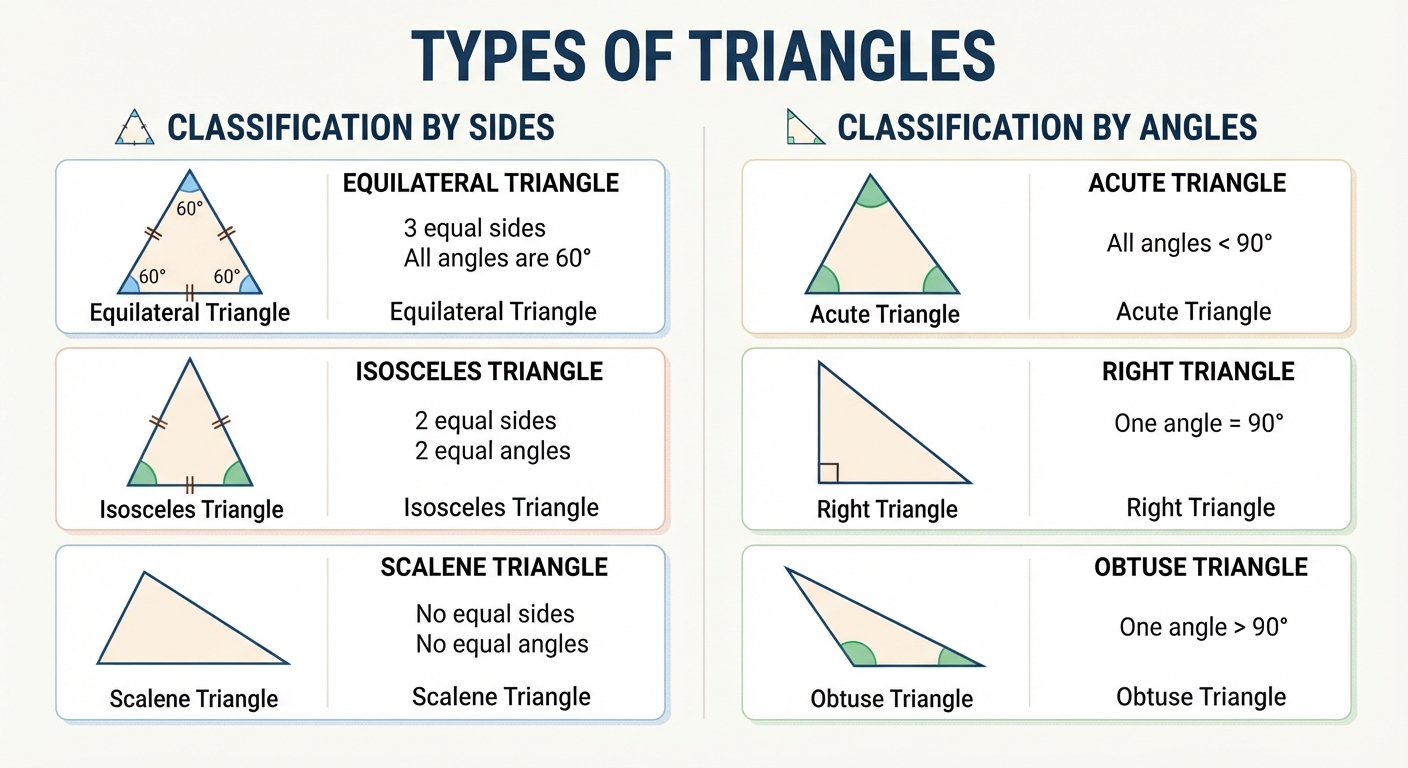
Sides give you equilateral (all three equal), isosceles (exactly two equal) or scalene (none equal). Angles give you acute (every angle under 90), right (one angle exactly 90) or obtuse (one angle over 90). A triangle always has one label from each list.
Types of triangles by side length
Equilateral: all three sides the same length. Because the sides match, the angles do too, and since they add to 180, each one is 180 ÷ 3 = 60 degrees. Always.
Isosceles: two sides the same length. The two angles opposite those matching sides are equal as well. Fold one down the middle and the halves line up.
Scalene: all three sides different lengths, so all three angles are different too. Most triangles you draw by accident are scalene.
Tick marks on a diagram do this job for you. One tick on two sides means those two match. No ticks anywhere means scalene.
Types of triangles by angle
Acute: all three angles are less than 90 degrees. A triangle with angles of 50, 60 and 70 is acute. Note that you have to check all three, not just one.
Right: one angle is exactly 90 degrees, usually marked with a small square in the corner. The side across from the right angle is the hypotenuse, and it’s always the longest side.
Obtuse: one angle is bigger than 90 degrees. Only one can be, since two angles over 90 would blow past 180 on their own.
The full chart of triangle types
Here’s every combination in one place, including the ones that can’t exist.
| Sides | Acute | Right | Obtuse |
|---|---|---|---|
| Equilateral | Yes: 60, 60, 60 | Impossible | Impossible |
| Isosceles | Yes: 70, 70, 40 | Yes: 90, 45, 45 | Yes: 100, 40, 40 |
| Scalene | Yes: 50, 60, 70 | Yes: 90, 60, 30 | Yes: 120, 40, 20 |
The two impossible boxes are worth a minute at the kitchen table. An equilateral triangle has three 60 degree angles by definition. It can’t have a 90 or a 110 tucked in there, because the three angles are already decided the moment the sides match.
How to classify any triangle in three steps
Work through it in order and you’ll never be stuck.
1. Compare the three sides. All equal, two equal, or none equal?
2. Find the largest angle. Under 90, exactly 90, or over 90?
3. Say the angle word first, then the side word: “obtuse isosceles.”
If the problem gives you sides but no angles, you can still test for a right angle. Square the two shorter sides, add them, and compare to the square of the longest side. Equal means right. Bigger means acute. Smaller means obtuse.
Worked example: sides of 6, 8 and 10
Step 1: 6, 8 and 10 are all different, so it’s scalene.
Step 2: square the two shorter sides. 6² = 36 and 8² = 64, and 36 + 64 = 100. The longest side squared is 10² = 100.
They match, so the largest angle is exactly 90 degrees.
Step 3: it’s a right scalene triangle.
Worked example: angles of 110, 35 and 35
Step 1: two angles are equal, which means the sides opposite them are equal, so the triangle is isosceles.
Step 2: the largest angle is 110, which is over 90, so it’s obtuse.
Step 3: obtuse isosceles.
Check the angles first: 110 + 35 + 35 = 180. Correct.
Two rules every triangle obeys
The angles add to 180
Tear the three corners off a paper triangle and line them up along a ruler. They form a straight line every time, and a straight line is 180 degrees. That’s why you can always find a missing angle by subtracting.
Angles of 45 and 85 degrees, find the third: 45 + 85 = 130, and 180 – 130 = 50 degrees.
The two short sides have to beat the long one
This is the triangle inequality, and most lessons skip it. Three lengths only close up into a triangle if the sum of the two shorter ones is greater than the longest one.
Sides of 2, 3 and 6: 2 + 3 = 5, which is less than 6. The two short sides can’t reach, so no triangle exists.
Sides of 4, 5 and 8: 4 + 5 = 9, which is more than 8. This one works.
Hand your child two short pencils and one long one and let them try. Seeing the ends fail to meet lands better than the rule does.
Common mistakes with types of triangles
Giving a triangle only one label. “Right” isn’t a complete answer. Every triangle has a side name and an angle name.
Checking one angle for acute. Acute means all three are under 90. A triangle with 30, 40 and 110 has two small angles and is still obtuse.
Assuming a tilted right triangle isn’t one. Rotating a shape changes nothing. The right angle is still 90 degrees wherever it points.
Calling an equilateral triangle “not isosceles.” Some books treat equilateral as a special case of isosceles, since it certainly has two equal sides. Check the definition your child’s class uses.
Picking the hypotenuse wrong. The hypotenuse sits across from the right angle, not just wherever the longest looking line is drawn.
Practice problems
1. Classify a triangle with sides of 7 cm, 7 cm and 7 cm.
2. Classify a triangle with angles of 50, 60 and 70 degrees.
3. Two angles of a triangle are 45 and 85 degrees. Find the third.
4. Classify a triangle with sides of 6, 8 and 10.
5. Classify a triangle with angles of 110, 35 and 35 degrees.
6. Can a triangle have sides of 2 in, 3 in and 6 in? Explain.
7. Can a triangle have two right angles? Explain.
8. A triangle has sides of 5, 5 and 9. Is it acute, right or obtuse?
Answers
1. Equilateral by sides, and acute by angles, since all three angles are 60 degrees.
2. All three angles are different, so the sides are too: scalene. The largest is 70, under 90, so acute. Acute scalene. Check: 50 + 60 + 70 = 180.
3. 45 + 85 = 130, and 180 – 130 = 50 degrees.
4. Right scalene. 6² + 8² = 36 + 64 = 100, which equals 10².
5. Obtuse isosceles. Two equal angles make it isosceles, and 110 is over 90.
6. No. 2 + 3 = 5, and 5 is less than 6, so the two shorter sides can’t reach across the longest one.
7. No. Two right angles already use 90 + 90 = 180 degrees, leaving 0 for the third angle, and an angle of 0 doesn’t exist in a triangle.
8. Obtuse. 5² + 5² = 25 + 25 = 50, and 9² = 81. Since 50 is less than 81, the largest angle is bigger than 90 degrees. It’s an obtuse isosceles triangle.
What it means if your kid is stuck here
Classifying triangles is mostly vocabulary, so when a child struggles it’s rarely about triangles.
If they can’t keep the six words apart, the issue is that the words arrived faster than the pictures. Fix it by drawing rather than reviewing: ask for an obtuse isosceles triangle on scrap paper, then a right scalene one. Drawing forces both labels at once, and it takes about ten minutes.
If the words are fine but the number work sinks them, watch which step fails. Squaring 6 and 8 needs multiplication facts. 180 – 130 needs subtraction with regrouping. Those are third and fourth grade skills quietly wrecking a seventh grade geometry grade, which is the exact pattern in Is My Child Behind In Math? 12 Signs By Grade Level. Math Skills By Grade Level: What Your Child Should Know sets out what should already be automatic, and if angle problems are the specific sore spot, Supplementary Angles, Explained covers the rules that pair with this one.
Frequently asked questions
What are the six types of triangles?
Equilateral, isosceles and scalene by side length, plus acute, right and obtuse by angle. Every triangle gets one name from each set.
Can a triangle be both right and isosceles?
Yes. A right isosceles triangle has angles of 90, 45 and 45. The two legs are equal and the hypotenuse is longer.
What is a scalene triangle?
One with three sides of different lengths, which also means three different angles. It can be acute, right or obtuse.
Why can’t a triangle have two obtuse angles?
Two angles over 90 would add to more than 180 by themselves, and the three angles have to total exactly 180. There’d be nothing left for the third corner.
What grade do kids learn to classify triangles?
Naming by sides and angles usually lands in fourth and fifth grade. Using the angle sum to solve for a missing angle shows up in sixth through eighth, and it comes back in high school geometry.
Find the actual gap
Geometry units are where older gaps surface, because every problem quietly asks for arithmetic your child was supposed to master years earlier. Math Anon starts with a short adaptive assessment that changes difficulty as your child works, then hands you a written report naming the skills that actually came up short.
After that, it’s about 20 minutes of daily practice targeted at those exact skills, with a weekly progress report so you can see what’s closing. Start the assessment for $49, which comes back to you in full on the first month. Everything else is on the pricing page.





