
What Is A Straight Angle? Definition And Examples
The short version
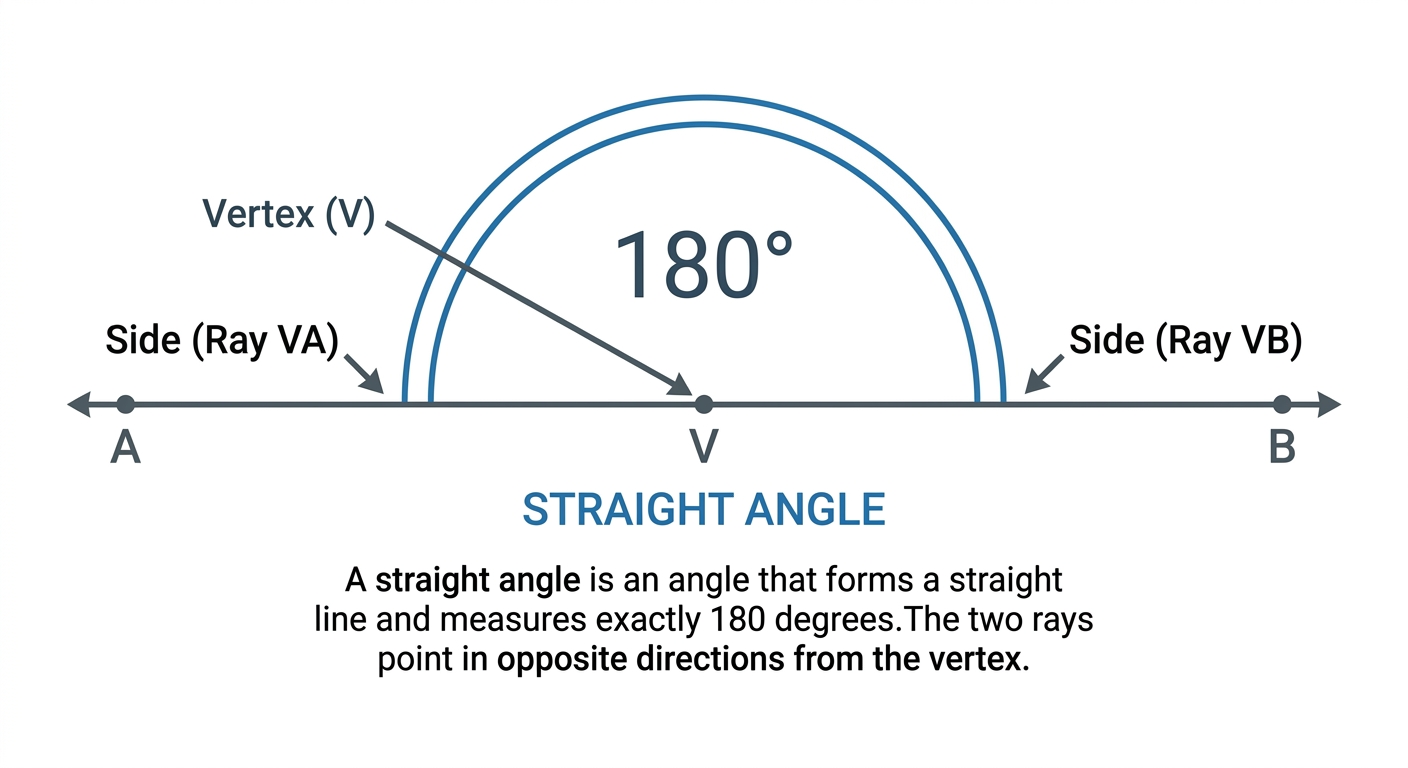
- A straight angle measures exactly 180°. It looks like a straight line with a point (the vertex) marked on it, and its two sides point in opposite directions.
- A straight angle is half of a full turn and equals two right angles put together.
- Any angles that sit side by side on a straight line add up to 180°. That’s the rule behind most straight angle homework: 180° – 64° = 116°.
- Angles between 90° and 180° are obtuse. Angles between 180° and 360° are reflex. Only exactly 180° is straight.
A straight angle is an angle that measures exactly 180°. Its two rays start at the same vertex and point in exactly opposite directions, so together they form a straight line. It’s half a full rotation, the same as two right angles side by side.
The definition takes one sentence. The useful part is what it lets kids do: find missing angles on a line, check their protractor readings, and, later, prove that a triangle’s angles add to 180°. We’ll cover all of it with worked examples, then give practice problems with answers.
Straight angle definition, and how it fits with other angles
Angles are sorted by size. A straight angle sits right in the middle of the list, which makes it a handy reference point for everything else.
| Angle type | Measure | What it looks like |
|---|---|---|
| Acute | More than 0° and less than 90° | A narrow opening, like a slice of pizza |
| Right | Exactly 90° | A square corner |
| Obtuse | More than 90° and less than 180° | Wider than a corner, but still bent |
| Straight | Exactly 180° | A flat line through the vertex |
| Reflex | More than 180° and less than 360° | The long way around a bent angle |
| Full (complete) | Exactly 360° | One whole turn back to the start |
Kids sometimes ask, “Isn’t a straight angle just a line?” It looks like one. The difference is the vertex. A line is just a line. A straight angle is two rays with a shared starting point, so you can name it with three letters, like angle ABC, where B is the vertex sitting on the line between A and C.
In higher math you’ll also see a straight angle written as π radians. That’s the same 180°, measured a different way.
Where straight angles show up
A few everyday pictures help this stick:
- A clock at 6:00. The hands point in opposite directions. Each hour mark is 30° apart, and 6 × 30° = 180°.
- A book opened completely flat on a table.
- A door hinge folded all the way back until the door lies flat against the wall on the other side.
- Turning around to face the opposite way. That’s why skateboarders call it a “180.”
Worked examples: angles on a straight line
This is the rule that shows up on almost every straight angle worksheet: if angles sit next to each other on a straight line and share a vertex, they add up to 180°. Two angles that add up to 180° are called supplementary, and we cover that idea in depth in Supplementary Angles, Explained.
Example 1: one missing angle
A ray splits a straight angle into two parts. One part is 57°. Find the other.
57° + x = 180°
x = 180° – 57°
x = 123°
Sanity check: 57° is acute, so its partner has to be obtuse. 123° is obtuse. Good.
Example 2: three angles on a line
Two rays split a straight angle into three parts: 40°, 75°, and x. The three parts still fill the 180°.
40° + 75° + x = 180°
115° + x = 180°
x = 65°
Example 3: an algebra version
Two angles on a straight line measure x° and (2x + 15)°. Find both.
x + (2x + 15) = 180
3x + 15 = 180
3x = 165
x = 55
The angles are 55° and 2(55) + 15 = 125°. Check: 55 + 125 = 180.
Example 4: using a straight angle to prove the triangle rule
Here’s why a triangle’s three angles always add to 180°, and it runs on a straight angle. Draw any triangle ABC. Through the top corner B, draw a line parallel to the bottom side AC.
At point B, that new line forms a straight angle, 180°, split into three pieces. The middle piece is the triangle’s own angle at B. The left piece equals the triangle’s angle at A, and the right piece equals the angle at C, because they’re alternate interior angles formed by parallel lines. So the triangle’s three angles fill the straight angle exactly: angle A + angle B + angle C = 180°.
That’s high school geometry, but it’s worth knowing that the triangle fact kids memorize in middle school comes straight from this idea.
How to draw and measure a straight angle
With a protractor:
- Draw a straight line with a ruler and mark a point on it. That point is the vertex.
- Line up the protractor’s center hole on the vertex and its baseline along the line.
- Read the scale that starts at 0 on one side. The other side of the line lands on 180.
That last step is where kids go wrong on every angle, not only straight ones. Protractors have two scales. Always start from the scale that reads 0 on the ray you lined up.
Common mistakes with straight angles
- Saying a straight angle isn’t an angle. It is. It has a vertex and two rays, and it measures 180°.
- Calling 180° obtuse. Obtuse stops just below 180°. Exactly 180° is its own category.
- Using 360° for angles on a line. Angles around a full point add to 360°. Angles on one side of a straight line add to 180°. Kids mix these up when a diagram has both.
- Assuming a line is straight. In geometry, only trust a straight angle when the problem shows a line (or says so). A drawing that looks flat might not be.
- Forgetting a third piece. If two rays split the line, there are three angles to add, not two.
- Subtraction slips. 180 – 64 is 116. Many wrong answers here come from borrowing mistakes in the subtraction.
Practice problems
- How many degrees are in a straight angle?
- How many right angles make one straight angle?
- Classify each angle: 179°, 180°, 181°.
- Two angles on a straight line: one is 64°. Find the other.
- Three angles on a straight line: 35°, 90°, and x. Find x.
- How many degrees does a clock’s minute hand turn in 30 minutes?
- Two angles on a straight line measure x° and 3x°. Find both angles.
- Two angles on a straight line measure (5x – 10)° and (2x + 15)°. Find x and both angles.
Answers
- 180°
- 2, because 90° + 90° = 180°.
- 179° is obtuse, 180° is straight, 181° is reflex.
- 180 – 64 = 116°
- 180 – 35 – 90 = 55°
- 180°. The minute hand turns 360° in 60 minutes, so half of that in 30 minutes.
- x + 3x = 180, so 4x = 180 and x = 45. The angles are 45° and 135°.
- 7x + 5 = 180, so 7x = 175 and x = 25. The angles are 5(25) – 10 = 115° and 2(25) + 15 = 65°. Check: 115 + 65 = 180.
If your child is stuck on straight angles
Most kids learn angle types and angle measurement in 4th grade, including the idea that angle measures add. If straight angle problems keep going wrong, look at which step breaks:
- If they can’t say whether an angle is more or less than 90°, the gap is angle sense, and a protractor drill won’t fix it on its own.
- If they set up 180 – 64 correctly and get the wrong number, it’s multi-digit subtraction from 2nd and 3rd grade.
- If the algebra versions fall apart, it’s two-step equations, which lean on earlier fraction and number work.
You can see where each of these sits in Math Skills By Grade Level: What Your Child Should Know. If you’re seeing mistakes like these across several topics, Is My Child Behind In Math? 12 Signs By Grade Level will help you judge whether it’s a pattern. Short, regular practice tends to fix these faster than long catch-up sessions, for reasons we cover in Why 20 Minutes A Day Beats A 90-Minute Tutoring Session.
Frequently asked questions
What is a straight angle in simple words?
It’s an angle opened all the way flat, so it looks like a straight line. It measures 180°.
Is a straight angle 180 or 360 degrees?
180°. A full turn is 360°, and a straight angle is half of that.
Is a straight angle obtuse?
No. Obtuse angles are more than 90° and less than 180°. A straight angle is exactly 180°, so it gets its own name.
What is the difference between a straight angle and a straight line?
A straight angle has a vertex, a specific point on the line where the two rays start. A plain line has no vertex. Mark a point on a line and you’ve made a straight angle.
How many straight angles are in a full circle?
Two. 180° + 180° = 360°.
Find the actual gap
Missing straight angle problems can mean shaky angle sense, weak subtraction, or trouble with equations, and each needs a different fix. Math Anon starts with a short adaptive assessment that identifies which skills are actually missing and writes up what it finds in a report you can read.
Your child then gets about 20 minutes a day of practice aimed at those skills, and you get progress reports weekly. The assessment is $49, and we credit the whole amount back on your first month. Start the assessment or see pricing.





