
What Is A Protractor And How Do You Use One?
The short version
- A protractor is a tool for measuring and drawing angles in degrees. The common school kind is a clear half circle marked from 0° to 180°.
- To measure an angle, put the center point on the vertex, line the baseline up with one ray, and read where the other ray crosses the scale.
- Use the scale that starts at 0 on the ray you lined up. That one choice fixes most wrong answers.
- Estimate first. If the angle looks smaller than a square corner, the answer has to be under 90°.
- For an angle bigger than 180°, measure the smaller angle and subtract it from 360°.
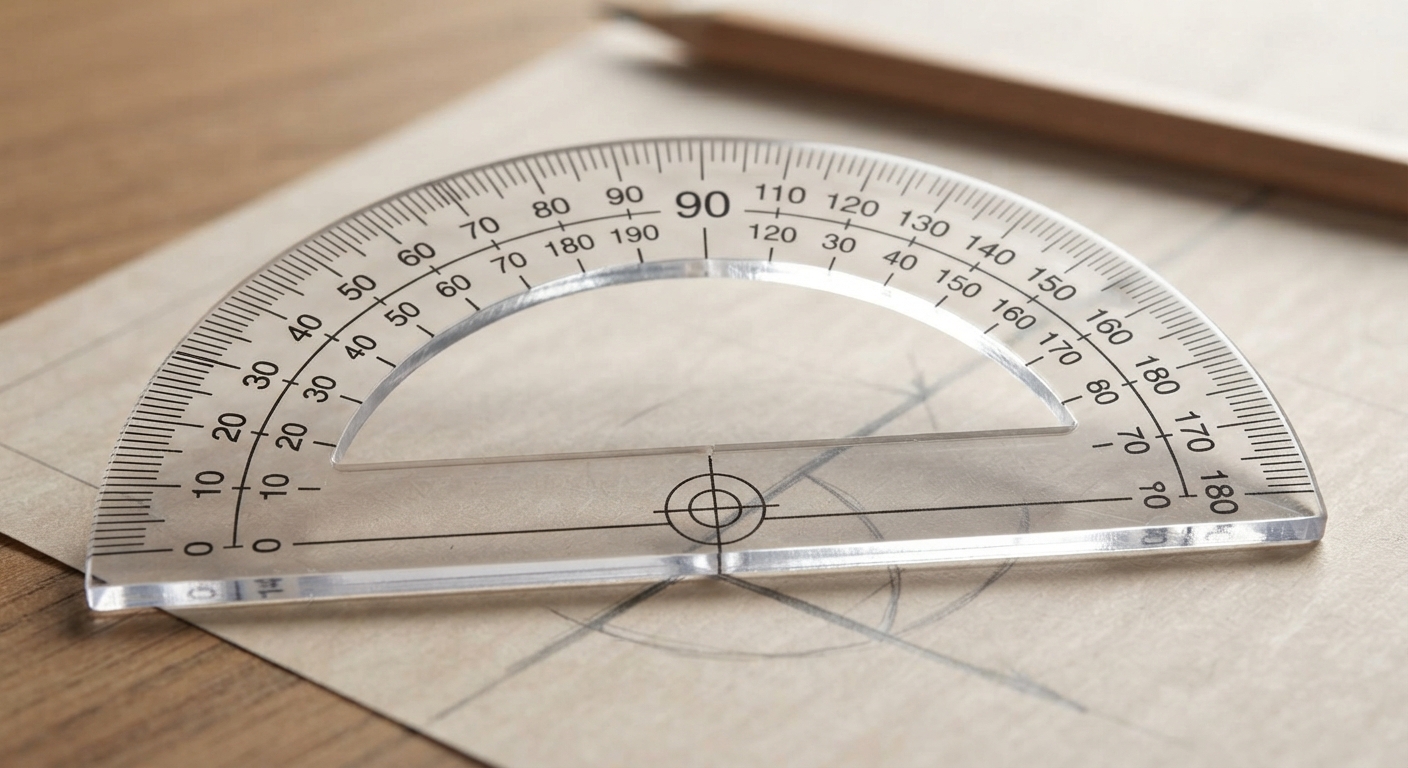
A protractor is a measuring tool for angles, the way a ruler is a measuring tool for length. Most students use a flat, clear half circle marked in degrees from 0 to 180, with two sets of numbers running in opposite directions. You line it up on the corner of an angle and read how wide the angle opens.
In the US, kids start using protractors in 4th grade, when the standards ask them to measure and sketch angles in whole degrees. The tool looks simple, but reading it correctly takes a few specific habits. Here’s how it works, step by step, with the mistakes that trip kids up.
Parts of a protractor
| Part | What it is | What it’s for |
|---|---|---|
| Baseline | The straight line across the flat side, running through 0° and 180° | Lines up with one ray of the angle |
| Center point | A small hole, cross, or dot in the middle of the baseline | Goes exactly on the vertex |
| Outer scale | Numbers around the outside edge | One of the two scales, counting up from one side |
| Inner scale | Numbers on the inside arc | The other scale, counting up from the opposite side |
| Tick marks | Small lines, usually every 1°, longer every 5° and 10° | Let you read to the exact degree |
Look closely at a school protractor and you’ll notice the baseline often sits a little above the bottom plastic edge. Kids who line up the edge instead of the baseline end up a few degrees off.
Which scale is “outer” and which is “inner” varies by brand. What matters is that one scale counts up from the left and the other counts up from the right.
How to use a protractor to measure an angle
- Estimate. Decide if the angle is acute (less than 90°), right (exactly 90°), or obtuse (between 90° and 180°).
- Place the center point on the vertex, where the two rays meet.
- Turn the protractor so the baseline lies exactly along one ray.
- Find the 0 on that ray. Follow that same scale around.
- Read the number where the second ray crosses the scale. If the ray is too short to reach the numbers, extend it with a ruler first.
- Check against your estimate. If you estimated acute and read 130°, switch scales.
Worked example: picking the right scale
Say one ray points to the right along the baseline and the other ray crosses the arc at a spot labeled both 50 and 130.
The ray on the baseline points right, so find the 0 on the right end. Follow that scale up. It reaches the second ray at 50.
The angle looks narrower than a square corner, so it’s acute.
Answer: 50°, not 130°.
If the angle instead opened wide, and the first ray pointed left, you’d follow the scale starting at 0 on the left, and the same crossing point would read 130°.
Worked example: when neither ray is on 0
Sometimes a problem shows a protractor where one ray crosses at 25 and the other at 95, both on the same scale. Subtract: 95 – 25 = 70°. The protractor still works; you’ve just measured from a different starting mark.
How to draw an angle with a protractor
Example: Draw a 65° angle.
- Draw a straight ray with a ruler. Its endpoint is your vertex.
- Put the center point on the endpoint and line the baseline up with the ray.
- Find 0 on the ray, follow that scale to 65, and make a small dot at 65.
- Remove the protractor and use the ruler to connect the vertex to the dot.
- Label it 65°. Quick check: it should look a little narrower than a square corner.
Measuring angles bigger than 180°
A half circle protractor stops at 180°, but angles can be bigger. An angle between 180° and 360° is called a reflex angle. Two ways to handle it:
- Subtract from 360. Measure the smaller angle on the other side, then subtract. If the small side measures 110°, the reflex angle is 360 – 110 = 250°.
- Add 180. Extend one ray straight through the vertex to make a straight line (180°), measure the extra piece past it, and add. If the extra piece is 70°, the angle is 180 + 70 = 250°.
Both methods give 250°, which is a good sign you’ve done it right.
Types of protractors
| Type | Range | Who uses it |
|---|---|---|
| Half circle (semicircle) | 0° to 180° | Most elementary and middle school classes |
| Full circle | 0° to 360° | Reflex angles, map work, some high school work |
| Bevel protractor | Usually 0° to 180°, with a swinging arm | Woodworking, metalworking, drafting |
| Digital protractor or angle finder | Varies | Construction and trades; shows the angle on a screen |
For homework, a basic clear half circle protractor is all a child needs. Clear plastic matters, because you have to see the rays through it.
Common mistakes with a protractor
- Reading the wrong scale. This is by far the most common one. It gives the supplement of the right answer, like 130° instead of 50°. Estimating first catches it.
- Lining up the bottom edge instead of the baseline. This shifts the vertex and throws the reading off by several degrees.
- Vertex off the center point. Even a small slide gives a wrong answer, especially with short rays.
- Not extending short rays. If the ray stops before the numbers, kids eyeball it. Extend it with a ruler.
- Miscounting tick marks. Between 40 and 50, each small tick is 1°. A ray three ticks past 40, on the scale you’re reading, is 43°. Kids who count the 40 mark itself as a tick get 42°.
Practice problems
- Classify each angle as acute, right, obtuse, straight, or reflex: 35°, 90°, 145°, 180°, 200°.
- The first ray of an angle lines up with 0 on the left side of the protractor. The second ray crosses at a mark labeled 120 on the left starting scale and 60 on the other. What’s the angle?
- Same crossing point, but this time the first ray lines up with 0 on the right side. What’s the angle?
- One ray crosses a protractor’s scale at 30 and the other at 110, both read on the same scale. What’s the angle?
- Two angles sit side by side on a straight line. One measures 48°. What does the other measure?
- A half circle protractor shows the smaller side of an angle is 75°. What’s the reflex angle on the other side?
- Three angles meet around a point. Two of them are 100° and 145°. What’s the third?
- What’s the angle between the hands of a clock at exactly 2:00?
Answers
- 35° acute, 90° right, 145° obtuse, 180° straight, 200° reflex.
- 120°, since you follow the scale that starts at 0 on your first ray.
- 60°.
- 110 – 30 = 80°.
- 180 – 48 = 132°.
- 360 – 75 = 285°.
- 360 – 100 – 145 = 115°.
- Each hour mark is 360 ÷ 12 = 30° apart, and the hands are 2 marks apart, so 2 × 30 = 60°.
If your child is stuck using a protractor
When a kid keeps getting protractor questions wrong, the tool is rarely the whole story. Often they don’t yet have a feel for how big angles are, so they can’t tell that 130° is obviously wrong for a narrow angle. That sense comes from comparing angles to a right angle and knowing that a straight line is 180°. Our post on supplementary angles builds exactly that idea, and it’s why misread scales always give an answer that adds up to 180 with the right one.
Other kids struggle with reading scales in general, like counting by 1s between labeled marks on a ruler or number line. That’s a 2nd and 3rd grade skill. See math skills by grade level for where angle measurement fits, and these signs a child is behind in math if you suspect the gap is bigger than one tool.
Frequently asked questions
What is a protractor used for?
Measuring angles and drawing angles of a given size. Students use them in geometry, and carpenters, engineers, and designers use sturdier versions at work.
Why does a protractor have two sets of numbers?
So you can measure an angle no matter which way it opens. One scale starts at 0 on the right, and the other starts at 0 on the left. You always use the one that starts at 0 on the ray you lined up.
How many degrees is a protractor?
A standard half circle protractor measures 0° to 180°. A full circle protractor measures 0° to 360°.
How do you measure an angle greater than 180 degrees with a protractor?
Measure the smaller angle on the other side and subtract it from 360°. You can also extend one ray to make 180°, measure what’s left, and add it on.
What grade do kids learn to use a protractor?
Usually 4th grade in the US, where students measure angles in whole degrees and sketch angles of a given size. They keep using protractors through middle school geometry.
Find the actual gap
If angle work keeps going wrong, it helps to know whether the issue is the protractor, angle sense, or something older like reading scales. Math Anon starts with a short adaptive assessment that finds exactly which skills are missing and gives you a written report.
Then your child practices only those skills, about 20 minutes a day, and you see a progress report each week. The assessment is $49 and gets credited back in full on the first month. Start the assessment or view pricing.





