
How To Solve Two Step Equations (Do Undo Method)
The short version
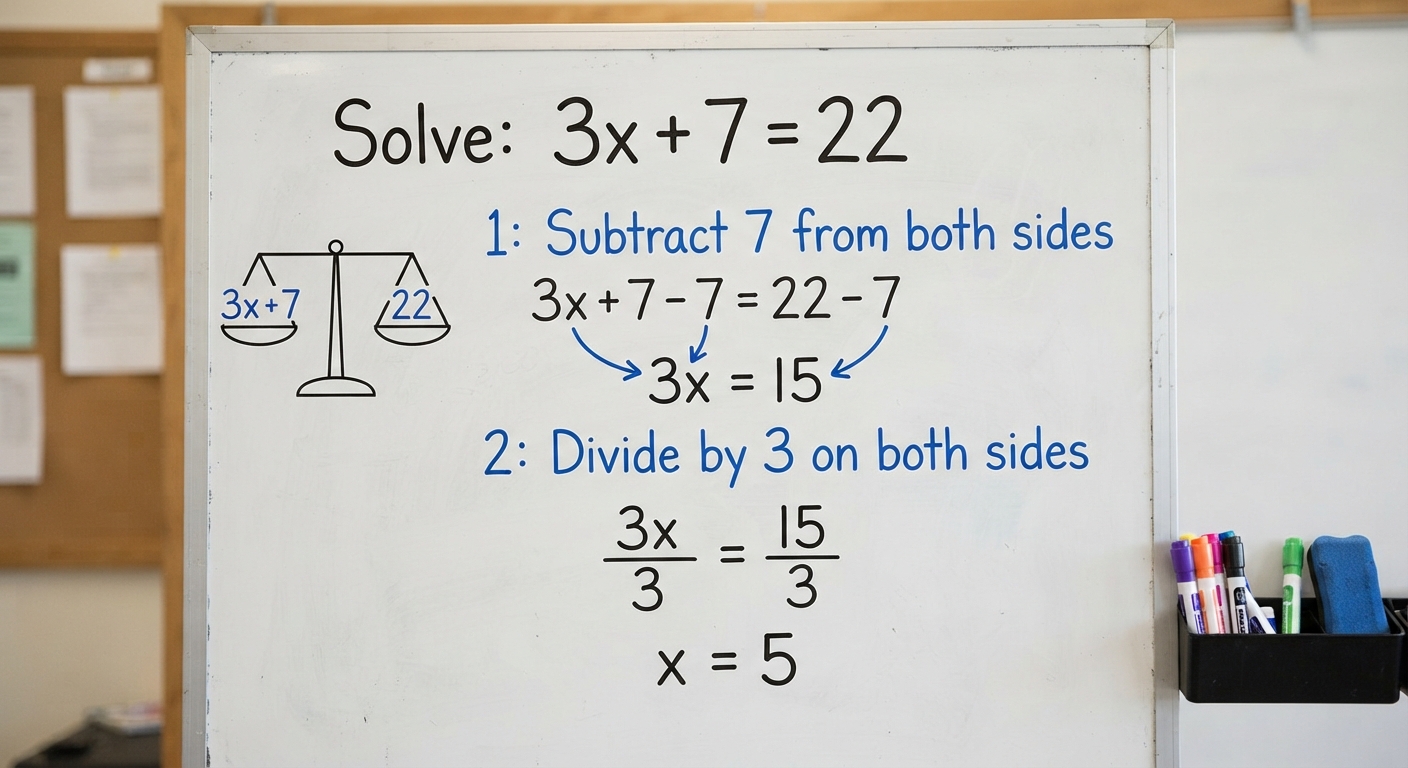
- Two step equations take two inverse operations to solve, like 3x + 7 = 22. Undo the adding or subtracting first, then undo the multiplying or dividing. Here, subtract 7 to get 3x = 15, then divide by 3 to get x = 5.
- The do undo method: list what was done to x, in order, then undo each step in reverse order with the opposite operation.
- Whatever you do to one side of the equation, do the exact same thing to the other side.
- Check every answer by plugging it back in. 3(5) + 7 = 22, so x = 5 is right.
- Most wrong answers come from negative signs, not from the method. Keep the sign with the number it belongs to.
Two step equations are equations that need two operations to get the variable by itself. To solve one, undo addition or subtraction first, then undo multiplication or division. In 3x + 7 = 22, subtract 7 from both sides (3x = 15), then divide both sides by 3 (x = 5). Plug 5 back in to check: 3 × 5 + 7 = 22.
That’s the whole recipe. The rest of this post shows why the order works, how to handle negatives and fractions, and how to turn a word problem into an equation.
The do undo method
Think of x as a number that got put through a machine. For 3x + 7 = 22, the machine did two things to x:
| Step | Do (what happened to x) | Undo (reverse order, opposite operation) |
|---|---|---|
| 1 | Multiply by 3 | Subtract 7 |
| 2 | Add 7 | Divide by 3 |
Undoing works like taking off shoes and socks. You put socks on first and shoes second, so you take shoes off first. The last thing done to x is the first thing you undo.
The opposite pairs are simple: addition undoes subtraction, and multiplication undoes division, in both directions.
How to solve two step equations, step by step
- Figure out what’s being done to the variable and in what order.
- Undo the last operation first, on both sides. Usually that’s the adding or subtracting.
- Undo the remaining operation, on both sides. Usually that’s the multiplying or dividing.
- Check by substituting your answer into the original equation.
Worked example 1: 3x + 7 = 22
3x + 7 = 22
3x + 7 – 7 = 22 – 7
3x = 15
3x ÷ 3 = 15 ÷ 3
x = 5
Check: 3(5) + 7 = 15 + 7 = 22 ✓
Worked example 2: n/5 + 3 = 9
n/5 + 3 = 9
Subtract 3 from both sides: n/5 = 6
Multiply both sides by 5: n = 30
Check: 30/5 + 3 = 6 + 3 = 9 ✓
Two step equations with negative numbers
The method doesn’t change. The arithmetic gets trickier, and this is where most points get lost.
Worked example 3: -2x + 5 = 17
Subtract 5 from both sides: -2x = 12
Divide both sides by -2: x = -6
Check: -2(-6) + 5 = 12 + 5 = 17 ✓
The key move is dividing by -2, not 2. The negative belongs to the 2, so it comes along.
Worked example 4: 10 – 3x = 1
This one looks backward because the number comes first. Rewrite it in your head as 10 + (-3x) = 1.
Subtract 10 from both sides: -3x = -9
Divide both sides by -3: x = 3
Check: 10 – 3(3) = 10 – 9 = 1 ✓
A kid who ignores the minus sign gets 3x = -9 and x = -3. Plug that in and you get 10 + 9 = 19, not 1, which is exactly why checking matters.
Fractions, and when the order flips
Worked example 5: (2/3)x – 4 = 6
Add 4 to both sides: (2/3)x = 10
Multiply both sides by the reciprocal, 3/2: x = 10 × 3/2 = 30/2 = 15
Check: (2/3)(15) – 4 = 10 – 4 = 6 ✓
Multiplying by the flipped fraction undoes the fraction in one move. You could also multiply by 3 and then divide by 2. Same answer.
Worked example 6: (x + 4)/3 = 5
Here the do undo list matters. The parentheses mean x had 4 added first, then the result was divided by 3. So you undo the division first.
Multiply both sides by 3: x + 4 = 15
Subtract 4 from both sides: x = 11
Check: (11 + 4)/3 = 15/3 = 5 ✓
This is the case where “always subtract first” fails, and it’s why we teach the do undo list instead of a fixed rule.
Turning word problems into equations
Most word problems that lead to two step equations have a one time amount and an amount that repeats.
Worked example 7
A gym charges a $25 sign up fee plus $15 a month. Maria has paid $130 in total. How many months has she been a member?
Repeating amount: 15 per month, so 15m
One time amount: 25
Equation: 15m + 25 = 130
Subtract 25: 15m = 105
Divide by 15: m = 7
Check: 15(7) + 25 = 105 + 25 = 130 ✓. She’s been a member for 7 months.
Common mistakes with two step equations
- Undoing in the wrong order. Dividing 3x + 7 = 22 by 3 first means dividing the 7 too, which kids often forget. Undo the adding first.
- Doing it to one side only. An equation is a balance. Subtracting 7 on the left and not the right breaks it.
- Dropping a negative sign. In -2x = 12, you divide by -2 and get -6. Dividing by positive 2 instead gives the wrong answer, 6.
- Using the wrong opposite. In n/5 = 6, kids sometimes divide by 5 again and get 1.2. Division is undone by multiplying.
- Skipping the check. It takes 20 seconds and catches almost every sign error.
Practice problems
- 2x + 5 = 17
- 4y – 9 = 11
- m/3 + 4 = 10
- -5x + 8 = 43
- 12 – 2k = 4
- (3/4)p + 2 = 11
- (w – 6)/2 = 9
- Movie tickets cost $14 each, and popcorn costs $8. Sam spends exactly $50 on tickets and one popcorn. How many tickets did he buy?
Answers
- x = 6. Subtract 5: 2x = 12. Divide by 2: x = 6.
- y = 5. Add 9: 4y = 20. Divide by 4: y = 5.
- m = 18. Subtract 4: m/3 = 6. Multiply by 3: m = 18.
- x = -7. Subtract 8: -5x = 35. Divide by -5: x = -7.
- k = 4. Subtract 12: -2k = -8. Divide by -2: k = 4.
- p = 12. Subtract 2: (3/4)p = 9. Multiply by 4/3: p = 12.
- w = 24. Multiply by 2: w – 6 = 18. Add 6: w = 24.
- 3 tickets. 14t + 8 = 50, so 14t = 42 and t = 3.
If your kid is stuck on two step equations
When two step equations fall apart, the method is rarely the problem. Watch where the mistake actually happens. If it’s in -3x = -9, the gap is integer rules (a negative divided by a negative is positive). If it’s in (2/3)x = 10, the gap is fractions. If it’s the steps themselves, the gap is usually one step equations, which should come first.
This is the pattern we describe in Struggling With Algebra? The Real Problem Is Usually Fourth Grade Fractions. Equations are often the first place old gaps become visible, because they need negatives, fractions, and division all at once.
If you’re seeing it in more than one topic, our list of signs your child is behind in math can help you size it up. And if your child freezes as soon as a letter shows up in a problem, Math Anxiety In Children covers what that looks like and what helps.
Frequently asked questions
What is a two step equation?
An equation that takes two inverse operations to solve, such as 4x – 3 = 13. You undo the subtraction, then the multiplication, to find x = 4.
What is the do undo method?
A way to solve equations by listing what was done to the variable, in order, then undoing each operation in reverse order. It’s the same idea as working backward.
Do you always add or subtract first in two step equations?
Usually, but not always. In (x + 4)/3 = 5, the addition happened inside parentheses first, so you undo the division first. The rule is to undo the last operation done to x first.
What is the difference between one step and two step equations?
A one step equation like x + 9 = 14 takes one inverse operation. A two step equation like 2x + 9 = 15 takes two: subtract 9, then divide by 2, giving x = 3.
What grade learns two step equations?
In most US schools, students solve one step equations in sixth grade and two step equations in seventh grade, including ones with negatives and fractions.
Find the actual gap
If two step equations keep coming back with red marks, the real trouble is often negatives, fractions, or one step equations from a year earlier. Math Anon opens with a short adaptive assessment that finds which of those skills are missing and gives you a written report.
Your child then works on exactly those skills for about 20 minutes a day, and you get a weekly progress report. Start the assessment for $49, which is fully credited toward your first month. Details are on the pricing page.





