
Slope Intercept To Standard Form: Steps And Examples
The short version
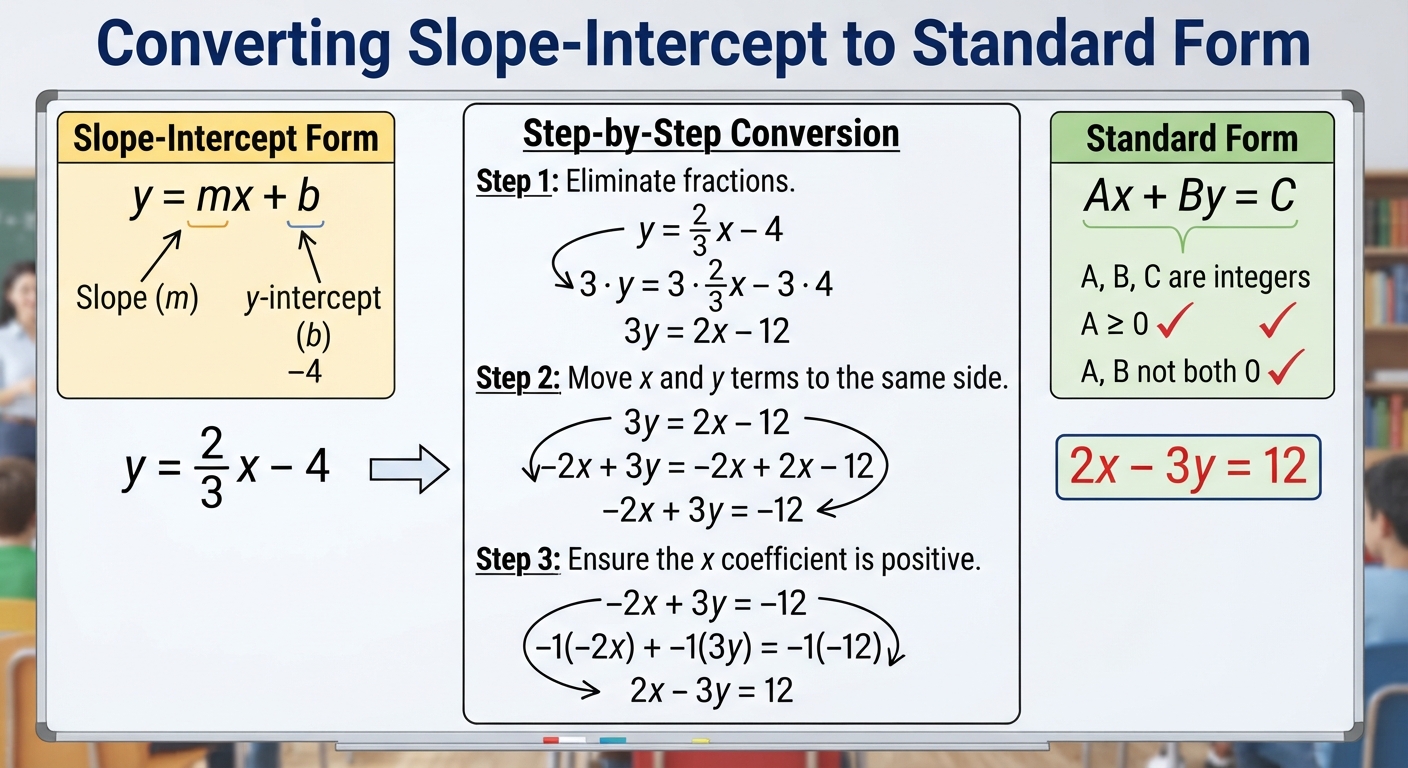
- To go from slope intercept form (y = mx + b) to standard form (Ax + By = C), move the x term to the left side so x and y sit together and the constant sits alone on the right.
- If the slope or intercept has fractions or decimals, multiply every term by the least common denominator so A, B and C are all integers.
- Most classes want A to be positive, so if the x term is negative, multiply the whole equation by -1.
- Divide out any common factor at the end: 4x – 6y = 8 should become 2x – 3y = 4.
- Check your answer by plugging in x = 0. You should get the same y intercept you started with.
Converting slope intercept to standard form means rewriting y = mx + b as Ax + By = C, where A, B and C are integers, A isn’t negative, and the three numbers share no common factor. You do it in three moves: get x and y on the same side, clear any fractions, then fix the sign of A.
That’s the whole idea. The trouble kids run into is almost never the concept. It’s the sign flips and the fraction clearing, so that’s where we’ll spend most of this post.
The two forms, side by side
Both forms describe the same line. They just put the information in different places.
| Form | Looks like | What it shows fast | Example |
|---|---|---|---|
| Slope intercept | y = mx + b | Slope (m) and y intercept (b) | y = 2x – 4 |
| Standard | Ax + By = C | Both intercepts, easy to set up systems | 2x – y = 4 |
Slope intercept form is great for graphing from a starting point. Standard form is handy for finding both intercepts, for solving systems by elimination, and for word problems like “adult tickets cost $8, kid tickets cost $5, and we spent $120,” which lands naturally as 8x + 5y = 120. Standard form can also write a vertical line, like x = 3, which slope intercept form can’t do at all because a vertical line has no slope.
How to convert slope intercept to standard form in 4 steps
- Move the x term. Subtract mx from both sides so you have -mx + y = b.
- Clear fractions or decimals. Multiply every single term by the least common denominator (or by 10, 100 and so on for decimals).
- Make A positive. If the x coefficient is negative, multiply every term by -1.
- Simplify. If A, B and C share a common factor, divide it out.
Some teachers do steps 1 and 2 in the other order. That’s fine. The finished equation comes out the same.
Worked examples
Example 1: whole numbers
Convert y = 3x – 7.
Subtract 3x from both sides:
-3x + y = -7
A is negative, so multiply every term by -1:
3x – y = 7
Check with x = 0: 3(0) – y = 7, so y = -7. The original equation also has a y intercept of -7. It matches.
Example 2: a fraction in the slope
Convert y = (2/5)x + 4.
Multiply every term by 5:
5y = 2x + 20
Subtract 2x from both sides:
-2x + 5y = 20
Multiply by -1:
2x – 5y = -20
Check with x = 5: 2(5) – 5y = -20, so 10 – 5y = -20, -5y = -30, y = 6. The original gives (2/5)(5) + 4 = 2 + 4 = 6. Same point.
Example 3: fractions in both places
Convert y = -(3/4)x – 1/2.
The denominators are 4 and 2, so the least common denominator is 4. Multiply every term by 4:
4y = -3x – 2
Add 3x to both sides:
3x + 4y = -2
A is already positive, so you’re done. Check with x = 2: 3(2) + 4y = -2, so 4y = -8 and y = -2. The original gives -(3/4)(2) – 1/2 = -1.5 – 0.5 = -2. It checks.
Example 4: decimals
Convert y = 0.4x + 1.2.
0.4 is 2/5 and 1.2 is 6/5, so multiplying by 5 clears both:
5y = 2x + 6
-2x + 5y = 6
2x – 5y = -6
Multiplying by 10 also works. You’d get 4x – 10y = -12, then divide out the common factor of 2 to land on the same answer.
Example 5: a horizontal line
Convert y = 5. There’s no x term, so the slope is 0. In standard form this is 0x + y = 5, which everyone just writes as y = 5. Here A is 0, and that’s allowed.
Going the other way: standard form to slope intercept
Kids usually get asked for both directions on the same worksheet. To undo the conversion, solve for y.
Convert 2x + 3y = 12.
Subtract 2x: 3y = -2x + 12
Divide every term by 3: y = -(2/3)x + 4
Slope is -2/3 and the y intercept is 4. The most common slip here is dividing only the 12 by 3 and forgetting the -2x.
Bonus: reading intercepts straight from standard form
This is the payoff for learning standard form. Cover up one variable by setting it to zero.
For 2x – 5y = -20:
Set y = 0: 2x = -20, so x = -10. The x intercept is (-10, 0).
Set x = 0: -5y = -20, so y = 4. The y intercept is (0, 4).
Plot those two points, connect them, and you’ve graphed the line without ever computing a slope.
Common mistakes with slope intercept to standard form
- Dropping the sign when moving the x term. In y = 3x – 7, the 3x is positive, so subtracting it leaves -3x on the left. Kids who write 3x + y = -7 have moved the term without changing its sign.
- Multiplying only part of the equation. In y = (2/5)x + 4, multiplying by 5 has to hit the y and the 4 too. Writing 5y = 2x + 4 is a very common slip.
- Stopping with a negative A. -2x + 5y = 20 is a true equation for the line, but most teachers will mark it incomplete.
- Leaving a common factor. 6x + 4y = 10 should be 3x + 2y = 5.
- Using the wrong multiplier for decimals. Multiplying y = 0.25x + 3 by 10 gives 2.5x, still a decimal. You’d need 4 or 100.
- Putting C on the wrong side. Standard form has the constant alone on the right. 3x – y – 7 = 0 is a different format (general form).
Practice problems
Write each equation in standard form with integer coefficients and a positive A.
- y = 2x + 5
- y = -4x + 9
- y = (1/3)x – 2
- y = -(5/2)x + 3
- y = (3/4)x + 1/2
- y = 0.6x – 1.5
- y – 4 = 2(x + 1)
- The line through (0, 3) and (4, 0)
Answers
- 2x – y = -5
- 4x + y = 9
- x – 3y = 6 (multiply by 3 to get 3y = x – 6, then -x + 3y = -6, then multiply by -1)
- 5x + 2y = 6
- 3x – 4y = -2
- 6x – 10y = 15 (multiply by 10; 6, 10 and 15 share no common factor, so it stays)
- 2x – y = -6 (distribute to get y – 4 = 2x + 2, so y = 2x + 6)
- 3x + 4y = 12 (the slope is -3/4 and the y intercept is 3)
If your kid is stuck on this, look earlier
Converting between line forms is an Algebra 1 skill, but it leans hard on things kids were supposed to lock down years before. When a student can explain the steps and still gets the answer wrong, the problem usually sits in one of these places:
- Integer rules. Almost every mistake above is a sign error. If a kid hesitates on -3 × -1 or on 7 – (-2), standard form will feel impossible.
- Fractions. Knowing that (2/5) × 5 = 2 without thinking about it is a fourth and fifth grade skill. We wrote a whole post on why struggling with algebra usually traces back to fourth grade fractions, and this topic is a textbook case.
- Doing the same thing to both sides. Kids who treat the equals sign as “the answer goes next” rather than “both sides balance” tend to multiply only one side.
If you’re not sure which of these it is, the grade by grade list in math skills by grade level is a quick way to see where the foundation sits, and these signs your child is behind in math can help you tell a one-off rough week from a real gap.
Frequently asked questions
What is standard form of a linear equation?
Standard form is Ax + By = C, where A, B and C are integers, A is zero or positive, and A and B aren’t both zero. Many textbooks also ask that A, B and C have no common factor other than 1.
How do you convert y = mx + b to Ax + By = C?
Subtract mx from both sides so x and y are on the left, multiply through by a common denominator if there are fractions, and multiply by -1 if the x coefficient is negative. For y = 4x – 1 you get -4x + y = -1, then 4x – y = 1.
Can A be negative in standard form?
The equation is still true if A is negative, but the usual convention says A should be positive, and most teachers grade to that. A few textbooks relax the rule, so check your kid’s class notes if a worksheet seems to accept both.
Why do we even need standard form?
It makes both intercepts easy to find, it’s the setup you want for solving systems by elimination, and it’s how many word problems naturally come out, like 3x + 2y = 24 for a budget. It’s also the only one of the two forms that can write a vertical line.
How do you convert slope intercept to standard form with fractions?
Find the least common denominator of every fraction in the equation and multiply every term by it, including the y. For y = (1/6)x + 2/3, multiply by 6 to get 6y = x + 4, then rearrange to x – 6y = -4.
Find the actual gap
When a kid keeps missing these, more worksheets on line forms rarely fix it, because the mistake usually lives in integers or fractions. Math Anon starts with a short adaptive assessment that finds exactly which earlier skills are missing and gives you a written report on what we found.
From there it’s about 20 minutes a day of practice aimed at those specific skills, and you get a progress report every week. The assessment is $49, and that’s credited back in full on your first month. Start the assessment, or see pricing first.





