
Inverse Operations: How They Work, With Examples
The short version
- Inverse operations are pairs of operations that undo each other. Addition and subtraction are one pair. Multiplication and division are the other main pair.
- Kids use them to check work: if 72 – 38 = 34, then 34 + 38 should equal 72.
- They’re how you solve equations. To get x alone in x + 17 = 42, subtract 17 from both sides: x = 25.
- In two-step equations, undo in reverse order. Deal with the adding or subtracting first, then the multiplying or dividing.
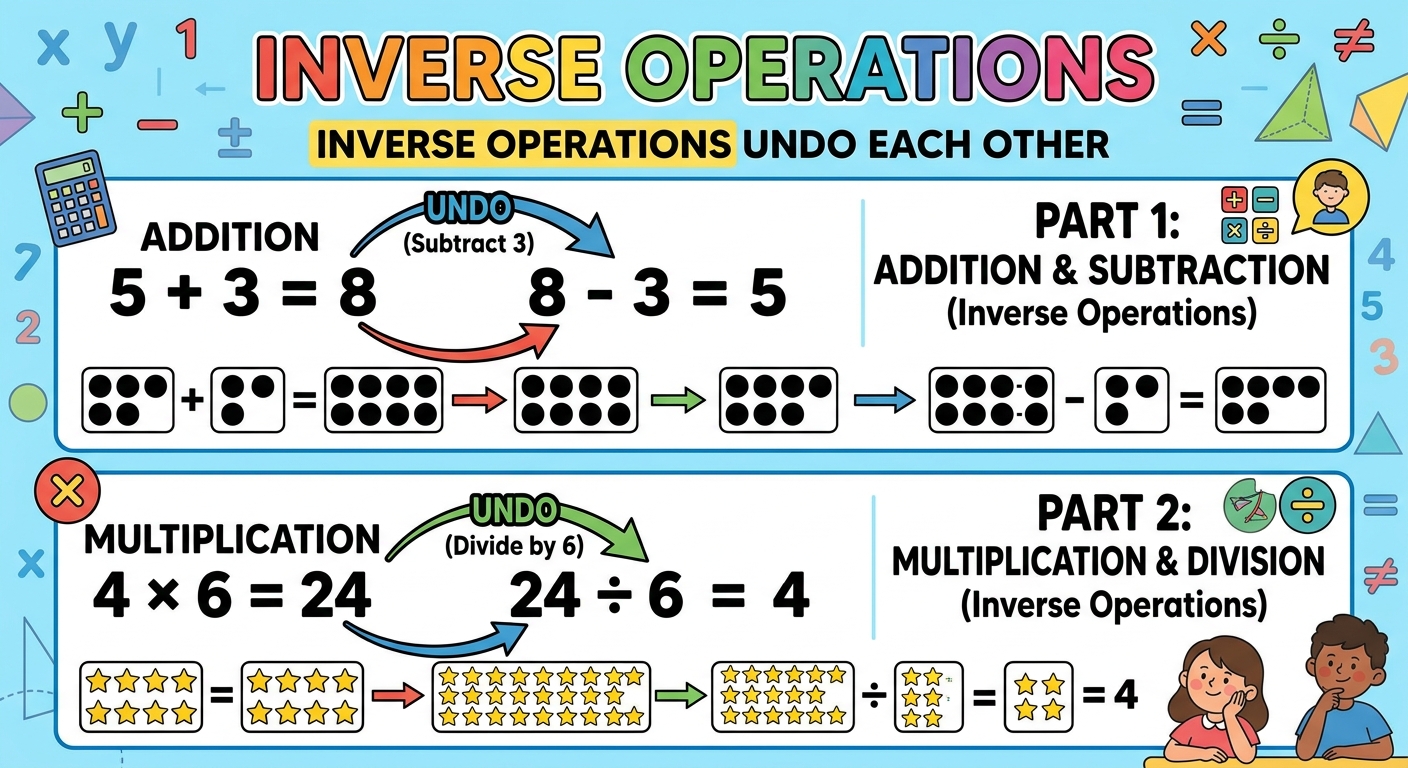
Inverse operations are operations that reverse each other: addition undoes subtraction, and multiplication undoes division. Start with 10, add 4 to get 14, subtract 4, and you’re back at 10. The same goes for multiplying by 3 and dividing by 3.
That undo idea runs from 1st grade fact families all the way to algebra. Below, we’ll show the main pairs, how kids use inverse operations to check answers and solve equations, the mistakes that cause the most wrong answers, and a practice set with a worked answer key.
The inverse operation pairs
| Operation | Inverse | Example |
|---|---|---|
| Add 6 | Subtract 6 | 9 + 6 = 15, and 15 – 6 = 9 |
| Subtract 6 | Add 6 | 20 – 6 = 14, and 14 + 6 = 20 |
| Multiply by 5 | Divide by 5 | 7 × 5 = 35, and 35 ÷ 5 = 7 |
| Divide by 5 | Multiply by 5 | 40 ÷ 5 = 8, and 8 × 5 = 40 |
| Square | Square root | 6² = 36, and √36 = 6 |
The squaring pair comes up in middle school. It works cleanly for positive numbers. For equations like x² = 49, remember there are two answers, 7 and -7, since (-7)² is also 49.
Multiplying by zero is the one move you can’t undo. 5 × 0 = 0 and 8 × 0 = 0, so if you only see the 0, there’s no way to tell where you started. That’s the real reason you can’t divide by zero.
Fact families: inverse operations in early grades
Young kids meet inverse operations as fact families, a set of related facts built from the same three numbers.
For 3, 5 and 8:
3 + 5 = 8
5 + 3 = 8
8 – 5 = 3
8 – 3 = 5
For 4, 6 and 24:
4 × 6 = 24
6 × 4 = 24
24 ÷ 6 = 4
24 ÷ 4 = 6
This matters more than it looks. A kid who knows 6 × 4 = 24 and understands fact families gets 24 ÷ 4 for free. A kid who treats division as a separate list of facts has twice as much to memorize.
Using inverse operations to check answers
This is the most practical habit in elementary math. Every subtraction and division answer can be checked with its inverse.
Subtraction: 72 – 38 = 34
Check: 34 + 38 = 72. It matches, so the answer is right.
Division: 156 ÷ 12 = 13
Check: 13 × 12 = 156. Correct.
Catching an error: a kid writes 91 – 47 = 54.
Check: 54 + 47 = 101, which doesn’t match 91. Something’s off. The real answer is 44, and 44 + 47 = 91.
Division with a remainder checks the same way, plus one step. 50 ÷ 7 = 7 R1, so 7 × 7 + 1 should be 50. It is.
Solving equations with inverse operations
An equation is a balance. Whatever you do to one side, you do to the other. To solve, look at what’s been done to x and do the inverse to both sides until x is alone.
One-step equations
x + 17 = 42
17 was added to x, so subtract 17 from both sides.
x = 42 – 17 = 25
Check: 25 + 17 = 42.
6x = 54
x was multiplied by 6, so divide both sides by 6.
x = 54 ÷ 6 = 9
Check: 6 × 9 = 54.
x ÷ 4 = 7
x was divided by 4, so multiply both sides by 4.
x = 7 × 4 = 28
x – 9 = 15
9 was subtracted, so add 9 to both sides.
x = 15 + 9 = 24
Two-step equations
When two things have been done to x, undo them in reverse order. Think of getting dressed: socks go on, then shoes. To undo it, shoes come off first.
3x + 5 = 26
Order done to x: multiply by 3, then add 5.
Undo the last one first. Subtract 5: 3x = 21
Then divide by 3: x = 7
Check: 3 × 7 + 5 = 21 + 5 = 26.
(x – 4) ÷ 3 = 5
Order done to x: subtract 4, then divide by 3.
Multiply both sides by 3: x – 4 = 15
Add 4: x = 19
Check: (19 – 4) ÷ 3 = 15 ÷ 3 = 5.
Working backward in word problems
“I think of a number, double it and add 6. I get 30. What was my number?”
Start at 30 and run the steps in reverse with inverse operations.
Undo “add 6”: 30 – 6 = 24
Undo “double”: 24 ÷ 2 = 12
The number is 12. Check: 12 × 2 + 6 = 30.
Inverse operations vs. inverse numbers
Kids sometimes mix these up because both use the word inverse.
- The additive inverse of a number is its opposite. The additive inverse of 5 is -5, because 5 + (-5) = 0.
- The multiplicative inverse is the reciprocal. The multiplicative inverse of 4 is 1/4, because 4 × 1/4 = 1.
They connect to inverse operations neatly. Subtracting 5 is the same as adding -5. Dividing by 4 is the same as multiplying by 1/4. That’s why dividing by a fraction means multiplying by its reciprocal.
Common mistakes with inverse operations
- Doing it to one side only. In x + 17 = 42, subtracting 17 from the left and leaving 42 alone. Both sides, every time.
- Using the same operation instead of the inverse. Solving x – 9 = 15 by subtracting 9 again and getting 6. The answer is 24.
- Undoing in the wrong order. In 3x + 5 = 26, dividing only the 3x by 3 and leaving the 5 and 26 as they are. That gives x + 5 = 26 and a wrong answer of 21.
- Flipping the order in subtraction or division. 8 – 5 = 3 belongs to the fact family, but 5 – 8 = 3 doesn’t. Order matters for subtraction and division.
- Skipping the check. Plugging the answer back in takes a few seconds and catches almost every mistake on this list.
Practice problems
- What’s the inverse of adding 9?
- Write the fact family for 7, 8 and 56.
- Use an inverse operation to check: is 91 – 47 = 44 correct?
- Solve: x + 38 = 100
- Solve: x ÷ 5 = 12
- Solve: 4x – 7 = 29
- Solve: (x + 3) ÷ 2 = 11
- I think of a number, multiply it by 3, then subtract 4. I get 20. What’s my number?
Answers
- Subtracting 9
- 7 × 8 = 56, 8 × 7 = 56, 56 ÷ 8 = 7, 56 ÷ 7 = 8
- Yes. 44 + 47 = 91.
- x = 62 (100 – 38)
- x = 60 (12 × 5)
- Add 7: 4x = 36. Divide by 4: x = 9. Check: 4 × 9 – 7 = 29.
- Multiply by 2: x + 3 = 22. Subtract 3: x = 19. Check: (19 + 3) ÷ 2 = 11.
- Add 4: 20 + 4 = 24. Divide by 3: 24 ÷ 3 = 8. The number is 8.
If your kid is stuck on inverse operations
A kid who struggles to solve 3x + 5 = 26 is usually missing an earlier idea: that operations come in undo pairs, which they should have picked up through fact families in 1st to 3rd grade. If 56 ÷ 8 feels like a brand new fact instead of the flip side of 7 × 8, equations will feel like magic tricks.
The other common gap is the equal sign. Some kids read it as “the answer goes here” instead of “both sides are the same amount.” Balancing both sides makes no sense until that shifts. This is a big part of why kids struggle with algebra years later. Our math skills by grade level guide lists the fact fluency and operation skills to look for. Short, steady practice is what builds that fluency, and 20 minutes a day tends to beat a long weekly session.
Frequently asked questions
What are inverse operations in math?
They’re operations that undo each other. Addition and subtraction are inverses, and so are multiplication and division.
What is the inverse operation of multiplication?
Division. If 9 × 4 = 36, then 36 ÷ 4 = 9 takes you back to where you started.
Why do we use inverse operations to solve equations?
To get the variable alone. Whatever was done to x, the inverse cancels it out, and doing it to both sides keeps the equation balanced.
What grade learns inverse operations?
The idea starts in 1st and 2nd grade with addition and subtraction fact families, extends to multiplication and division in 3rd grade, and becomes the main tool for solving equations in 6th and 7th grade.
Are addition and multiplication inverse operations?
No. Multiplication is repeated addition, but it doesn’t undo addition. Addition’s inverse is subtraction, and multiplication’s inverse is division.
Find the actual gap
If equations keep going wrong, the missing piece might be fact fluency, fact families or how your child reads the equal sign. Math Anon’s short adaptive assessment checks those earlier skills and tells you, in a written report, which ones need work.
Your child then gets about 20 minutes of daily practice built around those skills, and you get a weekly report showing progress. The assessment costs $49, credited back in full on the first month. Start the assessment or read about pricing.





