
What Is Mode In Math? Definition, Examples And Practice
The short version
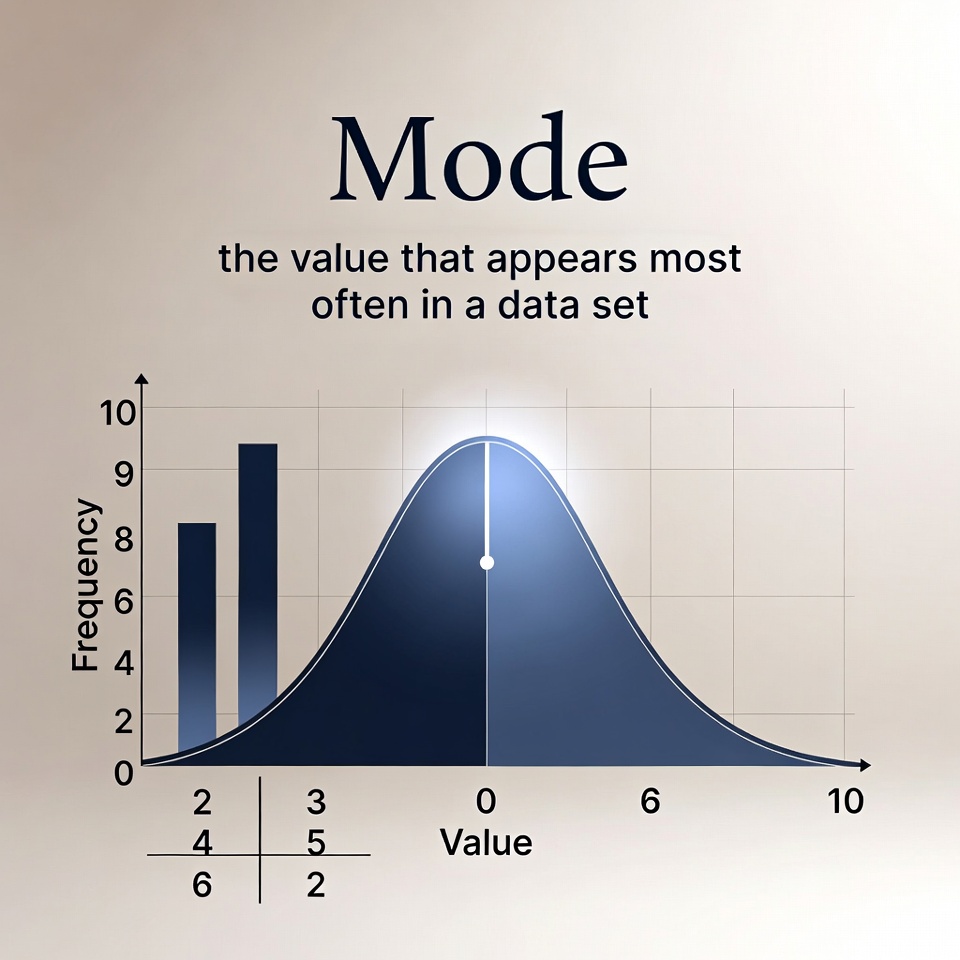
- The mode in math is the value that shows up most often in a set of data. In 2, 3, 4, 7, 7, 7, 9, the mode is 7.
- To find it, put the numbers in order, count how many times each appears and pick the one with the highest count.
- A data set can have one mode, two or more modes, or no mode at all. If nothing repeats, there’s no mode, and the answer isn’t 0.
- Memory trick: MOde and MOst start the same way.
- The mode is the only measure of center that works for words, like favorite colors or pizza toppings.
The mode in math is the number or item that appears most often in a data set. To find it, count how many times each value appears. The one with the highest count is the mode. In 4, 7, 2, 7, 9, 7, 3, the number 7 appears three times, more than anything else, so the mode is 7.
That’s the mode math definition. Kids usually learn it alongside mean, median and range, and that’s where the mix-ups start. Below, we cover every case your child will see on a worksheet, how the mode compares with the other three, the common mistakes and a practice set with answers.
How to find the mode in math, step by step
- Put the numbers in order. It’s not required, but it lines up repeated values next to each other so you don’t miss any.
- Count each value. A quick tally works well for longer lists.
- Find the highest count. The value (or values) with that count is the mode.
- Check the special cases. A tie means more than one mode. If every value appears once, there’s no mode.
Example with one mode
Data: 4, 7, 2, 7, 9, 7, 3
In order: 2, 3, 4, 7, 7, 7, 9
Counts: 2 appears once, 3 once, 4 once, 7 three times, 9 once
Mode: 7
Example with two modes
Data: 6, 2, 8, 1, 6, 2, 5
In order: 1, 2, 2, 5, 6, 6, 8
Counts: 2 and 6 each appear twice. Everything else appears once.
Modes: 2 and 6
A set with two modes is called bimodal. With three or more, it’s multimodal.
Example with no mode
Data: 3, 10, 5, 8
Every number appears once, so nothing appears most often.
Mode: none
Write “no mode.” Don’t write 0. Zero is a number, and it isn’t in the data. Most textbooks also say there’s no mode when every value appears the same number of times, as in 2, 2, 4, 4.
Finding the mode in tables, graphs and word data
Frequency tables
Sometimes the counting is already done for you. Here are shoe sizes for a class:
| Shoe size | Number of kids |
|---|---|
| 4 | 3 |
| 5 | 6 |
| 6 | 4 |
| 7 | 2 |
The mode is the shoe size with the most kids, which is size 5. A common error here is answering 6, the biggest number in the second column. The mode is always a value from the data (a shoe size), never the count itself.
Bar graphs and line plots
On a bar graph, the mode is the category under the tallest bar. On a line plot, it’s the value with the tallest stack of X’s. Kids can find it without counting a single number.
Words instead of numbers
Say a class votes on favorite fruit: apple, banana, apple, grape, banana, apple. Apple gets 3 votes, banana 2, grape 1. The mode is apple.
You can’t find the mean or median of “apple, banana, grape,” because there’s nothing to add or put in number order. The mode is the only one of the three that works for categories like these.
Mode in math vs. mean, median and range
These four always get taught together, so here they are on one data set: 2, 4, 4, 5, 7, 8, 12.
| Measure | What it means | How to find it | Answer |
|---|---|---|---|
| Mode | Most common value | Count which value appears most | 4 |
| Median | Middle value | Put in order and find the middle | 5 |
| Mean | Average | Add them all, divide by how many: 42 ÷ 7 | 6 |
| Range | Spread | Biggest minus smallest: 12 – 2 | 10 |
Memory tricks that work:
- MOde is the MOst.
- Median sounds like the median of a road, the strip down the middle.
- Mean is the “mean” one because it takes the most work.
When the mode is the best choice
The mode answers “what’s most common?” That’s the right question more often than kids expect. A store deciding which shoe size to stock most of wants the mode, since an average size of 5.3 isn’t a shoe anyone wears. A class picking a field trip wants the mode of the votes.
The mode is a poor choice when values rarely repeat, like the exact heights of 20 kids. It also can land far from the middle. In 1, 1, 50, 60, 70, the mode is 1, even though most of the data sits much higher.
Common mistakes with the mode
- Mixing it up with median or mean. The single most common error. The mnemonic helps.
- Answering with the count. In 5, 5, 5, 8, the mode is 5, not 3 (the number of times 5 appears).
- Writing 0 for no mode. If nothing repeats, the answer is “no mode.”
- Stopping at the first repeat. In 1, 3, 3, 5, 5, a kid spots the 3s and stops, missing that 5 also appears twice. The answer is 3 and 5.
- Losing count on long lists. Skipping the sorting step on 15 numbers almost guarantees a miscount.
Practice problems
- Find the mode: 3, 6, 6, 8, 9
- Find the mode: 12, 15, 11, 15, 12, 15, 10
- Find the mode: 4, 9, 2, 7
- Find the mode: 1, 3, 3, 5, 5, 8
- Favorite fruit votes: apple, banana, apple, grape, banana, apple. What’s the mode?
- Test scores: 6 points (2 students), 7 points (5 students), 8 points (5 students), 9 points (3 students). What’s the mode?
- For 10, 4, 7, 4, 9, 8, find the mode, median, mean and range.
- What one number could you add to 2, 5, 5, 8, 8 so that 8 is the only mode?
Answers
- 6
- 15 (it appears three times, and 12 appears twice)
- No mode. Every number appears once.
- 3 and 5. Both appear twice.
- Apple (3 votes)
- 7 and 8. Both have 5 students. The answer is the scores, not 5.
- In order: 4, 4, 7, 8, 9, 10. Mode 4. Median (7 + 8) ÷ 2 = 7.5. Mean 42 ÷ 6 = 7. Range 10 – 4 = 6.
- 8. Then 8 appears three times and 5 appears twice.
If your kid is stuck on mode, mean and median
The mode in math is the easiest of the four measures, so trouble with it usually points to something else. Sometimes it’s just vocabulary: four new words that start with M or R, introduced in one week. That’s fixable with a mnemonic and some practice. If your child can find the mode but falls apart on the mean, look at division and adding long lists. If the median trips them up, check whether they can order numbers, especially decimals and fractions.
Reading tables and graphs is another quiet gap. A kid who answers “6” for the shoe size question may not see that a table has two kinds of numbers in it. Our math skills by grade level guide covers the data and number skills that should be in place by 5th grade. For a wider view of whether this is a blip or a pattern, see these 12 signs by grade level, and our guide to math assessment for kids explains how to pin down the exact gap.
Frequently asked questions
What does mode mean in math?
Mode means the value that appears most often in a set of data. It answers the question “what’s the most common one?”
Can there be more than one mode?
Yes. If two values tie for most common, both are modes, and the data is called bimodal. In 1, 3, 3, 5, 5, 8, the modes are 3 and 5.
What if no number repeats?
Then the data set has no mode. Write “no mode” instead of 0.
Is the mode the same as the average?
No. The average (the mean) is the total divided by how many values there are. The mode is the most frequent value. They can be the same number, but usually aren’t.
Can the mode be a word?
Yes. For data like favorite colors or pet types, the mode is the most popular answer. Mean and median don’t work for that kind of data.
What grade learns mean, median and mode?
It depends on the curriculum. Many kids see the mode on line plots in upper elementary school, and most study all four measures together around 6th grade.
Find the actual gap
If statistics homework keeps going sideways, it helps to know whether the issue is vocabulary, division, ordering numbers or reading a table. Math Anon starts with a short adaptive assessment that sorts that out and shows you the results in a written report.
From there, it’s about 20 minutes a day of practice aimed at your child’s specific gaps, plus a weekly progress report for you. The assessment is $49, credited in full toward the first month. Start the assessment, or see pricing.





