
What Is A Tessellation? Types, Examples And The Math
The short version
- A tessellation is a pattern of shapes that covers a flat surface with no gaps and no overlaps, and it can keep going forever in every direction.
- Only three regular polygons tessellate by themselves: equilateral triangles, squares and regular hexagons.
- The reason is angles. The corners meeting at any point have to add up to exactly 360°, so a shape’s interior angle has to divide evenly into 360.
- Regular pentagons fail because their 108° angles don’t fit: three make 324° and four make 432°.
- Every triangle and every quadrilateral will tessellate, even lopsided ones.
A tessellation is a repeating arrangement of shapes that covers a flat surface completely, with no gaps and no overlaps. Floor tiles, a honeycomb and a checkerboard are all tessellations. The math question hiding inside the art is which shapes can do it, and the answer comes down to one number: 360°.
That’s what most explanations skip. We’ll cover the types, but we’ll also show why a hexagon works and a pentagon doesn’t, with the arithmetic, so your kid can figure out any shape on a test without memorizing a list.
What counts as a tessellation
A pattern has to pass two tests:
- No gaps. Every bit of the surface is covered.
- No overlaps. No two shapes cover the same spot.
Most school definitions add that the pattern repeats and could extend forever. A single tile is the “tile,” and the whole pattern is the “tessellation” (you’ll also see the word “tiling,” which means the same thing). Circles can’t tessellate on their own, because round edges always leave curved gaps between them.
Why angles decide which shapes tessellate
Look at any spot in a tessellation where corners meet. That spot is called a vertex. The corners around it form a full turn, and a full turn is 360°. If the corners add up to less than 360°, there’s a gap. If they add up to more, the shapes overlap.
So for a regular polygon (all sides equal, all angles equal) to tessellate alone, its interior angle has to divide 360 with no remainder.
The interior angle of a regular polygon with n sides is:
angle = 180 × (n – 2) ÷ n
| Regular polygon | Sides | Interior angle | 360 ÷ angle | Tessellates alone? |
|---|---|---|---|---|
| Triangle | 3 | 60° | 6 | Yes, 6 meet at each vertex |
| Square | 4 | 90° | 4 | Yes, 4 meet at each vertex |
| Pentagon | 5 | 108° | 3.33… | No |
| Hexagon | 6 | 120° | 3 | Yes, 3 meet at each vertex |
| Heptagon | 7 | about 128.6° | 2.8 | No |
| Octagon | 8 | 135° | 2.67 | No |
Past the hexagon, the angles are all bigger than 120° but smaller than 180°. Three of them add up to more than 360°, and two add up to less. There’s no whole number that works, so no regular polygon with more than six sides can tessellate on its own. That’s the full proof that the list stops at three, and it only needs multiplication and division.
Worked example: the pentagon
Interior angle = 180 × (5 – 2) ÷ 5 = 180 × 3 ÷ 5 = 540 ÷ 5 = 108°.
Three pentagons at a vertex: 3 × 108 = 324°, which leaves a 36° gap.
Four pentagons at a vertex: 4 × 108 = 432°, which overlaps by 72°.
Neither one is 360°, so regular pentagons can’t tessellate.
Types of tessellation
Regular tessellations
One regular polygon, repeated, with every vertex looking the same. There are exactly three: the triangle, square and hexagon patterns from the table.
Semi-regular tessellations
Two or more kinds of regular polygon, with the same arrangement at every vertex. There are exactly eight of these. Mathematicians name them by listing the polygons around a vertex by their number of sides. A few examples, with the angle check:
| Name | Shapes at each vertex | Angle sum |
|---|---|---|
| 4.8.8 | 1 square, 2 octagons | 90 + 135 + 135 = 360° |
| 3.6.3.6 | 2 triangles, 2 hexagons | 60 + 120 + 60 + 120 = 360° |
| 3.12.12 | 1 triangle, 2 dodecagons | 60 + 150 + 150 = 360° |
| 4.6.12 | 1 square, 1 hexagon, 1 dodecagon | 90 + 120 + 150 = 360° |
| 3.3.3.4.4 | 3 triangles, 2 squares | 60 + 60 + 60 + 90 + 90 = 360° |
The other three are 3.3.3.3.6, 3.3.4.3.4 and 3.4.6.4. The 4.8.8 pattern is the classic octagon and square floor tile you’ve probably stood on in an old kitchen or hotel lobby.
Irregular tessellations
These use shapes that aren’t regular polygons. Some surprising facts:
- Any triangle tessellates. Put two copies together to make a parallelogram, and parallelograms stack in rows. At each vertex, each of the triangle’s three angles shows up twice, and 2 × 180° = 360°.
- Any quadrilateral tessellates, even a dented, non-convex one. Its four angles add to 360°, so one copy of each angle fits around every vertex.
- Some pentagons do tile, just not the regular one. Mathematicians have found 15 families of convex pentagons that tessellate. The most recent was found in 2015, and a proof that the list is complete followed a couple of years later.
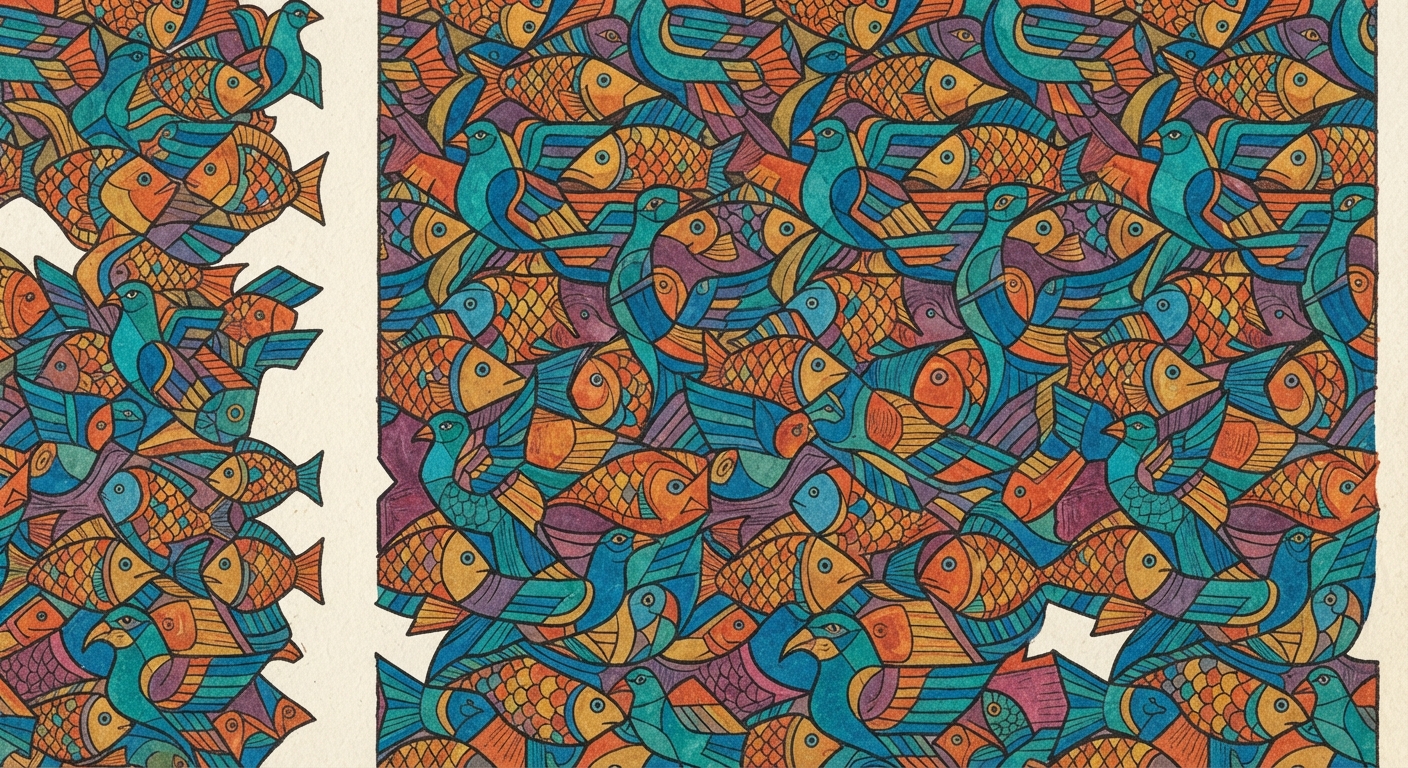
The artist M.C. Escher built his famous lizard and bird patterns by starting with a shape that tessellates, cutting a piece out of one side and adding it back on the opposite side. The area stays the same and the pieces still lock together. Kids can do this with a square index card, scissors and tape.
Tessellations you can point to
- Honeycomb cells, which are close to regular hexagons.
- Bathroom and kitchen tile, brick walls and paving stones.
- Many traditional Islamic geometric designs, which combine several polygons and stars.
- The panels on a lot of soccer balls. This one is a trick: they’re on a curved surface, so pentagons can show up alongside hexagons, which wouldn’t work on a flat floor.
Common mistakes with tessellation problems
- Thinking any regular polygon works. Kids who have seen hexagons tile often assume octagons will too. Run the 360° test.
- Using the angle sum instead of one angle. A hexagon’s angles add to 720°, but the number that matters at a vertex is one angle, 120°.
- Forgetting the (n – 2). The formula is 180 × (n – 2) ÷ n. Writing 180 × n ÷ n just gives 180 every time.
- Calling any pretty pattern a tessellation. If there are gaps, like circles packed in a box, it isn’t one.
- Assuming “irregular” means “won’t tile.” Every triangle and every quadrilateral does.
Practice problems
- What is the interior angle of a regular hexagon?
- In a tessellation of squares, how many squares meet at each vertex?
- Can regular pentagons tessellate on their own? Show why using angles.
- Find the interior angle of a regular octagon. If two octagons meet at a vertex, what regular polygon fills the gap?
- A regular 12-sided polygon (dodecagon) has an interior angle of 150°. Two dodecagons meet at a vertex. What regular polygon fills the rest?
- A regular polygon has interior angles of 140°. How many sides does it have, and can it tessellate alone?
- At one vertex there’s a square, a regular hexagon and one more regular polygon. Which polygon is it?
- Can a scalene triangle (no equal sides) tessellate? Explain.
Answers
- 120°, because 180 × 4 ÷ 6 = 120.
- 4, because 360 ÷ 90 = 4.
- No. Each angle is 108°. Three give 324° (a gap) and four give 432° (an overlap).
- 135°. Two octagons use 270°, leaving 360 – 270 = 90°, which is a square.
- 360 – 150 – 150 = 60°, so an equilateral triangle.
- Solve 180(n – 2) ÷ n = 140. That gives 180n – 360 = 140n, so 40n = 360 and n = 9. It can’t tessellate alone because 360 ÷ 140 is about 2.57, not a whole number.
- 360 – 90 – 120 = 150°, which is the regular 12-sided polygon (dodecagon).
- Yes. Every triangle tessellates. Each of its three angles appears twice at a vertex, and 2 × 180° = 360°.
If your kid is stuck on tessellations, look at angles first
Tessellation units look like art class, which makes them easy to underestimate. The math underneath is angle measurement, which usually starts around fourth grade, plus the idea that angles around a point add to 360° and angles on a straight line add to 180°.
A kid who can’t say why a pentagon fails usually has a gap in one of these:
- Knowing that a full turn is 360°. If this is shaky, supplementary angles (the 180° version of the same idea) is a good place to check first.
- Multiplying and dividing by numbers like 108 and 135 without getting lost.
- Reading a formula with parentheses in the right order.
The grade level list in math skills by grade level shows when each of those should be solid. If several look wobbly, these signs your child is behind in math will help you decide whether it’s worth a closer look.
Frequently asked questions
What is a tessellation in simple terms?
It’s a pattern of shapes that fit together like floor tiles, covering a flat surface with no gaps and no overlaps. A checkerboard is a tessellation of squares.
Which shapes can tessellate?
Among regular polygons, only equilateral triangles, squares and regular hexagons tessellate on their own. Every triangle and every quadrilateral tessellates, and some pentagons and other irregular shapes do too.
Why don’t circles tessellate?
Circles only touch at single points, so the curved spaces between them are always left uncovered. That breaks the no gaps rule.
What is the difference between a regular and a semi-regular tessellation?
A regular tessellation uses one kind of regular polygon. A semi-regular tessellation uses two or more kinds of regular polygon, with the same arrangement at every vertex. There are 3 regular and 8 semi-regular tessellations.
What grade learns about tessellations?
Kids often meet tessellations in elementary school as a pattern and art activity, then come back to them in middle school geometry once they can calculate interior angles. The exact grade depends on the curriculum.
Find the actual gap
If tessellation homework turns into tears, the real snag is usually older than the worksheet: angle facts, multiplication or division. Math Anon starts with a short adaptive assessment that pinpoints which of those skills are missing and sends you a written report.
Your kid then practices those exact skills for about 20 minutes a day, and you get a progress report each week. The assessment costs $49, fully credited back on the first month. Start the assessment or check pricing.





