
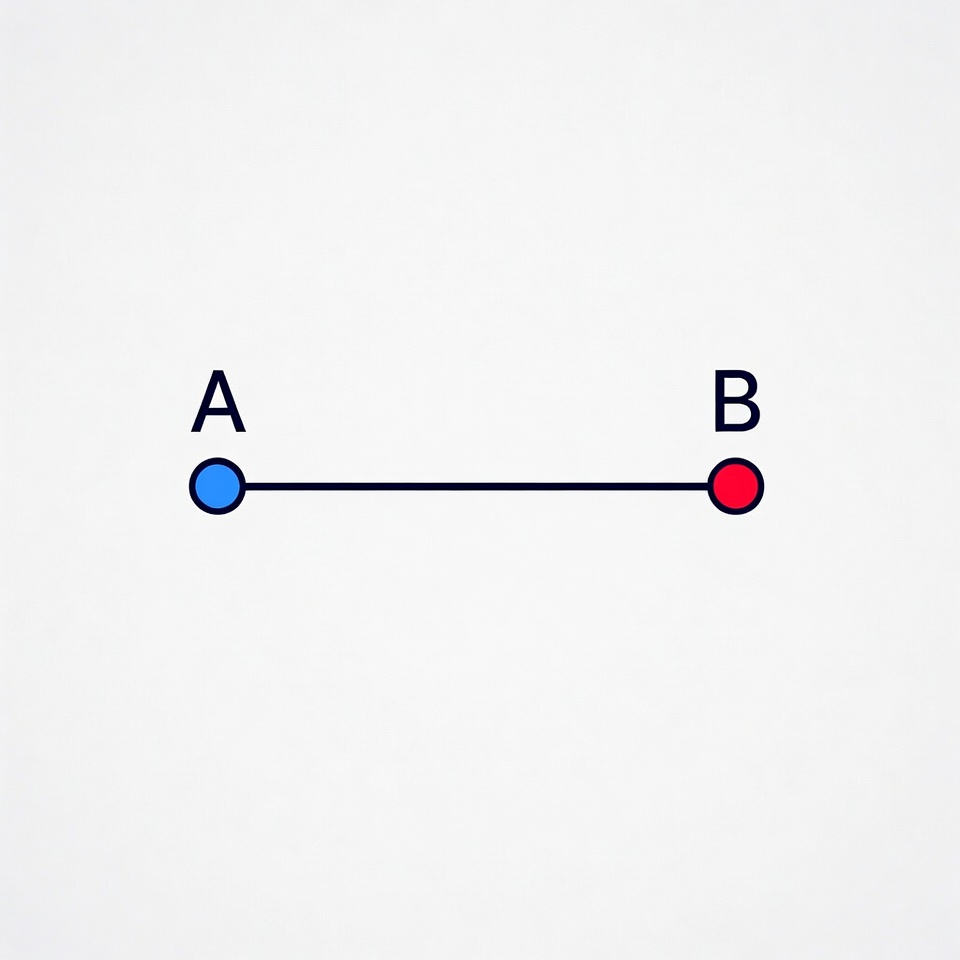
What Is A Line Segment? Definition, Notation And Examples
The short version
- A line segment is a straight part of a line with two endpoints. It has a fixed length you can measure.
- A line goes on forever both ways, a ray has one endpoint and goes forever one way, and a segment stops at both ends.
- Segment AB is written with a bar over the letters: AB. Its length is written AB with no bar.
- On a grid, subtract coordinates to find the length of a horizontal or vertical segment. For a slanted one, use the distance formula.
A line segment is the part of a line between two points, called endpoints. Unlike a line, which goes on forever, a line segment starts at one point and stops at another, so it has a length you can measure. The edge of a ruler, one side of a triangle, and the crease in a folded piece of paper are all line segments.
Kids first meet line segments in about fourth grade, when they learn to draw and name points, lines, rays and segments. The idea comes back in coordinate geometry and high school proofs, so below we cover the definition, the notation, how to measure one, and the problems that show up later, with practice at the end.
Line segment definition and notation
A line segment has three parts: two endpoints and every point on the straight path between them. You name a segment by its endpoints. A segment from point A to point B is called segment AB, or segment BA, since the order doesn’t matter.
In writing, there are two symbols kids need to keep straight:
| You see | It means |
|---|---|
| AB (bar on top) | The segment itself, the actual object |
| AB (no bar) | The length of the segment, a number |
| AB with a double arrow on top | Line AB, which goes on forever both ways |
| AB with a single arrow on top | Ray AB, starting at A and going on forever through B |
So “AB is 5 cm long” and “AB = 5 cm” say the same thing. Writing AB = 5 is technically mixing up the object and its length, and some geometry teachers will mark it.
When two segments have the same length, they’re called congruent. On diagrams you’ll see small tick marks through segments to show which ones match: one tick on each of two segments means they’re congruent, and two ticks marks a second matching pair.
Line vs ray vs line segment
This comparison is the most common worksheet question on the topic.
| Line | Ray | Line segment | |
|---|---|---|---|
| Endpoints | 0 | 1 | 2 |
| Goes on forever? | Both directions | One direction | No |
| Can you measure its length? | No | No | Yes |
| How it’s drawn | Arrows on both ends | A dot on one end, an arrow on the other | Dots on both ends |
| Real-world model | Hard to find, since nothing is infinite | A flashlight beam | A pencil, a door edge, a side of a book |
A quick way to remember: a segment is a segment of a line, the same way an orange segment is one piece of an orange. And since it’s a piece, it has to end somewhere.
How to measure a line segment
With a ruler
Line up the 0 mark (not the edge of the ruler) with one endpoint, then read the mark at the other endpoint. If you can’t start at 0, subtract.
Example: A segment starts at the 2 cm mark and ends at the 9.5 cm mark.
9.5 – 2 = 7.5
The segment is 7.5 cm long.
On a coordinate grid, horizontal or vertical
If the segment is vertical, the x-coordinates match, so subtract the y-coordinates. If it’s horizontal, subtract the x-coordinates.
Example: A(2, 3) and B(2, 11).
11 – 3 = 8
AB = 8 units.
Example: C(-4, 5) and D(6, 5).
6 – (-4) = 6 + 4 = 10
CD = 10 units. Kids who get 2 here subtracted 6 – 4 and dropped the negative sign.
On a coordinate grid, slanted
For a diagonal segment, use the distance formula, which is the Pythagorean theorem in disguise: d = √((x₂ – x₁)² + (y₂ – y₁)²).
Example: P(1, 2) and Q(7, 10).
Across: 7 – 1 = 6
Up: 10 – 2 = 8
d = √(6² + 8²) = √(36 + 64) = √100 = 10
PQ = 10 units.
More line segment problems: midpoints, addition and counting
Midpoint of a segment
The midpoint splits a segment into two congruent halves. Average the x-coordinates and average the y-coordinates.
Example: The midpoint of (2, 4) and (10, 8) is ((2 + 10) ÷ 2, (4 + 8) ÷ 2) = (6, 6).
Segment addition
If point B sits on segment AC between A and C, then AB + BC = AC. The small pieces add up to the whole.
Example: AB = 2x, BC = x + 5, and AC = 26. Find AB and BC.
2x + (x + 5) = 26
3x + 5 = 26
3x = 21
x = 7
AB = 2 × 7 = 14 and BC = 7 + 5 = 12. Check: 14 + 12 = 26.
Counting segments
If there are several points on one line, every pair of points makes a segment. With 4 points A, B, C, D in a row, the segments are AB, AC, AD, BC, BD and CD, which is 6. The shortcut is n × (n – 1) ÷ 2 for n points, so 4 × 3 ÷ 2 = 6.
Common mistakes
- Measuring from the ruler’s edge. Many rulers have a gap before 0. Starting at the edge makes every answer a little too long.
- Calling a segment a line. In everyday speech, “draw a line” means draw a segment. In geometry, a line has no ends.
- Dropping negatives on the grid. The distance from -3 to 5 is 8, not 2.
- Forgetting to square root. In the distance formula, students often stop at 100 and write PQ = 100.
- Solving for x and stopping. In segment addition problems, the question usually wants the lengths, not x.
Practice problems
- How many endpoints does a line segment have? A ray? A line?
- A segment starts at the 3 cm mark and ends at the 11 cm mark. How long is it?
- Find the length of the segment from (3, -2) to (3, 7).
- Find the length of the segment from (-5, 1) to (4, 1).
- B is between A and C. AB = 15 and AC = 40. Find BC.
- Find the midpoint of the segment from (-2, 6) to (8, 0).
- Find the length of the segment from (0, 0) to (5, 12).
- B is between A and C. AB = 3x – 1, BC = 2x + 4 and AC = 38. Find x, AB and BC.
Answers
- A segment has 2, a ray has 1, and a line has 0.
- 11 – 3 = 8 cm.
- 7 – (-2) = 9 units.
- 4 – (-5) = 9 units.
- 40 – 15 = 25.
- ((-2 + 8) ÷ 2, (6 + 0) ÷ 2) = (3, 3).
- √(5² + 12²) = √(25 + 144) = √169 = 13 units.
- (3x – 1) + (2x + 4) = 38, so 5x + 3 = 38, 5x = 35, x = 7. AB = 3 × 7 – 1 = 20 and BC = 2 × 7 + 4 = 18. Check: 20 + 18 = 38.
If your kid is stuck on line segments
The definition is simple enough that kids rarely get stuck on it. When they struggle with line segment problems, it’s usually one of the skills around it.
For younger kids, it’s often measurement. Reading a ruler means knowing where 0 is, counting spaces instead of marks, and understanding halves and quarters of an inch, which is fraction work. If fractions on a ruler confuse your child, that same gap will show up later in algebra, as we explain in Struggling With Algebra? The Real Problem Is Usually Fourth Grade Fractions. For older students, trouble with grid problems usually traces to negative numbers or squares and square roots. Our grade-level skills guide shows when each of these is expected, and these signs by grade can help you tell a one-off from a pattern.
Frequently asked questions
What is a line segment in simple words?
It’s a straight path between two points that stops at both ends. Because it stops, you can measure how long it is.
What is the difference between a line and a line segment?
A line goes on forever in both directions and has no endpoints. A line segment has two endpoints and a set length.
How do you name a line segment?
Use its two endpoints with a bar over the letters, like CD. You can write the letters in either order.
Is a side of a triangle a line segment?
Yes. A triangle is made of three line segments, a rectangle of four, and every polygon’s sides are segments. A curve can’t be a segment, because segments are straight.
What grade learns about line segments?
Under the Common Core standards, fourth graders learn to draw and identify points, lines, line segments and rays. Measuring segments on a grid comes later, and the distance formula usually shows up in eighth grade or high school geometry.
Find the actual gap
If geometry homework keeps falling apart on the measuring or the negative numbers, that’s worth pinning down. Math Anon begins with a short adaptive assessment that finds exactly which skills are missing and gives you a written report on them.
After that, your child works on those skills for about 20 minutes a day with targeted practice, and you get a weekly progress report. The assessment is $49, credited back in full on your first month. Start the assessment or look over pricing.
Related reading
- Supplementary Angles, Explained
- Math Skills By Grade Level: What Your Child Should Know
- Struggling With Algebra? The Real Problem Is Usually Fourth Grade Fractions
- Is My Child Behind In Math? 12 Signs By Grade Level
- What Is A Ray In Geometry? Definition, Naming And Examples
- What Are Skew Lines? Definition, Examples And A Quick Test





