
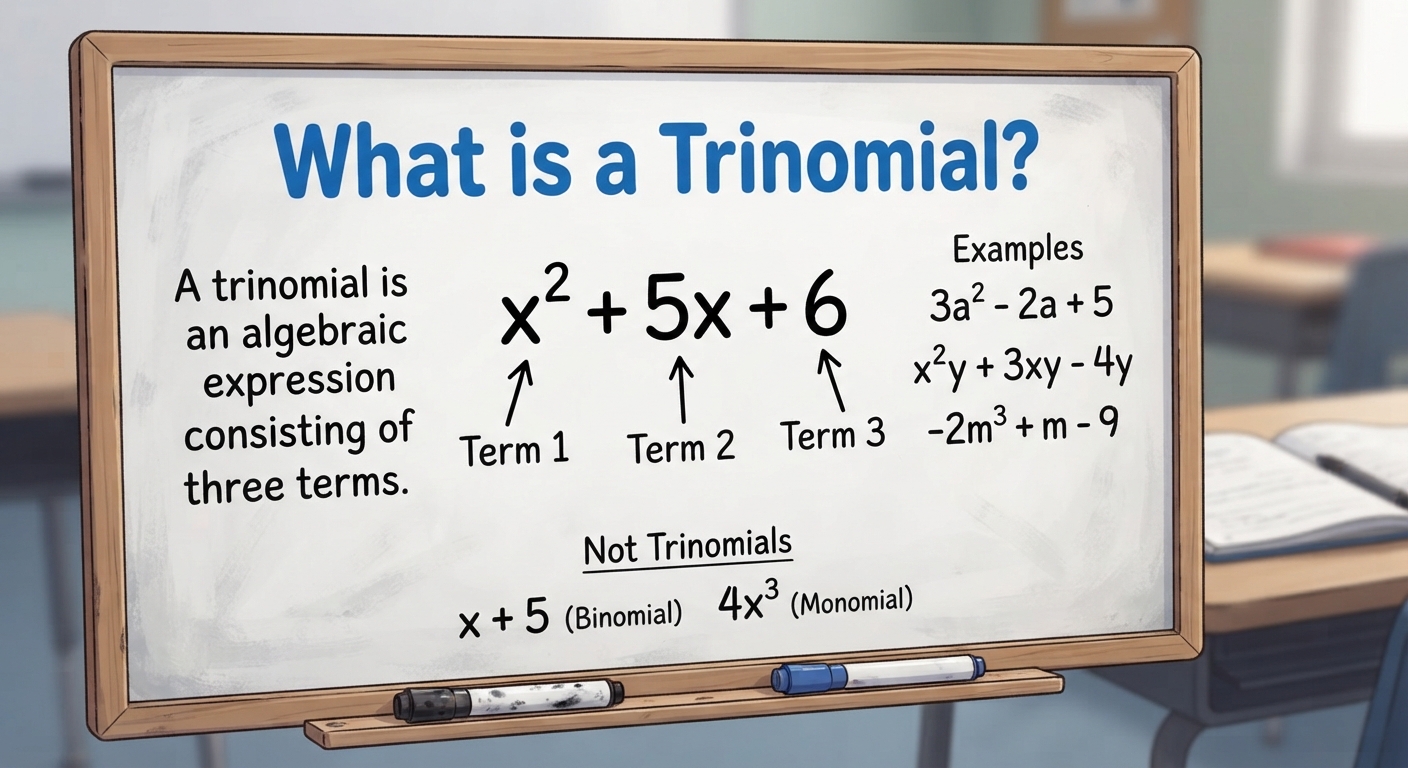
What Is A Trinomial? Definition And How To Factor
The short version
- A trinomial is a polynomial with exactly three terms, like x² + 5x + 6.
- Count terms only after combining like terms. x² + 3x + 2x looks like three terms but simplifies to x² + 5x, which is a binomial.
- Most trinomials in school are quadratic, written ax² + bx + c.
- To factor x² + bx + c, find two numbers that multiply to c and add to b. For x² + 7x + 12, that’s 3 and 4, so the answer is (x + 3)(x + 4).
- When the x² term has a number in front, like 2x² + 7x + 3, use the ac method: multiply a × c, split the middle term, and factor by grouping.
A trinomial is an algebraic expression with exactly three terms that are added or subtracted, where every exponent on a variable is a whole number. x² + 5x + 6 is a trinomial. So are 3a² – 2a + 1 and 4x + 2y – 3. The prefix “tri” means three, the same as in triangle and tricycle.
Knowing what a trinomial is takes about a minute. Factoring one is where homework gets stuck, so most of this post covers that: the quick method, the harder method, the special patterns, and the mistakes that cost points.
Monomial, binomial, trinomial: the naming chart
| Name | Number of terms | Examples |
|---|---|---|
| Monomial | 1 | 7, 4x, -3a²b |
| Binomial | 2 | x + 9, 4x² – 1 |
| Trinomial | 3 | x² + 5x + 6, 2y³ – y + 8 |
| Polynomial | any number | All of the above, plus x⁴ + x³ – x + 2 |
Every trinomial is a polynomial, but not every polynomial is a trinomial. After three terms, people usually just say “polynomial with four terms.”
What is and isn’t a trinomial
- x² + 3x + 2x isn’t one. Combine like terms first: x² + 5x has two terms.
- 5x + 1/x + 2 isn’t one. Dividing by x is a negative exponent (x to the -1), so it isn’t a polynomial at all.
- x⁴ + 3x² – 10 is one. Three terms, whole number exponents.
- ab + bc + ca is one. Trinomials can have more than one variable.
The degree of a trinomial
The degree is the highest exponent in any one term (for a term with more than one variable, add its exponents). It tells you what kind of trinomial you have.
- x² + 5x + 6 has degree 2. It’s a quadratic trinomial, the kind you’ll factor most.
- 5x³ – 2x + 8 has degree 3, a cubic trinomial.
- 4x + 2y – 3 has degree 1, a linear trinomial.
Standard form means writing the terms from highest exponent to lowest. 6 + x² + 5x in standard form is x² + 5x + 6.
How to factor a trinomial when a = 1
For x² + bx + c, you need two numbers that multiply to c and add to b.
Example 1: x² + 7x + 12
Factor pairs of 12: 1 and 12, 2 and 6, 3 and 4.
Which pair adds to 7? 3 + 4 = 7.
Answer: (x + 3)(x + 4)
Check by multiplying back: x² + 4x + 3x + 12 = x² + 7x + 12 ✓.
Example 2: x² – 2x – 15
You need two numbers that multiply to -15 and add to -2.
Since the product is negative, one number is positive and one is negative.
-5 × 3 = -15 and -5 + 3 = -2.
Answer: (x – 5)(x + 3)
Check: x² + 3x – 5x – 15 = x² – 2x – 15 ✓.
The sign shortcut
| Trinomial looks like | Signs of the two numbers | Example |
|---|---|---|
| x² + bx + c | Both positive | x² + 7x + 12 = (x + 3)(x + 4) |
| x² – bx + c | Both negative | x² – 7x + 12 = (x – 3)(x – 4) |
| x² + bx – c | Opposite signs, bigger one positive | x² + x – 12 = (x + 4)(x – 3) |
| x² – bx – c | Opposite signs, bigger one negative | x² – x – 12 = (x – 4)(x + 3) |
How to factor a trinomial when a isn’t 1
When there’s a number in front of x², the ac method (also called factoring by grouping) is the most reliable way.
Example 3: 2x² + 7x + 3
a = 2, b = 7, c = 3, so a × c = 6.
Find two numbers that multiply to 6 and add to 7: 6 and 1.
Split the middle term: 2x² + 6x + x + 3
Group: 2x(x + 3) + 1(x + 3)
Factor out (x + 3): (2x + 1)(x + 3)
Check: 2x² + 6x + x + 3 = 2x² + 7x + 3 ✓.
Example 4: 6x² – x – 2
a × c = 6 × -2 = -12.
Two numbers that multiply to -12 and add to -1: -4 and 3.
Split: 6x² – 4x + 3x – 2
Group: 2x(3x – 2) + 1(3x – 2)
Answer: (2x + 1)(3x – 2)
Check: 6x² – 4x + 3x – 2 = 6x² – x – 2 ✓.
Example 5: pull out a common factor first
3x² + 15x + 18
Every term is divisible by 3: 3(x² + 5x + 6)
Now factor the inside: 2 × 3 = 6 and 2 + 3 = 5
Answer: 3(x + 2)(x + 3)
Always look for a greatest common factor before anything else. It makes the numbers smaller and saves a lot of guessing.
Perfect square trinomials and trinomials that won’t factor
A perfect square trinomial is what you get when you square a binomial. The pattern is a² + 2ab + b² = (a + b)², or a² – 2ab + b² = (a – b)².
How to spot one: the first and last terms are perfect squares, and the middle term is twice their square roots multiplied together.
- x² + 10x + 25: x² and 25 are squares of x and 5, and 2 × x × 5 = 10x. So it’s (x + 5)².
- 4x² – 12x + 9: 4x² and 9 are squares of 2x and 3, and 2 × 2x × 3 = 12x. So it’s (2x – 3)².
Some trinomials don’t factor using whole numbers. x² + 3x + 5 is one: the only factor pair of 5 is 1 and 5, and they add to 6, not 3. Teachers call these prime, and once you’ve checked every pair, “prime” is a correct answer.
Common mistakes with trinomials
- Counting terms before combining. x² + 2x + 4x is a binomial in disguise.
- Finding numbers that multiply to c but ignoring the sum. For x² + 7x + 12, the pair 2 and 6 multiplies to 12 but adds to 8.
- Losing a negative sign. x² – 2x – 15 is (x – 5)(x + 3), not (x + 5)(x – 3). Multiply back and the middle term tells you which.
- Using the a = 1 shortcut when a isn’t 1. 2x² + 7x + 3 is not (x + 6)(x + 1).
- Forgetting the GCF in the final answer. 3x² + 15x + 18 factors to 3(x + 2)(x + 3). Dropping the 3 changes the expression.
- Not checking. Multiplying the factors back together takes a few seconds and catches almost every error above.
Practice problems
- Is 4x² – 9 a trinomial?
- Is 2x + 5x + x² a trinomial?
- What is the degree of 5x³ – 2x + 8?
- Factor x² + 9x + 20.
- Factor x² – x – 12.
- Factor x² – 10x + 21.
- Factor 3x² + 11x + 6.
- Factor 2x² + 8x – 42 completely.
Answers
- No. It has two terms, so it’s a binomial.
- No. 2x + 5x combines to 7x, leaving x² + 7x, a binomial.
- 3. It’s a cubic trinomial.
- (x + 4)(x + 5), since 4 × 5 = 20 and 4 + 5 = 9.
- (x – 4)(x + 3), since -4 × 3 = -12 and -4 + 3 = -1.
- (x – 3)(x – 7), since -3 × -7 = 21 and -3 + -7 = -10.
- (3x + 2)(x + 3). a × c = 18, and 9 + 2 = 11, so 3x² + 9x + 2x + 6 = 3x(x + 3) + 2(x + 3).
- 2(x + 7)(x – 3). Take out 2 to get 2(x² + 4x – 21), then 7 × -3 = -21 and 7 + -3 = 4.
If your kid is stuck on trinomials
Factoring trinomials is an Algebra 1 topic, but the skill it leans on hardest is from third and fourth grade: knowing multiplication facts and factor pairs cold. A kid who has to work out 6 × 7 every time will find factoring slow and frustrating, because the whole method is a search through factor pairs.
The other usual gaps:
- Integer signs. Most factoring errors are sign errors.
- The distributive property. Factoring is distributing in reverse. If (x + 3)(x + 4) doesn’t feel like something they could multiply out, factoring won’t make sense either.
You can see when those skills should be in place in math skills by grade level. We also explain why struggling with algebra so often starts years earlier. And because factoring rewards fast recall, a little practice every day works better than one long session.
Frequently asked questions
What’s a trinomial in math?
It’s a polynomial with exactly three terms, such as x² + 5x + 6. The terms are separated by plus or minus signs, and the exponents are whole numbers.
What is the difference between a binomial and a trinomial?
A binomial has two terms, like x + 4. A trinomial has three, like x² + 5x + 4. Multiplying two binomials often gives you a trinomial: (x + 1)(x + 4) = x² + 5x + 4.
Is x² + 2x + 1 a trinomial?
Yes. It’s a perfect square trinomial, because it equals (x + 1)².
How do you factor a trinomial with a leading coefficient?
Take out any common factor first. Then use the ac method: multiply a by c, find two numbers that multiply to that product and add to b, split the middle term into those two pieces, and factor by grouping.
Can every trinomial be factored?
No. Some, like x² + x + 1, have no factors with whole numbers. You can still solve equations with them using the quadratic formula.
Find the actual gap
When factoring feels impossible, multiplication facts or negative numbers are often what’s slowing everything down. Math Anon opens with a short adaptive assessment that identifies exactly which skills are missing and writes them up in a report for you.
Then your kid does about 20 minutes a day of practice aimed at those skills, and you get a progress report every week. The assessment is $49, credited back in full when you start your first month. Start the assessment or take a look at pricing.





