
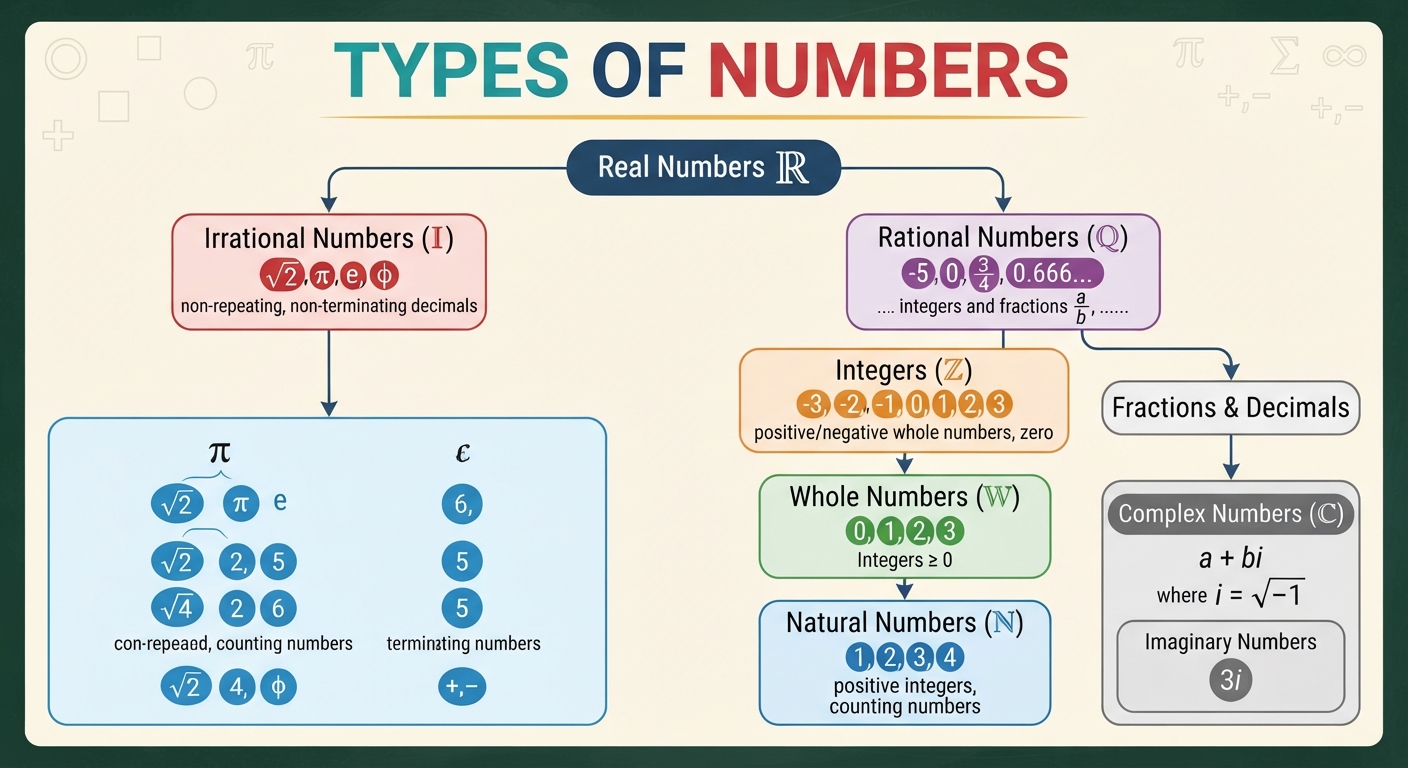
Types Of Numbers, Explained
The short version
- The main types of numbers are natural, whole, integers, rational, irrational, real and imaginary. Most of them sit inside each other like nesting boxes, so one number usually belongs to several types at once.
- Natural numbers are 1, 2, 3 and up. Add zero and you have whole numbers. Add the negatives and you have integers.
- Rational numbers are anything you can write as a fraction of two integers, which includes every integer, every terminating decimal and every repeating decimal.
- Irrational numbers, like π and √2, run forever without repeating and can’t be written as a fraction. Rationals and irrationals together make up the real numbers.
- Imaginary numbers come from square roots of negatives, built on i = √-1. They sit outside the real numbers entirely.
The types of numbers in math are categories that describe what a number is made of and what you can do with it. The number 7 is a natural number, a whole number, an integer, a rational number and a real number all at once. That sounds like a trick, but it’s just how the categories stack: each one contains the one before it.
Once you see the nesting, classification questions stop being memorization. You ask a short series of yes or no questions about a number and the answer falls out.
Every type of number in one table
| Type | What it includes | Examples | Not included |
|---|---|---|---|
| Natural | Counting numbers from 1 up | 1, 2, 3, 48 | 0, -5, 1/2 |
| Whole | Natural numbers plus zero | 0, 1, 2, 3 | -5, 1/2, 0.3 |
| Integers | Whole numbers plus the negatives | -7, -1, 0, 4 | 1/2, 0.3, π |
| Rational | Anything writable as a fraction of integers | 3/4, -2, 0.25, 0.666… | π, √2 |
| Irrational | Decimals that never end and never repeat | π, √2, √10 | 0.5, 9/4 |
| Real | Every rational and irrational number | -3, 0.5, π | √-4 |
| Imaginary | Square roots of negative numbers | i, 3i, √-9 | any real number |
How the types of numbers nest
Picture five boxes, each inside the next. Natural numbers sit in the smallest box. Whole numbers are that box plus zero. Integers are that box plus the negatives. Rational numbers are that box plus every fraction. Real numbers are that box plus the irrationals, which sit alongside the rationals rather than inside them.
So every natural number is also a whole number, an integer, a rational and a real. It doesn’t work in reverse. Here’s what that looks like for a few specific numbers.
| Number | Natural | Whole | Integer | Rational | Real |
|---|---|---|---|---|---|
| 9 | Yes | Yes | Yes | Yes | Yes |
| 0 | No | Yes | Yes | Yes | Yes |
| -4 | No | No | Yes | Yes | Yes |
| 3/8 | No | No | No | Yes | Yes |
| π | No | No | No | No | Yes |
One naming warning. In most American classrooms, natural numbers start at 1 and whole numbers start at 0. Some textbooks, especially outside the United States, include 0 in the natural numbers. If your child’s answer disagrees with a worksheet, check which convention the class uses before assuming the answer is wrong.
Rational or irrational? Use the decimal
This is the split that causes the most confusion, and there’s a reliable test. Write the number as a decimal and look at what happens after the point.
If it stops, the number is rational. 0.75 stops, and 0.75 = 3/4.
If it repeats a pattern forever, the number is rational. 0.666… = 2/3, and 0.454545… = 5/11.
If it runs forever with no repeating pattern, the number is irrational. √2 = 1.41421356… and π = 3.14159265… and neither one ever settles into a cycle.
A fraction is always rational, because “rational” comes from ratio. Every integer is rational too, since 6 can be written as 6/1. That surprises students who assume rational means “has a fraction bar in it.”
Square roots are the tricky case
A square root is irrational only when the number underneath isn’t a perfect square.
√16 = 4, which is rational.
√25 = 5, which is rational.
√10 = 3.16227766…, which is irrational.
√2 = 1.41421356…, which is irrational.
So the radical sign doesn’t decide anything on its own. Ask whether the number under it is a perfect square, and if it is, the root is a plain integer wearing a costume.
Where imaginary numbers come in
Squaring any real number gives a positive result or zero, since a negative times a negative is positive. That means no real number squares to -1, so √-1 has no answer among the reals.
Mathematicians named that missing value i, where i² = -1. Multiples of it, like 3i or -7i, are imaginary numbers. Combine a real part and an imaginary part and you get a complex number, written like 2 + 5i.
Students usually meet i in algebra 2, when quadratic equations turn up with no real solutions. The name is unfortunate. Imaginary numbers are as legitimate as any other type, and they do heavy lifting in electrical engineering and signal processing.
Common mistakes
Assuming every square root is irrational. √36 is 6, a whole number. Check for a perfect square first.
Assuming a fraction can’t be an integer. 8/2 equals 4, so it belongs in every box that 4 does. What matters is the value, not how it’s written.
Thinking π equals 22/7. 22/7 is 3.142857…, a repeating decimal and therefore rational. π is 3.141593…, irrational, and the two are close but not equal.
Calling a long decimal irrational. 0.123456789 ends, so it’s rational. Length isn’t the test. Whether it ends or repeats is the test.
Forgetting negatives are real numbers. “Real” doesn’t mean positive. -8 is a real number, an integer and a rational number.
Putting zero in the wrong box. Zero is a whole number, an integer, a rational and a real. In the usual American convention it isn’t a natural number.
Practice problems
1. Is -12 a whole number?
2. Name every set from the table that 8 belongs to.
3. Is 0.6 rational or irrational?
4. Is √49 rational or irrational?
5. Is √11 rational or irrational?
6. Classify 2 + 5i. Is it a real number?
7. Which is larger, 22/7 or π, and which one is rational?
8. Name a number that is an integer but not a natural number, and a number that is rational but not an integer.
Answers
1. No. Whole numbers start at 0 and go up. Since -12 is negative, it’s an integer, a rational and a real number, but not a whole number.
2. Natural, whole, integer, rational and real. Every one of them.
3. Rational. The decimal stops, and 0.6 = 6/10 = 3/5.
4. Rational. 49 is a perfect square, so √49 = 7.
5. Irrational. 11 isn’t a perfect square, and √11 = 3.31662479… with no repeating pattern.
6. It’s a complex number with a real part of 2 and an imaginary part of 5i. It is not a real number.
7. 22/7 is larger, at 3.142857… against π at 3.141593… And 22/7 is the rational one, since its decimal repeats.
8. Any negative whole number works for the first, such as -5. Any fraction that doesn’t simplify to a whole number works for the second, such as 7/2.
What it means if your child is stuck on this
Number classification questions look like vocabulary, and parents often treat them that way. They aren’t. A child who can’t decide whether 3/8 is an integer is telling you something about their grasp of what a fraction is, and a child who calls every square root irrational is telling you their perfect squares aren’t memorized.
Watch which specific questions go wrong. Trouble with negatives points to the number line. Trouble with fractions and decimals points to the single biggest gap we see, which is a shaky sense of what a fraction represents. That one doesn’t stay quiet either. We wrote about how algebra trouble usually traces back to fourth grade fractions, and classification questions are often the first visible symptom. For what should already be in place, see math skills by grade level, and 12 signs your child is behind in math helps you tell a gap from a bad week.
Frequently asked questions
How many types of numbers are there?
School math covers seven main types of numbers: natural, whole, integers, rational, irrational, real and imaginary. Beyond those, mathematicians use more categories, but these are the ones that appear on tests from elementary school through algebra 2.
What is the difference between whole numbers and natural numbers?
Zero. Natural numbers are the counting numbers 1, 2, 3 and up. Whole numbers are the same list with 0 added at the front. Neither includes negatives or fractions.
Are all fractions rational numbers?
Yes, as long as the top and bottom are integers and the bottom isn’t zero. That’s the definition of rational. Something like π/2 is written with a fraction bar but isn’t rational, because π isn’t an integer.
Is every real number rational?
No. Real numbers split into two groups: rational and irrational. π, √2 and √10 are all real numbers that no fraction can produce.
What type of number is zero?
Zero is a whole number, an integer, a rational number and a real number. Under the convention used in most American classrooms it is not a natural number, since counting starts at 1.
Can a number belong to more than one type?
Almost every number does. Because the categories nest inside each other, the number 5 is natural, whole, integer, rational and real simultaneously. Classification questions usually want the smallest category that fits, or a complete list, so read the wording carefully.
Find the actual gap
If these questions keep going wrong, the fix isn’t more flashcards with the word “rational” on them. Something underneath is loose, usually fractions, negatives or perfect squares, and finding out which one takes a proper look. Math Anon starts with a short adaptive assessment that identifies the exact skills your child is missing and sends you a written report in plain language.
After that it’s roughly 20 minutes of daily practice pointed at those skills, and a weekly progress report so you can see movement instead of guessing. Start the assessment for $49, which we credit back in full on your first month. The pricing page covers the rest, and what math tutoring costs is worth a look if you’re comparing options.
Related reading
- Struggling With Algebra? The Real Problem Is Usually Fourth Grade Fractions
- Math Skills By Grade Level: What Your Child Should Know
- Is My Child Behind In Math? 12 Signs By Grade Level
- Mind The Gap: A Parent’s Guide To Math Assessment For Kids
- Math Anxiety In Children: What It Looks Like And What Helps





