
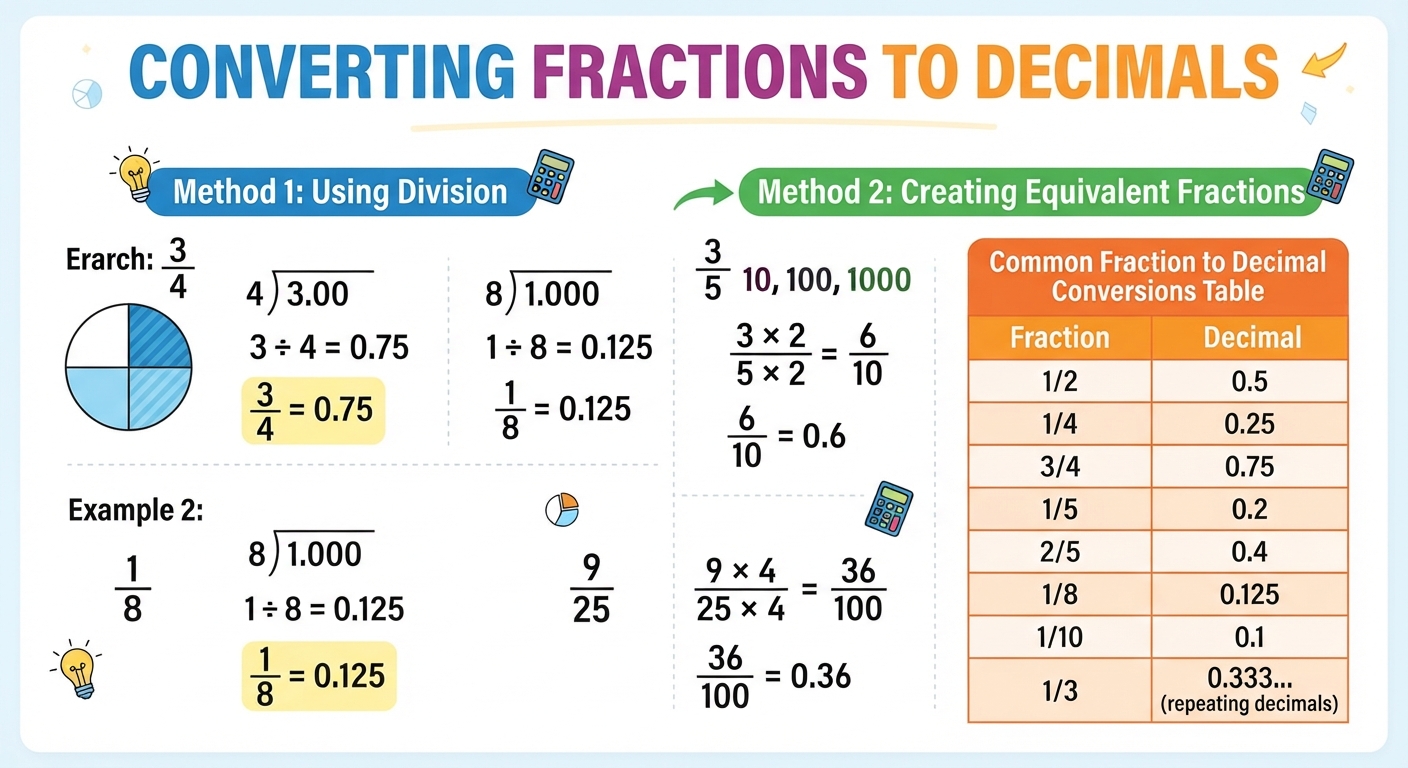
How To Convert Fractions To Decimals
The short version
- To convert fractions to decimals, divide the top number by the bottom number. 3 ÷ 8 = 0.375, so 3/8 = 0.375.
- Faster option: if the bottom scales up to 10, 100 or 1,000, scale the top by the same amount and read the decimal straight off. 7/20 becomes 35/100, which is 0.35.
- Some fractions never finish. 1/3 = 0.3333… forever, and those are called repeating decimals.
- Going backwards is a place value trick: 0.45 is 45 hundredths, so 45/100, which reduces to 9/20.
- Memorizing about a dozen common conversions saves your child more time on tests than any other fraction skill.
To convert fractions to decimals, divide the numerator by the denominator. The fraction bar already means divide, so 3/4 is another way of writing 3 ÷ 4, and that division gives 0.75. That one sentence handles every fraction you’ll ever meet, including the ugly ones.
There’s a shortcut worth knowing for fractions whose bottoms are friendly with 10, and a second skill for converting decimals back the other way. Both are below, with a chart of the conversions that show up most and practice at the end.
Method 1: divide to convert fractions to decimals
Set up the division with the numerator inside and the denominator outside, then add a decimal point and zeros to the top number as you need them.
Convert 3/8.
Set up 3 ÷ 8, and write 3 as 3.000
8 goes into 30 three times: 3 × 8 = 24, and 30 – 24 = 6
Bring down a zero. 8 goes into 60 seven times: 7 × 8 = 56, and 60 – 56 = 4
Bring down a zero. 8 goes into 40 five times exactly, remainder 0
Answer: 3/8 = 0.375
The decimal point in the answer sits directly above the one in 3.000. Kids who float it somewhere else get 3.75 or 37.5 and don’t notice, so make placing it the first move, not the last.
Mixed numbers get handled in pieces. For 2 1/4, leave the 2 alone, convert 1/4 to 0.25, and put them back together as 2.25.
Method 2: scale the denominator to 10, 100 or 1,000
Our number system is built on tens, so any fraction with a denominator of 10, 100 or 1,000 converts on sight. Tenths get one decimal place, hundredths get two, thousandths get three.
9/10 = 0.9
63/100 = 0.63
7/1000 = 0.007
When the denominator isn’t one of those but divides into one, multiply top and bottom by the same number.
Convert 7/20. 20 × 5 = 100, so multiply both parts by 5: 7 × 5 = 35, giving 35/100 = 0.35.
Convert 3/5. 5 × 2 = 10, so 3 × 2 = 6, giving 6/10 = 0.6.
This works for denominators of 2, 4, 5, 8, 10, 16, 20, 25, 40, 50 and a few others. It does not work for 3, 6, 7, 9 or 11, because no amount of multiplying turns those into a power of ten. Those are exactly the fractions that repeat.
Conversions worth memorizing
These come up constantly on tests, in recipes and in prices. A student who knows them cold stops burning time on division.
| Fraction | Decimal | Fraction | Decimal |
|---|---|---|---|
| 1/2 | 0.5 | 1/8 | 0.125 |
| 1/3 | 0.333… | 3/8 | 0.375 |
| 2/3 | 0.666… | 5/8 | 0.625 |
| 1/4 | 0.25 | 7/8 | 0.875 |
| 3/4 | 0.75 | 1/10 | 0.1 |
| 1/5 | 0.2 | 1/16 | 0.0625 |
| 2/5 | 0.4 | 1/20 | 0.05 |
| 1/6 | 0.1666… | 1/100 | 0.01 |
Repeating decimals
Divide 1 by 3 and the remainder is 1 every single time, so the answer is 0.33333… with no end. That’s a repeating decimal, and it’s written with three dots or with a bar over the repeating digits.
1/3 = 0.333…
2/3 = 0.666…
5/6 = 0.8333…
1/7 = 0.142857142857…
When a problem asks for a rounded answer, round the way it says. 2/3 to two decimal places is 0.67, because the next digit is 6. Writing 0.66 is the usual error.
The clue for spotting a repeater before you divide: reduce the fraction first, then look at the denominator. If its only prime factors are 2s and 5s, the decimal ends. Anything else, like a 3 or a 7, and it repeats forever.
Turning decimals back into fractions
Read the decimal out loud and you’ve said the fraction. Then reduce.
0.6 is six tenths, so 6/10, which reduces to 3/5.
0.45 is forty five hundredths, so 45/100. Divide both by 5 to get 9/20.
0.125 is 125 thousandths, so 125/1000. Divide both by 125 to get 1/8.
2.75 keeps the 2 and converts the rest: 75/100 = 3/4, so 2 3/4.
The count of decimal places tells you the denominator. One place is tenths, two places is hundredths, three is thousandths. No counting on fingers required.
Common mistakes
Dividing the wrong way. For 3/8, kids divide 8 by 3 because 8 is bigger, and get 2.666 instead of 0.375. The top number always goes inside the division bracket. A sanity check helps: 3/8 is less than 1, so the answer has to start with a 0.
Losing the decimal point. Writing 375 or 3.75 instead of 0.375. Line the point up before dividing.
Stopping after one zero. A student divides 3 by 8, sees a remainder, and writes “0.3 remainder 6.” Keep bringing down zeros until the remainder is 0 or a pattern shows up.
Multiplying only the denominator. Turning 7/20 into 7/100 = 0.07. Whatever you do to the bottom has to happen to the top.
Rounding a repeater down by habit. 2/3 rounded to hundredths is 0.67, not 0.66.
Practice problems
Convert 1 through 6 to decimals. Convert 7 and 8 to fractions in lowest terms.
1. 1/4
2. 3/5
3. 7/8
4. 9/20
5. 2/3, rounded to two decimal places
6. 11/16
7. 0.35
8. 1.6
Answers
1. 1 ÷ 4 = 0.25. Or scale: 1/4 = 25/100.
2. 5 × 2 = 10, so 3/5 = 6/10 = 0.6.
3. 7 ÷ 8 = 0.875. Check: 0.875 × 8 = 7.
4. 20 × 5 = 100, so 9 × 5 = 45, giving 45/100 = 0.45.
5. 2 ÷ 3 = 0.666…, which rounds to 0.67.
6. 11 ÷ 16 = 0.6875. Check: 0.6875 × 16 = 11.
7. 0.35 is 35 hundredths, so 35/100. Divide both by 5: 7/20.
8. 1.6 is 1 and 6 tenths, so 6/10 reduces to 3/5, giving 1 3/5, or 8/5 as an improper fraction.
What it means if your kid is stuck here
This topic sits on top of two older skills, and a child who struggles with it is usually missing one of them rather than the conversion rule itself.
The first is division with decimals in the answer. If long division is still shaky, adding a decimal point and trailing zeros makes it worse, and the whole lesson collapses into an arithmetic problem. The second is place value past the decimal point. A student who can’t say what the 5 in 0.45 is worth has no way to go backwards from decimals to fractions, because that direction is nothing but naming place values.
Fifth and sixth grade is where this bites, because fractions, decimals and percents start being treated as the same thing in three costumes. If your child can do each separately but jams when a problem switches between them, that’s the gap. The grade level skill checklist shows where this was supposed to land, and the signs of being behind help you tell a rough week from a real hole. Left alone, this one follows kids straight into algebra, where fraction fluency decides almost everything.
Frequently asked questions
What is the fastest way to convert a fraction to a decimal?
Check the denominator first. If it scales to 10, 100 or 1,000, multiply and read it off, which takes seconds. If it doesn’t, divide the top by the bottom.
How do you convert a fraction to a decimal without a calculator?
Long division. Write the numerator with a decimal point and a few zeros, divide by the denominator, and keep bringing down zeros until the remainder hits 0 or the digits start repeating.
Why do some fractions never end as decimals?
Because the division never reaches a remainder of 0. Reduce the fraction, then look at the denominator: if it’s built only from 2s and 5s, the decimal ends. Any other prime factor makes it repeat.
How do you turn a repeating decimal back into a fraction?
The common ones are worth knowing outright: 0.333… is 1/3, 0.666… is 2/3, and 0.1666… is 1/6. There’s an algebra method for the rest, and students meet it around eighth grade.
What grade do kids convert fractions to decimals?
Fourth grade introduces fractions with denominators of 10 and 100 as decimals. Fifth and sixth grade cover the division method and the link between fractions, decimals and percents.
Is 0.5 the same as 1/2?
Yes. They’re two ways of writing the same amount, the way “a half” and “50%” are. Any fraction has a decimal twin and the other way round.
Find the actual gap
Fraction and decimal trouble rarely starts where you notice it. Math Anon begins with a short adaptive assessment that changes as your child works, so it can tell the difference between a shaky conversion rule and a division or place value hole two grades back. You get a written report naming exactly what came up short.
From there your child practices about 20 minutes a day on those precise skills, and a weekly progress report shows which ones have closed. The assessment is $49 and we credit it back in full on your first month. Start the assessment or check pricing first.





