
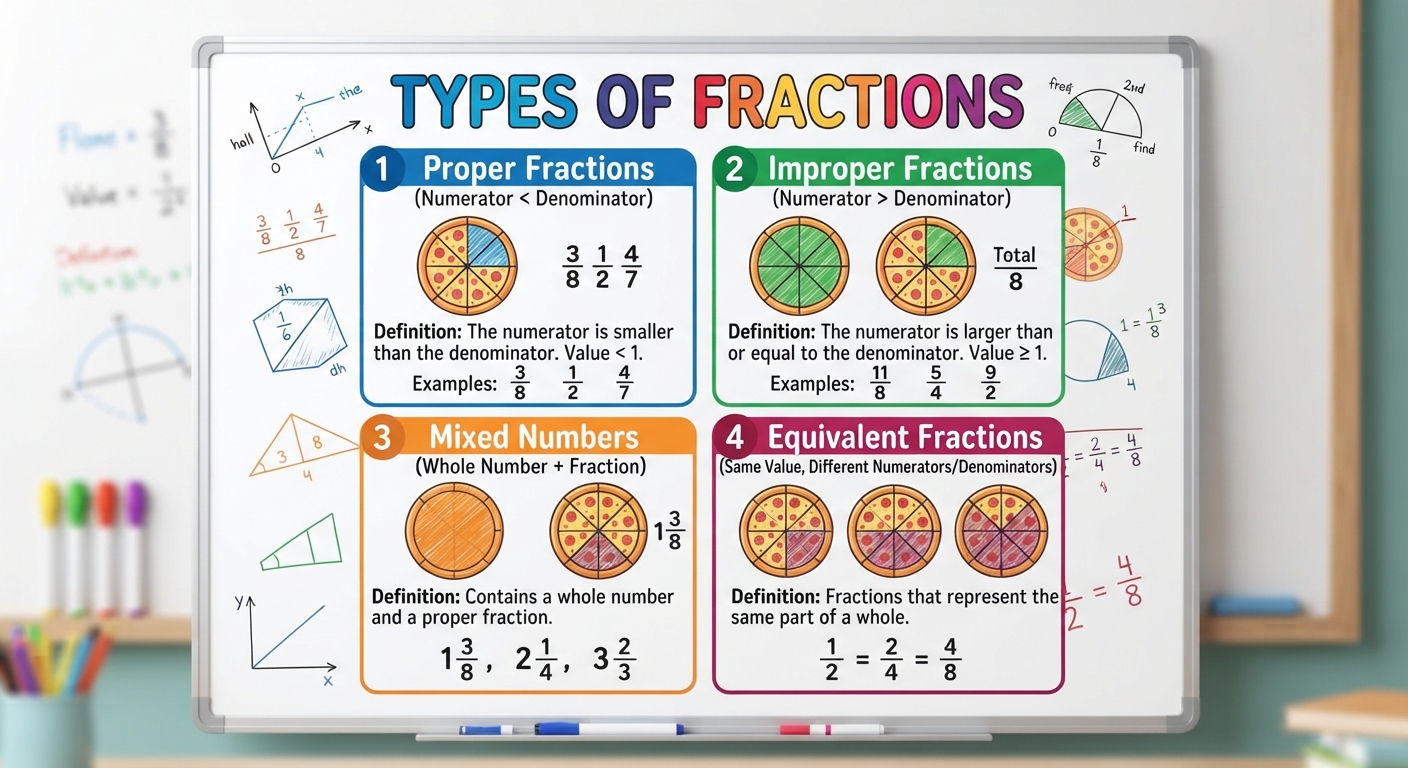
Types Of Fractions, Explained
The short version
- There are four types of fractions based on the numbers themselves: proper, improper, mixed and unit.
- There are three more that describe how two fractions relate: like, unlike and equivalent.
- Proper means the top is smaller than the bottom, so the value is under 1. Improper means the top is equal to or bigger than the bottom, so the value is 1 or more.
- The type isn’t trivia. It decides what you’re allowed to do next. You can only add or subtract fractions once they’re like fractions.
- Every fraction is also a decimal and a percent. Kids who see those as three separate subjects end up doing three times the work.
The types of fractions fall into two groups. One group sorts a single fraction by how its numerator compares to its denominator: proper, improper, mixed and unit. The other group compares two or more fractions to each other: like, unlike and equivalent.
A fraction is a division problem written with the top number, the numerator, over the bottom number, the denominator. The denominator says how many equal pieces the whole was cut into. The numerator says how many of those pieces you have. Everything below comes from that one idea.
The four types of fractions by value
Proper fractions
The numerator is smaller than the denominator, so the fraction is worth less than 1. Examples: 3/4, 5/9, 11/20. Cut a pizza into 8 slices and take 3, and you have 3/8 of a pizza, which is clearly less than a whole one.
Improper fractions
The numerator is equal to or larger than the denominator, so the value is 1 or more. Examples: 7/4, 9/2, 5/5. The word “improper” makes students think something is wrong with these. Nothing is. 7/4 is a perfectly good number, and in algebra it’s the form you actually want.
Mixed numbers
A whole number sitting next to a proper fraction, like 1 3/4 or 2 1/2. It’s the same value as an improper fraction wearing different clothes: 1 3/4 and 7/4 are the same amount. Recipes and rulers use mixed numbers because people think in wholes plus leftovers.
Unit fractions
The numerator is exactly 1: 1/2, 1/5, 1/16. These are the building blocks. Every other fraction is a pile of unit fractions, since 3/8 is just three copies of 1/8. That framing makes a lot of fraction work click, so it’s worth saying out loud to a kid who’s struggling.
The three types that compare fractions
Like fractions
Same denominator. 2/9 and 5/9 are like fractions. They’re already cut into the same size pieces, so adding them is as easy as counting: 2/9 + 5/9 = 7/9. The bottom number stays put.
Unlike fractions
Different denominators. 1/3 and 1/4 are unlike fractions. You can’t add them as they stand, because the pieces are different sizes. Rewrite both with a common denominator of 12 first: 4/12 + 3/12 = 7/12.
Equivalent fractions
Different numbers, same value. 1/2, 2/4, 3/6 and 50/100 are all equivalent. Multiply or divide the top and bottom by the same number and the value doesn’t change, because you’re only re-slicing the same amount. This is the engine behind common denominators and behind reducing to lowest terms.
All the types of fractions in one table
| Type | The test | Examples | Where it matters |
|---|---|---|---|
| Proper | Top smaller than bottom | 3/4, 5/9 | Value is between 0 and 1 |
| Improper | Top equal to or bigger than bottom | 7/4, 5/5 | Multiplying and dividing fractions |
| Mixed number | Whole number plus a proper fraction | 1 3/4, 2 1/2 | Measuring, recipes, final answers |
| Unit | Numerator is 1 | 1/2, 1/16 | Building and comparing other fractions |
| Like | Two fractions, same denominator | 2/9 and 5/9 | Adding and subtracting |
| Unlike | Two fractions, different denominators | 1/3 and 1/4 | Finding a common denominator |
| Equivalent | Two fractions, same value | 1/2 and 3/6 | Reducing and rewriting |
Switching between improper fractions and mixed numbers
Improper to mixed: divide the top by the bottom. The quotient is the whole number, the remainder is the new numerator, and the denominator doesn’t move.
Convert 11/4. 11 ÷ 4 = 2 with a remainder of 3, so 11/4 = 2 3/4.
Mixed to improper: multiply the whole number by the denominator, add the numerator, keep the denominator.
Convert 3 2/7. 3 × 7 = 21, plus 2 = 23, so 3 2/7 = 23/7.
Why the type changes what you do
This is the part most fraction lessons skip, and it’s the reason the vocabulary exists at all.
Adding and subtracting need like fractions. If the denominators don’t match, that’s step one, every time. Multiplying and dividing don’t care about matching denominators, but they do hate mixed numbers, so convert those to improper fractions first. Trying to multiply 1 1/2 × 2 1/3 while it’s still in mixed form is how students end up with 2 1/6 instead of 3 1/2.
Comparing is where equivalent fractions earn their keep. Is 5/8 bigger than 3/5? Rewrite both over 40: 25/40 and 24/40. Yes, by one fortieth.
Every fraction is also a decimal and a percent
Fractions, decimals and percents are three ways of writing the same thing, and the type of fraction tells you what to expect.
| Fraction | Decimal | Percent |
|---|---|---|
| 1/2 | 0.5 | 50% |
| 3/4 | 0.75 | 75% |
| 1/5 | 0.2 | 20% |
| 1/8 | 0.125 | 12.5% |
| 7/4 | 1.75 | 175% |
Divide the top by the bottom to get the decimal, then move the point two places right for the percent. Notice that improper fractions land above 100%, which is a fast way to check whether an answer makes sense.
Common mistakes
Thinking improper fractions are errors. They’re a valid form and often the better one. Nobody multiplies mixed numbers on purpose.
Missing that 5/5 is improper. The rule is top equal to or bigger than bottom, so any fraction equal to 1 counts. 5/5, 12/12 and 100/100 are all improper, and all equal 1.
Adding denominators. 1/4 + 1/4 becomes 2/8. The pieces don’t change size when you collect more of them, so the right answer is 2/4, which reduces to 1/2.
Assuming a bigger denominator means a bigger fraction. 1/8 is smaller than 1/3, because slicing a pizza into more pieces makes each one smaller. This one confuses kids for years.
Multiplying only the top when making equivalent fractions. Turning 2/5 into 8/5 instead of 8/20. Whatever you do above the bar happens below it.
Dropping the whole number. Converting 3 2/7 and answering 2/7. The 3 is most of the value.
Practice problems
1. Is 5/9 proper or improper?
2. Name the type: 1/12.
3. Are 5/8 and 3/8 like or unlike fractions?
4. Write 11/4 as a mixed number.
5. Write 3 2/7 as an improper fraction.
6. Write a fraction equivalent to 2/5 with a denominator of 20.
7. Are 3/4 and 9/12 equivalent? Show why.
8. What type is 7/7, and what does it equal?
Answers
1. Proper, since 5 is less than 9.
2. A unit fraction, because the numerator is 1. It’s also proper.
3. Like, because both denominators are 8.
4. 11 ÷ 4 = 2 remainder 3, so 2 3/4.
5. 3 × 7 = 21, and 21 + 2 = 23, so 23/7.
6. 5 × 4 = 20, so multiply the top by 4 as well: 2 × 4 = 8, giving 8/20.
7. Yes. Multiply 3/4 top and bottom by 3 and you get 9/12. Both equal 0.75.
8. Improper, since the top equals the bottom. It equals 1.
What it means if your kid is stuck on fractions
Fraction vocabulary is easy to memorize and easy to fake. A student can label seven types correctly on Monday and still lose points all week, because naming a fraction and understanding what it’s worth are different skills.
Watch for two specific signs. If your child can’t place 3/8 and 1/2 on a number line, the problem is that fractions still read as two separate whole numbers rather than one value. If they can convert 11/4 to 2 3/4 but can’t say which is bigger, 2/3 or 3/5, the missing piece is equivalent fractions and common denominators. Both are fourth and fifth grade skills, and both get quietly carried forward.
They matter later than parents expect. Fraction fluency is the single best predictor of how algebra goes, because every rational expression is a fraction with letters in it. If you want to see where your child should be right now, the grade by grade skill list lays it out, and the signs of falling behind help you judge how urgent it is.
Frequently asked questions
How many types of fractions are there?
Seven names come up in school math: proper, improper, mixed, unit, like, unlike and equivalent. The first four describe one fraction. The last three describe how fractions compare.
What is the difference between a proper and an improper fraction?
A proper fraction has a numerator smaller than its denominator and is worth less than 1, like 3/4. An improper fraction has a numerator equal to or greater than its denominator and is worth 1 or more, like 7/4 or 5/5.
Is a mixed number a fraction?
It’s a whole number joined to a proper fraction, and it names the same value as an improper fraction. 2 1/2 and 5/2 are the same amount written two ways.
What is a unit fraction used for?
Unit fractions are the pieces everything else is built from. Seeing 5/6 as five copies of 1/6 makes comparing, adding and drawing fractions much easier for younger students.
How do you know if two fractions are equivalent?
Cross multiply. For 3/4 and 9/12, check 3 × 12 = 36 and 4 × 9 = 36. Equal products mean equivalent fractions. You can also reduce both and see whether they match.
What grade do kids learn the types of fractions?
Third grade introduces fractions and unit fractions. Fourth grade adds equivalent fractions, mixed numbers and improper fractions. Fifth and sixth grade push into operations with unlike denominators.
Find the actual gap
Knowing the names of fraction types and being able to use them are two different things, and a report card grade won’t tell you which one your child has. Math Anon starts with a short adaptive assessment that adjusts as they answer, then gives you a written report naming the exact skills that came back weak, whether that’s comparing fractions, common denominators or something from two grades earlier.
Then it’s roughly 20 minutes of daily practice pointed at those skills, with a weekly progress report so nothing stays vague. The assessment costs $49 and gets credited back in full against your first month. Start the assessment, or read the pricing page first.





