
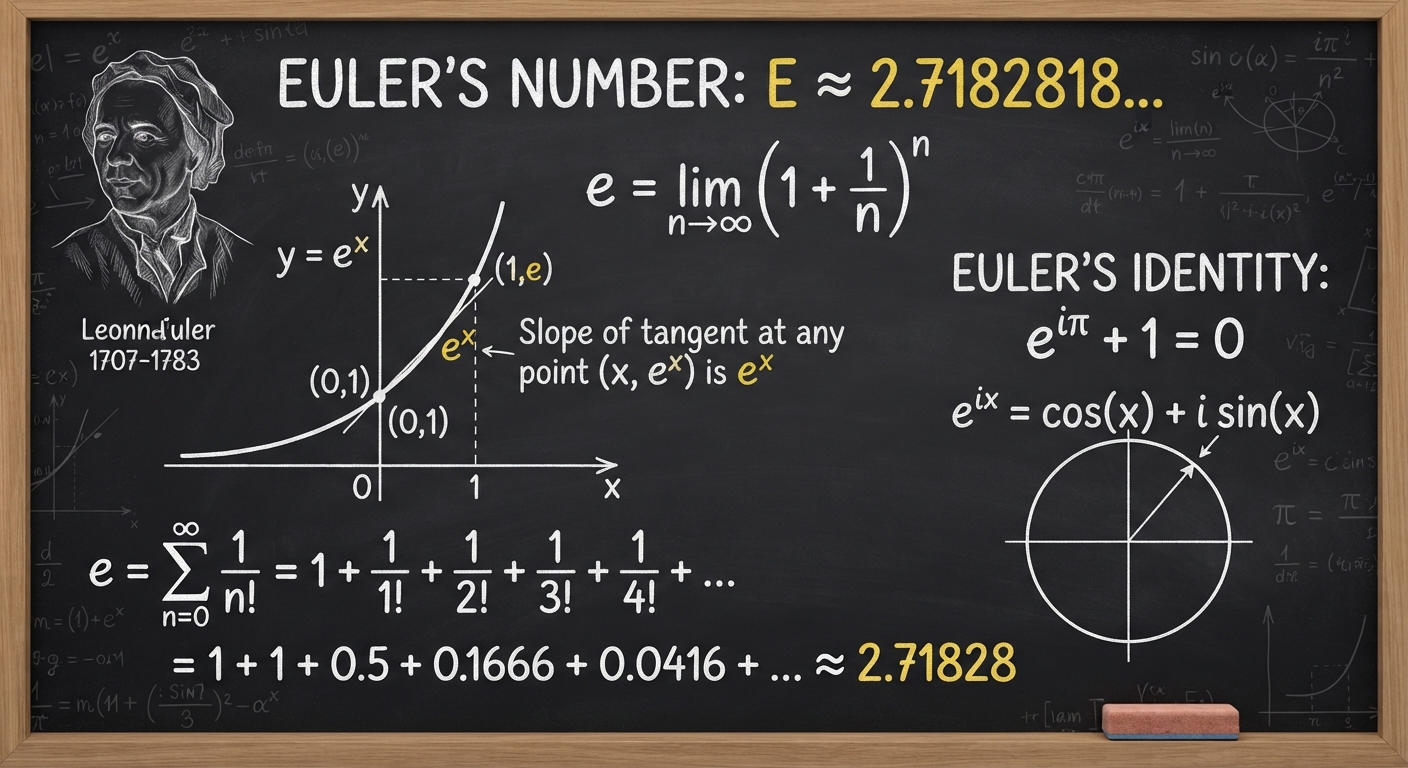
What Is Euler’s Number? Meet e In Math
The short version
- Euler’s number, written e, is about 2.71828. It never ends and never repeats, the same way pi doesn’t.
- It came out of a question about compound interest: what happens to your money if the bank adds interest every second instead of once a year?
- e is the base of natural logarithms, so ln(x) means log base e of x.
- Anything that grows or shrinks at a rate tied to its own size, like money, bacteria or a radioactive sample, gets described with e.
- Students usually meet e in Algebra 2 or precalculus, and it shows up everywhere in calculus.
Euler’s number is the constant e, roughly 2.718281828. It’s an irrational number, which means the decimals run forever with no repeating pattern, so you can’t write it as a fraction. It’s named for the Swiss mathematician Leonhard Euler, who gave it the letter e and worked out much of what it does.
The quick answer to why anybody cares: e is the natural rate of growth. When something grows continuously instead of in jumps, e is the number that falls out of the math. That makes it the base of natural logarithms and a fixture in every formula about growth, decay and interest.
Where Euler’s number comes from
Start with a bank account that pays a wildly generous 100% interest per year. Put in $1. After one year you have $2.
Now the bank pays 50% twice a year instead. After six months: $1 × 1.5 = $1.50. After twelve: $1.50 × 1.5 = $2.25. Splitting the interest into smaller, more frequent chunks earned you more, because the interest starts earning interest.
Keep splitting. The formula for n payments a year is (1 + 1 ÷ n)n.
| How often interest is added | n | End of year balance on $1 |
|---|---|---|
| Once a year | 1 | $2.00000 |
| Twice a year | 2 | $2.25000 |
| Quarterly | 4 | $2.44141 |
| Monthly | 12 | $2.61304 |
| Daily | 365 | $2.71457 |
| Hourly | 8,760 | $2.71813 |
| Every instant | infinite | $2.71828… |
The balance climbs, but it doesn’t run away. It closes in on 2.71828… and stops. That ceiling is e. Jacob Bernoulli spotted this in the 1680s while studying compound interest, decades before Euler named the constant.
The other way to build e
You can also add up a string of fractions built from factorials, where 4! means 4 × 3 × 2 × 1:
e = 1 + 1/1! + 1/2! + 1/3! + 1/4! + …
Run the totals and watch them settle:
1 + 1 = 2
plus 1/2 = 2.5
plus 1/6 = 2.6666667
plus 1/24 = 2.7083333
plus 1/120 = 2.7166667
Six terms and you’re already correct to two decimal places. The factorials in the bottom grow so fast that each new piece barely moves the total. This series is how calculators get e to as many digits as you want.
What makes e special
Plot y = 2x and the curve rises. Plot y = 3x and it rises faster. Somewhere between those two bases there’s a curve whose steepness at every point exactly equals its own height. That base is e.
In calculus that fact gets written as: the derivative of ex is ex. No other function does that. It’s the reason e sits at the center of anything involving rates of change, and the reason calculus teachers seem to reach for it constantly.
Natural logarithms
A logarithm asks “what exponent do I need?” Log base 10 of 1,000 is 3, because 10³ = 1,000. The natural log, written ln, asks the same question with base e.
So ln(e) = 1, because e¹ = e.
And ln(1) = 0, because e0 = 1.
And ln(e5) = 5.
The ln button on a calculator is there because so many real formulas use e as the base. Solving for time in a growth problem almost always means taking a natural log of both sides.
Where Euler’s number shows up
Continuously compounded interest: A = Pert, where P is the starting amount, r the rate as a decimal and t the time in years.
Worked example. Put $1,000 in an account paying 5% compounded continuously. How much after 3 years?
The exponent is r times t, so 0.05 × 3 = 0.15
e0.15 = 1.161834
A = 1000 × 1.161834 = $1,161.83
Radioactive decay and cooling use the same shape with a negative exponent, so the quantity shrinks toward zero instead of climbing. Population models, the spread of an illness, and the bell curve in statistics all have e buried in them. Continuous change keeps producing the same constant.
Common mistakes
Mixing up e the constant with e in scientific notation. On a calculator screen, 3e8 means 3 × 10⁸, not 3 × 2.718. Different button, different meaning.
Treating e like a variable. It’s a fixed number, as fixed as 7. You can’t solve for it or cancel it.
Rounding too early. Using 2.7 instead of the calculator’s e turns a $1,161.83 answer into something noticeably off. Round at the end.
Reading ex as e times x. The x is an exponent. e² is about 7.389, not 5.44.
Assuming ln and log are the same button. On most calculators log means base 10 and ln means base e. Swapping them quietly wrecks the answer.
Practice problems
Use e = 2.718281828 and round money to the nearest cent.
1. Round Euler’s number to three decimal places.
2. Compute (1 + 1 ÷ 4)4 and say whether it’s above or below e.
3. What is ln(1)?
4. What is e0?
5. Add the first five terms of 1 + 1/1! + 1/2! + 1/3! + 1/4! and round to four decimal places.
6. What is ln(e7)?
7. $5,000 is invested at 4% compounded continuously for 10 years. Find the balance.
8. A sample starts at 200 grams and decays by N = 200e-0.1t. How much is left after 5 years?
Answers
1. 2.718.
2. 1.254 = 1.25 × 1.25 × 1.25 × 1.25 = 2.44140625, which is below e.
3. 0, because e0 = 1.
4. 1. Any nonzero number to the power 0 is 1.
5. 1 + 1 + 0.5 + 0.1666667 + 0.0416667 = 2.7083.
6. 7. The natural log undoes e to a power.
7. Exponent is 0.04 × 10 = 0.4, and e0.4 = 1.4918247. So 5000 × 1.4918247 = $7,459.12.
8. Exponent is -0.1 × 5 = -0.5, and e-0.5 = 0.6065307. So 200 × 0.6065307 = 121.31 grams.
What it means if your kid is stuck on e
Almost nobody is actually stuck on Euler’s number itself. It’s one number. What trips students up is the machinery around it, and that machinery is older material.
If your child can’t finish an e problem, watch which step stalls. Trouble with ex usually means exponent rules never got solid. Trouble converting 5% to 0.05 means percents and decimals are shaky. Trouble isolating t after taking a natural log means equation solving from Algebra 1 and the fraction work underneath it is the real gap. Kids get pulled into advanced courses while the floor still has holes, and those holes only show when the problems get long.
The tell is a student who can define e perfectly and still gets the money question wrong. That’s an arithmetic and algebra problem wearing a fancy costume. If you want a sense of whether this is a one topic wobble or a pattern, the grade by grade signs of falling behind are worth twenty minutes of your evening.
Frequently asked questions
What is e in math?
e is a fixed irrational constant equal to about 2.718281828. It’s the base of natural logarithms and the base that makes exponential growth behave in the simplest possible way.
Why is it called Euler’s number?
Leonhard Euler used the letter e for it in the 1700s and published the work that made it standard. Jacob Bernoulli had already run into the value through compound interest, so Euler named and popularized a constant he didn’t discover alone.
Is e bigger than pi?
No. e is about 2.718 and pi is about 3.142. Both are irrational, both show up all over math, and they’re linked in one of the most famous equations there is.
What is the difference between ln and log?
ln is log base e. Plain log on a calculator is log base 10. They answer the same kind of question with different bases, and the answers differ by a constant factor.
What grade do students learn about e?
Usually Algebra 2 or precalculus, around 10th or 11th grade, when exponential functions and logarithms come up. It gets far more use in calculus.
Do you have to memorize e?
Knowing 2.718 is plenty for checking whether an answer is reasonable. Every calculator has an e button, and tests that care about the number give it to you.
Find the actual gap
When a student hits a wall in Algebra 2, the cause is usually sitting several grades back. Math Anon begins with a short adaptive assessment that adjusts as your child answers, narrowing in on the exact skills that never locked in. You get a written report that names them instead of a vague “needs work on algebra.”
After that it’s roughly 20 minutes of daily practice aimed at those specific skills, and a progress report each week showing what closed and what’s next. The assessment is $49 and we credit the whole thing back on your first month. Start the assessment or read the pricing details first.





