
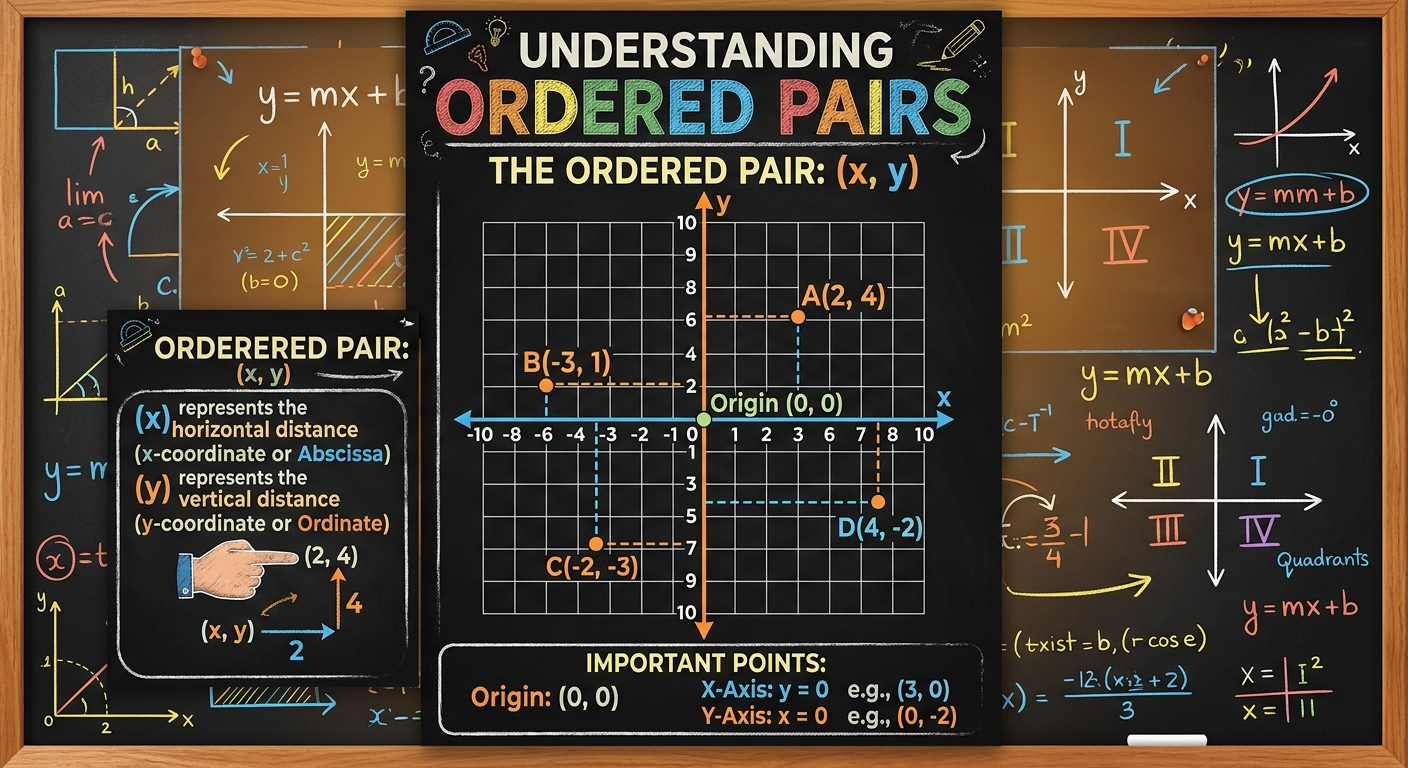
Ordered Pairs: How To Read, Plot And Use Them
The short version
- An ordered pair is two numbers written in parentheses, like (3, 5), that name one exact point on a graph. The first number is x (left or right), the second is y (up or down).
- Order matters: (3, 5) and (5, 3) are different points.
- To plot one, start at the origin (0, 0), move across by x, then up or down by y.
- The signs tell you the quadrant: (+, +) is I, (-, +) is II, (-, -) is III, and (+, -) is IV.
- Ordered pairs also show solutions to equations. (2, 7) solves y = 3x + 1 because 3 × 2 + 1 = 7.
Ordered pairs are pairs of numbers written as (x, y) that give the location of a point on a coordinate plane. The first number, x, says how far to move left or right from the center. The second number, y, says how far to move up or down. They’re called “ordered” because swapping the numbers gives you a different point.
Kids usually meet ordered pairs in fifth grade with positive numbers only, then add negatives in sixth grade, then use them to graph lines in seventh and eighth grade. This guide covers all of that with worked examples and practice problems.
How to read an ordered pair
Every ordered pair has the same shape: an opening parenthesis, the x-coordinate, a comma, the y-coordinate and a closing parenthesis.
| Ordered pair | x (across) | y (up/down) | In words |
|---|---|---|---|
| (4, 1) | 4 | 1 | 4 right, 1 up |
| (-2, 6) | -2 | 6 | 2 left, 6 up |
| (5, -3) | 5 | -3 | 5 right, 3 down |
| (0, -4) | 0 | -4 | no move across, 4 down |
| (0, 0) | 0 | 0 | the origin |
A memory trick kids like: you have to walk to the ladder before you can climb it. Across first, then up or down. Alphabetical order works too, since x comes before y.
How to plot ordered pairs, step by step
- Put your pencil on the origin, where the two axes cross.
- Read the first number. Positive means move right, negative means move left, zero means stay put.
- Read the second number. Positive means move up, negative means move down.
- Draw a dot and label it with the ordered pair.
Example: Plot (-3, 2).
Start at (0, 0).
x = -3, so move 3 units left.
y = 2, so move 2 units up.
Dot it. The point sits in the upper left part of the graph.
Going the other way works the same. If a point sits 6 units right of the origin and 1 unit down, its ordered pair is (6, -1).
The four quadrants
The x-axis and y-axis split the plane into four quadrants, numbered with Roman numerals. They go counterclockwise, starting at the upper right.
| Quadrant | Position | Sign of x | Sign of y | Example |
|---|---|---|---|---|
| I | upper right | + | + | (2, 5) |
| II | upper left | – | + | (-4, 3) |
| III | lower left | – | – | (-1, -6) |
| IV | lower right | + | – | (7, -2) |
A point with a 0 in it sits on an axis and isn’t in any quadrant. (0, -4) is on the y-axis. (8, 0) is on the x-axis. Kids get tripped up here because the rule “0 in the x spot means on the y-axis” feels backward. Think of it this way: if you never move across, you never leave the up-and-down line.
Using ordered pairs with equations
This is where ordered pairs stop being a map game and start being algebra. An ordered pair is a solution to an equation if plugging in its x and y makes the equation true.
Checking a solution
Example: Is (3, 7) a solution to y = 2x + 1?
Plug in x = 3: y = 2 × 3 + 1 = 7.
The pair says y = 7. It matches, so yes.
Example: Is (4, 8) a solution to y = 2x + 1?
Plug in x = 4: y = 2 × 4 + 1 = 9.
The pair says y = 8. That’s not 9, so no.
Making a table of ordered pairs
Pick a few x values, find each y and write the pairs. For y = 2x + 1:
| x | Work | y | Ordered pair |
|---|---|---|---|
| -1 | 2 × (-1) + 1 | -1 | (-1, -1) |
| 0 | 2 × 0 + 1 | 1 | (0, 1) |
| 1 | 2 × 1 + 1 | 3 | (1, 3) |
| 2 | 2 × 2 + 1 | 5 | (2, 5) |
Plot those four points and they line up perfectly. Connect them and you’ve graphed the line.
Distance and slope between two ordered pairs
When two points share a y-coordinate, the distance between them is the difference of the x values. From (-3, 2) to (5, 2) is 5 – (-3) = 8 units.
For any two points, the slope is the change in y divided by the change in x.
Example: Slope from (1, 3) to (4, 9)
Change in y: 9 – 3 = 6
Change in x: 4 – 1 = 3
Slope = 6 ÷ 3 = 2
And the straight-line distance uses the Pythagorean theorem.
Example: Distance from (1, 1) to (4, 5)
Across: 4 – 1 = 3. Up: 5 – 1 = 4.
√(32 + 42) = √(9 + 16) = √25 = 5 units
Sets of ordered pairs and functions
In eighth grade, ordered pairs show up as lists called relations, like {(1, 2), (2, 4), (3, 6)}. A relation is a function if no x value is paired with two different y values. That list is a function. The list {(2, 3), (2, 5)} is not, because x = 2 goes to both 3 and 5.
Common mistakes with ordered pairs
- Swapping x and y. This one shows up constantly. A kid who plots (2, 5) at 5 right and 2 up has the right idea and the wrong order.
- Counting the lines wrong. Some kids count the origin as “1,” so every point lands one unit short. You count the jumps, not the lines.
- Ignoring the negative sign. (-4, 3) and (4, 3) end up in the same spot on their paper.
- Putting axis points in a quadrant. (0, 5) is on the y-axis, not in Quadrant I.
- Subtracting negatives in the wrong direction. From (-3, 2) to (5, 2) is 8 units, not 2. It’s 5 – (-3), which is 5 + 3.
Practice problems
- Which quadrant is (-4, 7) in? Where is (0, -6)?
- Write the ordered pair for the point 3 units left and 5 units down from the origin.
- Is (2, 9) a solution to y = 3x + 3?
- Make ordered pairs for y = 4 – x using x = -2, 0 and 3.
- Which of these is a function: A = {(1, 4), (2, 4), (3, 5)} or B = {(4, 1), (4, 2), (5, 3)}?
- How far apart are (-2, 3) and (6, 3)?
- Find the slope from (2, 1) to (6, 9).
- Find the distance from (-1, 2) to (5, 10).
Answers
- (-4, 7) is in Quadrant II (negative x, positive y). (0, -6) is on the y-axis, so it’s in no quadrant.
- (-3, -5), in Quadrant III.
- Yes. 3 × 2 + 3 = 9, which matches y = 9.
- x = -2: 4 – (-2) = 6. x = 0: 4 – 0 = 4. x = 3: 4 – 3 = 1. The pairs are (-2, 6), (0, 4) and (3, 1).
- A is a function. In B, x = 4 goes to both 1 and 2, so B is not.
- 6 – (-2) = 8 units.
- Change in y: 9 – 1 = 8. Change in x: 6 – 2 = 4. Slope = 8 ÷ 4 = 2.
- Across: 5 – (-1) = 6. Up: 10 – 2 = 8. √(36 + 64) = √100 = 10 units.
What it means if your kid is stuck on ordered pairs
Plotting (4, 3) is a fifth grade skill, and most kids get it quickly. When ordered pairs keep going wrong in sixth grade or later, look underneath. The usual culprit is negative numbers. A kid who isn’t sure where -3 sits on a number line will struggle to find (-3, 2), and one who can’t do 5 – (-3) will get every distance and slope wrong.
The second common gap is order of operations in equations like y = 4 – x. If your kid gets the graph wrong but plots correctly, the arithmetic is the problem. That’s the same pattern we describe in why algebra struggles usually start earlier. Our grade level skills guide shows what should be solid before coordinate work, and if graph paper brings on tears, this piece on math anxiety is worth a read.
Frequently asked questions
What is an ordered pair in math?
It’s a pair of numbers in a set order, written (x, y), that names one point on a coordinate plane. x is the horizontal position and y is the vertical position.
Why is it called an ordered pair?
Because the order changes the meaning. (2, 6) and (6, 2) are two different points, so you can’t swap the numbers.
Which number comes first in an ordered pair?
The x-coordinate always comes first. It tells you how far to move left or right before you move up or down.
What is the ordered pair of the origin?
The origin is (0, 0), the point where the x-axis and y-axis cross.
Can an ordered pair have fractions or decimals?
Yes. (1.5, -2.25) and (1/2, 3) are both valid ordered pairs. They just land between the grid lines.
Find the actual gap
If coordinate graphing keeps falling apart, it helps to know whether the issue is the plane itself or the negative numbers and arithmetic underneath. Math Anon’s short adaptive assessment sorts that out and gives you a written report listing the exact skills to work on.
Your kid then gets about 20 minutes a day of practice aimed at those skills, with a progress report landing in your inbox each week. The assessment is $49 and fully credited to your first month. Start the assessment, or check pricing.





