
Roman Numerals 1 To 100: Full Chart And Easy Rules
The short version
- You only need five symbols for Roman numerals 1 to 100: I = 1, V = 5, X = 10, L = 50 and C = 100.
- Write a smaller symbol after a bigger one to add (VI = 6). Write it before a bigger one to subtract (IV = 4).
- Only six subtraction pairs are allowed: IV (4), IX (9), XL (40), XC (90), CD (400) and CM (900). That’s why 99 is XCIX, never IC.
- Break any number into tens and ones, write each part, and join them: 47 = 40 + 7 = XL + VII = XLVII.
Roman numerals 1 to 100 are built from five letters: I (1), V (5), X (10), L (50) and C (100). Put them in order from biggest to smallest and add them up, with one exception: a smaller letter placed just before a bigger one is subtracted. So 1 is I, 4 is IV, 9 is IX, 40 is XL, 90 is XC and 100 is C.
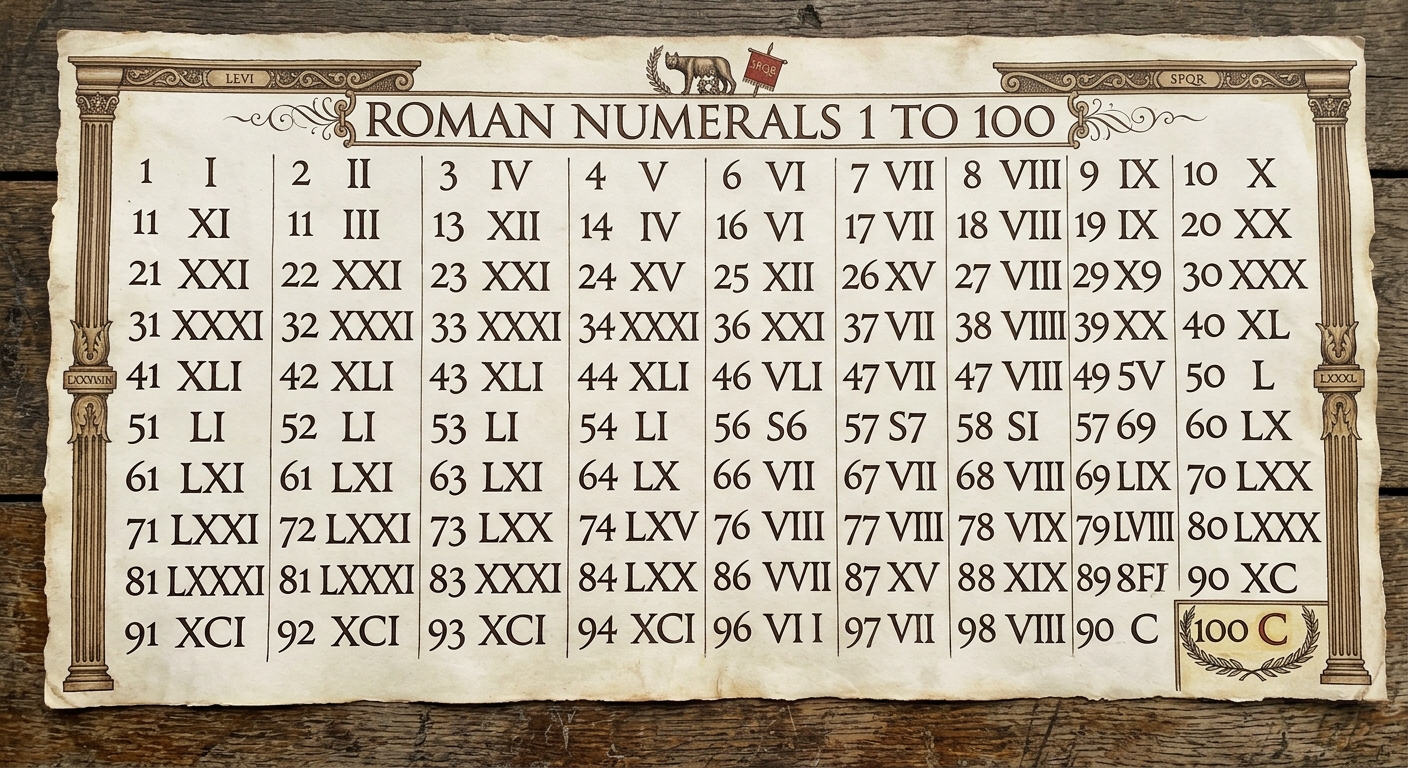
The full chart of Roman numerals 1 to 100 is below. Before it, we show the rules in a way that lets your child write any numeral without memorizing the chart, plus the mistakes that cost points on worksheets, and practice problems with answers.
The Roman numeral symbols
| Symbol | Value |
|---|---|
| I | 1 |
| V | 5 |
| X | 10 |
| L | 50 |
| C | 100 |
| D | 500 |
| M | 1,000 |
D and M only matter once you go past 100. For this chart, you need the first five. There’s no symbol for zero. The Roman system was used for counting and recording amounts, and it never developed a zero or place value the way our digits did.
The rules for reading and writing Roman numerals
Rule 1: Bigger to smaller means add
When the symbols go from largest to smallest, add them. XVI = 10 + 5 + 1 = 16. LXX = 50 + 10 + 10 = 70.
Rule 2: A smaller symbol in front means subtract
When a smaller symbol sits right before a larger one, subtract it from the larger. IV = 5 – 1 = 4. XC = 100 – 10 = 90.
This only works for specific pairs. I can go before V and X. X can go before L and C. C can go before D and M. Nothing else. V and L are never subtracted.
Rule 3: No more than three in a row
I, X and C can repeat up to three times: III = 3, XXX = 30. A fourth repeat gets replaced by a subtraction pair, so 4 is IV and 40 is XL. V and L never repeat, since VV would just be X and LL would be C.
How to write any number from 1 to 100
This is the method that makes the chart almost unnecessary. Split the number into tens and ones, write each part using the table below, then put them together.
| Ones | Numeral | Tens | Numeral |
|---|---|---|---|
| 1 | I | 10 | X |
| 2 | II | 20 | XX |
| 3 | III | 30 | XXX |
| 4 | IV | 40 | XL |
| 5 | V | 50 | L |
| 6 | VI | 60 | LX |
| 7 | VII | 70 | LXX |
| 8 | VIII | 80 | LXXX |
| 9 | IX | 90 | XC |
Notice the tens column follows exactly the same pattern as the ones column. Swap I for X, V for L and X for C, and 3 (III) becomes 30 (XXX), 4 (IV) becomes 40 (XL), and 9 (IX) becomes 90 (XC).
Worked examples
47
40 + 7
XL + VII = XLVII
64
60 + 4
LX + IV = LXIV
99
90 + 9
XC + IX = XCIX
99 is where the method pays off. It looks like it should be “1 less than 100,” so IC. But I can only go before V and X, and splitting into tens and ones gives XCIX automatically.
88
80 + 8
LXXX + VIII = LXXXVIII. That’s eight letters, the longest numeral between 1 and 100.
How to read a Roman numeral
Go left to right. If a symbol is smaller than the one after it, subtract it. Otherwise, add it.
XCIV
X is smaller than C, so subtract 10
C: add 100
I is smaller than V, so subtract 1
V: add 5
-10 + 100 – 1 + 5 = 94
A faster way to see it: group the subtraction pairs first. XC IV = 90 + 4 = 94.
Roman numerals 1 to 100 chart
| Number | Roman numeral | Number | Roman numeral |
|---|---|---|---|
| 1 | I | 51 | LI |
| 2 | II | 52 | LII |
| 3 | III | 53 | LIII |
| 4 | IV | 54 | LIV |
| 5 | V | 55 | LV |
| 6 | VI | 56 | LVI |
| 7 | VII | 57 | LVII |
| 8 | VIII | 58 | LVIII |
| 9 | IX | 59 | LIX |
| 10 | X | 60 | LX |
| 11 | XI | 61 | LXI |
| 12 | XII | 62 | LXII |
| 13 | XIII | 63 | LXIII |
| 14 | XIV | 64 | LXIV |
| 15 | XV | 65 | LXV |
| 16 | XVI | 66 | LXVI |
| 17 | XVII | 67 | LXVII |
| 18 | XVIII | 68 | LXVIII |
| 19 | XIX | 69 | LXIX |
| 20 | XX | 70 | LXX |
| 21 | XXI | 71 | LXXI |
| 22 | XXII | 72 | LXXII |
| 23 | XXIII | 73 | LXXIII |
| 24 | XXIV | 74 | LXXIV |
| 25 | XXV | 75 | LXXV |
| 26 | XXVI | 76 | LXXVI |
| 27 | XXVII | 77 | LXXVII |
| 28 | XXVIII | 78 | LXXVIII |
| 29 | XXIX | 79 | LXXIX |
| 30 | XXX | 80 | LXXX |
| 31 | XXXI | 81 | LXXXI |
| 32 | XXXII | 82 | LXXXII |
| 33 | XXXIII | 83 | LXXXIII |
| 34 | XXXIV | 84 | LXXXIV |
| 35 | XXXV | 85 | LXXXV |
| 36 | XXXVI | 86 | LXXXVI |
| 37 | XXXVII | 87 | LXXXVII |
| 38 | XXXVIII | 88 | LXXXVIII |
| 39 | XXXIX | 89 | LXXXIX |
| 40 | XL | 90 | XC |
| 41 | XLI | 91 | XCI |
| 42 | XLII | 92 | XCII |
| 43 | XLIII | 93 | XCIII |
| 44 | XLIV | 94 | XCIV |
| 45 | XLV | 95 | XCV |
| 46 | XLVI | 96 | XCVI |
| 47 | XLVII | 97 | XCVII |
| 48 | XLVIII | 98 | XCVIII |
| 49 | XLIX | 99 | XCIX |
| 50 | L | 100 | C |
Where kids see Roman numerals
- Clock and watch faces. Many clocks show 4 as IIII instead of IV, a long-standing clockmaker tradition, so don’t let that confuse your child.
- Chapter numbers in books and sections in outlines.
- Names of kings, queens and popes, like Henry VIII or Elizabeth II.
- Super Bowl numbers and sequels to movies and video games.
- Copyright years in movie credits, which use M and D too.
Common mistakes with Roman numerals
- IC for 99 or IL for 49. I can only be subtracted from V and X. 99 is XCIX and 49 is XLIX.
- IIII for 4 or XXXX for 40. Four in a row isn’t allowed in standard notation. Use IV and XL.
- VV for 10 or LL for 100. V and L never repeat.
- Reading XIV as 16. The I is before the V, so it’s X + IV = 14, not X + VI.
- Subtracting more than one symbol. 8 is VIII, not IIX.
Practice problems
- Write 19 in Roman numerals.
- Write 36 in Roman numerals.
- Write 49 in Roman numerals.
- Write 74 in Roman numerals.
- Write 92 in Roman numerals.
- What number is XXVIII?
- What number is LXVI?
- What number is XCIV?
Answers
- 10 + 9 = X + IX = XIX
- 30 + 6 = XXX + VI = XXXVI
- 40 + 9 = XL + IX = XLIX
- 70 + 4 = LXX + IV = LXXIV
- 90 + 2 = XC + II = XCII
- 10 + 10 + 5 + 1 + 1 + 1 = 28
- 50 + 10 + 5 + 1 = 66
- XC + IV = 90 + 4 = 94
If your child is stuck on Roman numerals
Roman numerals usually show up around third or fourth grade, and they’re a quiet test of place value. The tens-and-ones method above only works if your child can see 74 as 70 + 4 without thinking. If they can’t, they’ll try to memorize the whole chart instead, and that falls apart fast.
So if Roman numerals are a struggle, ask your child to split a few numbers into tens and ones out loud, and to add and subtract within 100 in their head. Trouble there points to a place value gap, which matters far beyond this worksheet. Our guide to math skills by grade level shows where place value should be by grades 3 to 5, and Is My Child Behind In Math? 12 Signs By Grade Level covers the signs that a gap is bigger than one topic.
Frequently asked questions
What is 100 in Roman numerals?
100 is C. It comes from the Latin word centum, meaning hundred, which is also where “century” and “cent” come from.
How do you write 1 to 10 in Roman numerals?
I, II, III, IV, V, VI, VII, VIII, IX, X. After that, the same pattern repeats with an X in front: XI is 11, XII is 12, and so on.
Why is 4 written IV and not IIII?
Standard rules allow at most three of the same symbol in a row, so 4 uses subtraction: one less than five. IIII does appear on many clock faces, but IV is what schoolwork expects.
How do you write 99 in Roman numerals?
XCIX. Split it into 90 + 9, which is XC + IX. IC is a common guess, but it breaks the rule that I can only be subtracted from V or X.
Is there a zero in Roman numerals?
No. The system has no symbol for zero and no place value. Our number system gets both from the Hindu-Arabic digits we use today.
Find the actual gap
If a simple chart turns into a battle, there may be a place value or mental math gap behind it, and those show up again in bigger ways later. Math Anon starts with a short adaptive assessment that finds the specific skills your child hasn’t mastered yet, then writes up what it found.
Each day after that, your child spends about 20 minutes on targeted practice, and you get a progress report every week. The assessment is $49 and is fully credited toward the first month. Start the assessment or take a look at pricing.





