
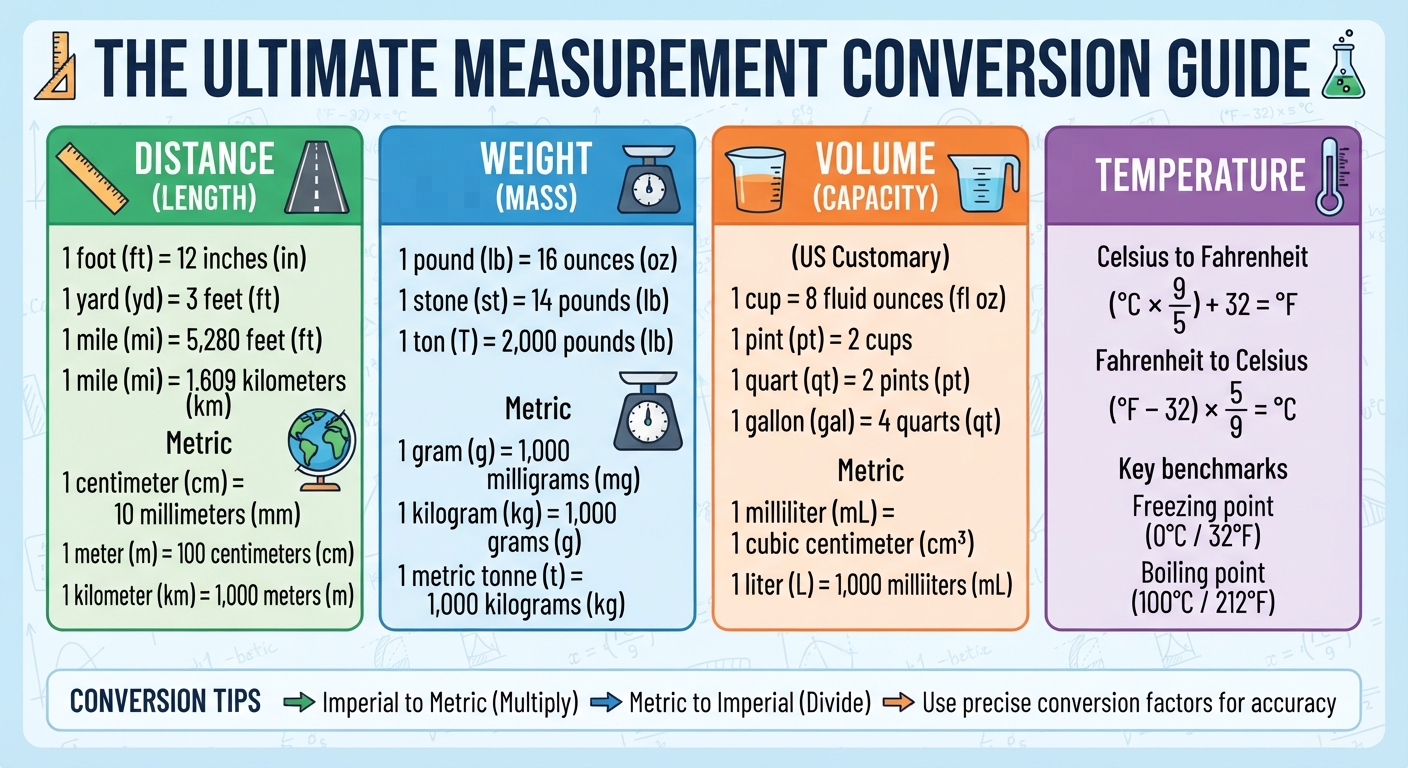
Measurement Conversions: Charts And Worked Examples
The short version
- Going from a bigger unit to a smaller one, multiply. Going from a smaller unit to a bigger one, divide. That one rule covers nearly every conversion your kid will see.
- Customary units (inches, pounds, gallons) use numbers you have to memorize. Metric units (meters, grams, liters) all step by 10, so you just move the decimal point.
- The key numbers: 12 inches in a foot, 3 feet in a yard, 5,280 feet in a mile, 16 ounces in a pound, 2,000 pounds in a ton, 8 fluid ounces in a cup, 4 quarts in a gallon.
- Writing the units next to every number catches most errors before they happen, because the wrong units cancel out in an obvious way.
- Most missed conversion problems are really multiplication or division problems in disguise.
Measurement conversions come down to one decision: multiply or divide. If the unit you’re moving to is smaller, you’ll need more of them, so multiply. If it’s bigger, you’ll need fewer, so divide. 5 feet becomes 5 × 12 = 60 inches, and 96 inches becomes 96 ÷ 12 = 8 feet.
Below are full charts for length, weight and capacity in both systems, the metric prefixes, temperature, and a setup method that works even when a problem needs two steps. Practice with a full answer key is at the bottom.
The two systems
The United States uses the customary system day to day and the metric system in science class, so kids have to hold both. The difference that matters: customary relationships are all different numbers (12, 3, 16, 5,280), while metric relationships are always powers of 10.
Conversion charts
Length
| Customary | Metric |
|---|---|
| 1 foot = 12 inches | 1 centimeter = 10 millimeters |
| 1 yard = 3 feet = 36 inches | 1 meter = 100 centimeters |
| 1 mile = 1,760 yards | 1 meter = 1,000 millimeters |
| 1 mile = 5,280 feet | 1 kilometer = 1,000 meters |
Weight and mass
| Customary | Metric |
|---|---|
| 1 pound = 16 ounces | 1 gram = 1,000 milligrams |
| 1 ton = 2,000 pounds | 1 kilogram = 1,000 grams |
| 1 ton = 32,000 ounces | 1 metric ton = 1,000 kilograms |
Capacity
| Customary | Metric |
|---|---|
| 1 cup = 8 fluid ounces | 1 liter = 1,000 milliliters |
| 1 pint = 2 cups = 16 fluid ounces | 1 kiloliter = 1,000 liters |
| 1 quart = 2 pints = 4 cups | 1 milliliter = 1 cubic centimeter |
| 1 gallon = 4 quarts = 16 cups = 128 fluid ounces | 1 liter = 1,000 cubic centimeters |
Between the systems
These are the approximations kids are usually given. Only the inch is exact.
| Customary | Metric |
|---|---|
| 1 inch | 2.54 centimeters (exact) |
| 1 mile | about 1.61 kilometers |
| 1 pound | about 0.45 kilograms |
| 1 ounce | about 28.35 grams |
| 1 quart | about 0.95 liters |
| 1 gallon | about 3.79 liters |
Metric prefixes and the decimal shortcut
Every metric prefix means the same thing whether you attach it to meters, grams or liters. Kilo always means 1,000 of something and milli always means one thousandth.
| Prefix | Means | Example |
|---|---|---|
| kilo | 1,000 | 1 kg = 1,000 g |
| hecto | 100 | 1 hL = 100 L |
| deka | 10 | 1 dam = 10 m |
| base unit | 1 | meter, gram, liter |
| deci | 0.1 | 1 dm = 0.1 m |
| centi | 0.01 | 1 cm = 0.01 m |
| milli | 0.001 | 1 mm = 0.001 m |
Because the chart steps by 10 each row, converting inside the metric system is just sliding the decimal point. Each step down the list moves it one place right, each step up moves it one place left. From kilometers to meters is three steps down, so 2.5 km becomes 2,500 m. From grams to kilograms is three steps up, so 2,500 g becomes 2.5 kg.
How to set up a conversion
For a one step problem, use the multiply or divide rule.
3.5 gallons to quarts. Quarts are smaller, so multiply.
1 gallon = 4 quarts
3.5 × 4 = 14 quarts
48 fluid ounces to cups. Cups are bigger, so divide.
1 cup = 8 fluid ounces
48 ÷ 8 = 6 cups
For two step problems, write each conversion as a fraction and let the units cancel. This is the method that saves kids in chemistry later, so it’s worth learning early.
7 yards to inches.
7 yd × (3 ft ÷ 1 yd) = 21 ft
21 ft × (12 in ÷ 1 ft) = 252 inches
The yards cancel against yards, the feet cancel against feet, and inches is what’s left. If your leftover unit isn’t the one the question asked for, you flipped a fraction.
Temperature
Temperature is the one conversion that isn’t a simple multiply or divide, because the two scales don’t start at the same place.
Fahrenheit to Celsius: C = (F – 32) × 5/9
68°F: 68 – 32 = 36, and 36 × 5/9 = 20°C
Celsius to Fahrenheit: F = (C × 9/5) + 32
25°C: 25 × 9/5 = 45, and 45 + 32 = 77°F
Common mistakes
- Multiplying when you should divide. The check is simple: more small units, fewer big ones. If 96 inches came out as 1,152 feet, the direction was backwards.
- Confusing ounces with fluid ounces. Ounces measure weight, fluid ounces measure volume, and they aren’t interchangeable. A cup of flour and a cup of water both hold 8 fluid ounces but weigh different amounts.
- Treating a ton like 1,000 pounds. A customary ton is 2,000 pounds. A metric ton is 1,000 kilograms.
- Losing track of the decimal in metric. Counting the steps on the prefix chart out loud fixes this faster than any rhyme.
- Dropping units from the work. A number with no unit written next to it is where most two step problems go wrong.
Practice problems
- 4 feet = how many inches?
- 3 pounds = how many ounces?
- 2.5 kilometers = how many meters?
- 64 fluid ounces = how many cups?
- 7,500 milliliters = how many liters?
- 2 gallons = how many pints?
- 86°F = how many degrees Celsius?
- A recipe calls for 3 quarts of stock and you have a 2 liter carton. Is that enough?
Answers
- 4 × 12 = 48 inches
- 3 × 16 = 48 ounces
- 2.5 × 1,000 = 2,500 meters
- 64 ÷ 8 = 8 cups
- 7,500 ÷ 1,000 = 7.5 liters
- 2 × 4 = 8 quarts, and 8 × 2 = 16 pints
- 86 – 32 = 54, and 54 × 5/9 = 30°C
- No. 3 quarts is about 3 × 0.95 = 2.85 liters, which is more than the carton holds
What it means if your kid is stuck on measurement conversions
Measurement conversions are one of those topics where the unit itself is rarely the problem. A kid who can tell you there are 12 inches in a foot and still misses the question is usually losing it somewhere else.
The three usual causes: multiplication and division facts that are slow enough to derail the thinking, decimal place value that wobbles the moment metric shows up, and multi step problems where the kid solves step one correctly and then stops. If your child gets every single step conversion right and falls apart on yards to inches, that’s a working memory and organization issue, and writing each step on its own line fixes more of it than extra drilling will.
Math Skills By Grade Level: What Your Child Should Know spells out when multiplication fluency and decimal place value are supposed to be solid, and Is My Child Behind In Math? 12 Signs By Grade Level covers what a gap in either one looks like from the kitchen table. If homework on this turns into tears rather than errors, read Math Anxiety In Children: What It Looks Like And What Helps first.
Frequently asked questions
How do I know whether to multiply or divide?
Compare the two units. Converting to a smaller unit means you’ll end up with a bigger number, so multiply. Converting to a bigger unit means a smaller number, so divide. Feet to inches multiplies. Inches to feet divides.
How many ounces are in a gallon?
128 fluid ounces. A gallon is 4 quarts, a quart is 32 fluid ounces, and 4 × 32 = 128.
Why is the metric system easier to convert?
Every step is a power of 10, so converting is just moving a decimal point. The customary system uses a different number for every pair of units, which means memorizing rather than counting.
What’s the difference between an ounce and a fluid ounce?
An ounce measures weight and a fluid ounce measures volume. They share a name for historical reasons, not because they measure the same thing, and mixing them up is one of the most common errors in cooking problems.
How do you convert Fahrenheit to Celsius?
Subtract 32, then multiply by 5/9. For 50°F: 50 – 32 = 18, and 18 × 5/9 = 10°C. To go the other way, multiply by 9/5 and then add 32.
What grade do kids learn measurement conversions?
Simple same system conversions start in second and third grade. Fourth and fifth grade handle full customary and metric conversions plus decimals. Converting between the two systems and using unit fractions is mostly sixth grade and up.
Find the actual gap
If conversions are a weekly fight, the memorized chart probably isn’t the issue. Math Anon starts with a short adaptive assessment that identifies which skill underneath is actually missing, and sends you a written report that says so in plain words instead of a score.
After that your child works about 20 minutes a day on practice built for those exact gaps, and you get a progress report every week. The assessment costs $49, and the full amount comes back as credit on your first month. Start the assessment, or see pricing first.





