
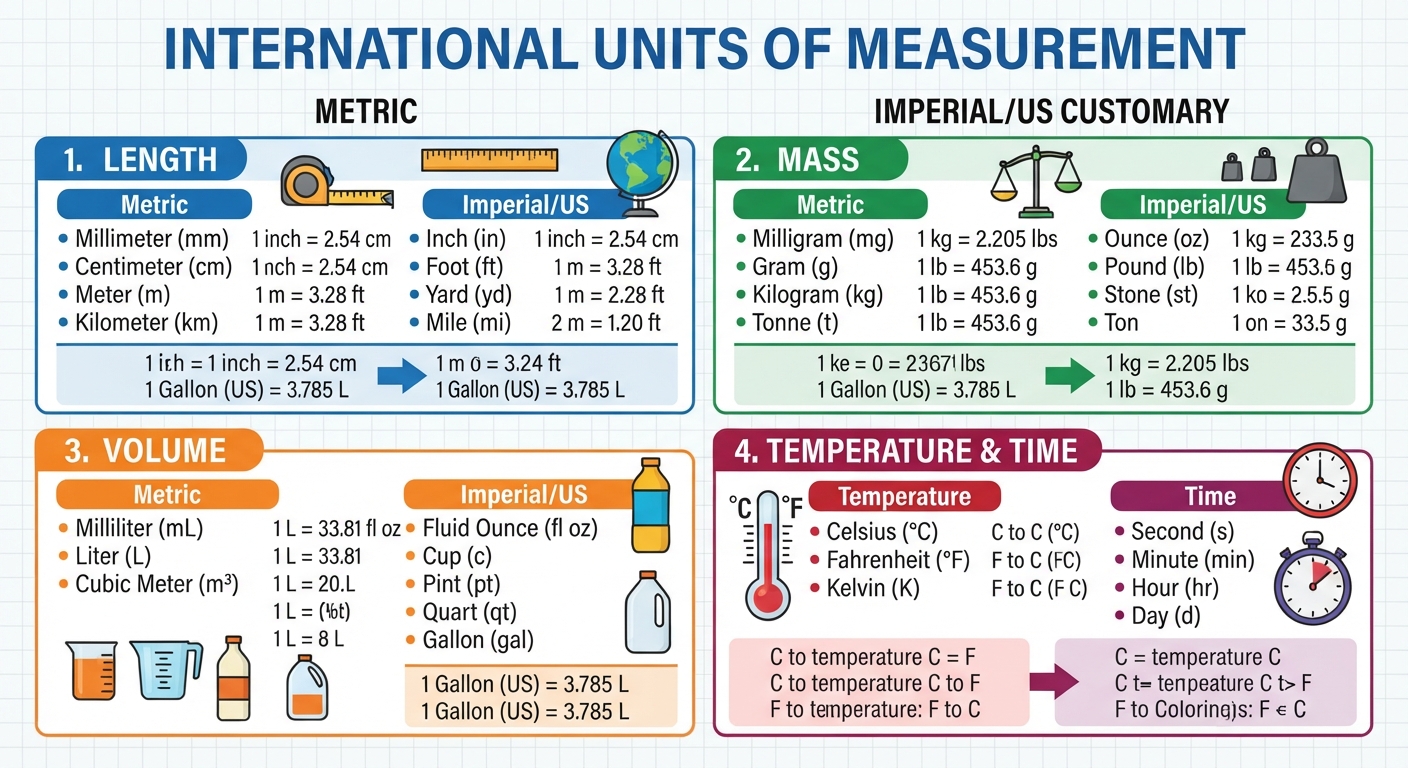
Units Of Measurement: Metric And Customary Charts
The short version
- A unit is the fixed amount you measure in. In “6 feet,” the number 6 says how many and the unit, feet, says of what.
- Units of measurement in the US come in two systems: customary (inches, pounds, gallons) and metric (meters, grams, liters).
- To convert, go from a bigger unit to a smaller one by multiplying, and from smaller to bigger by dividing. The number of units always grows when the units shrink.
- Metric conversions are all powers of 10, so they come down to moving the decimal point. Customary ones use odd numbers like 12, 16, and 5,280 that kids have to memorize.
- Area and volume units convert by the square or cube of the length factor: 1 square foot is 144 square inches, not 12.
Units of measurement are the standard amounts we use to measure things: inches and meters for length, pounds and grams for weight, cups and liters for volume, minutes for time. A measurement always has two parts, a number and a unit. “5” alone tells you nothing. “5 miles” and “5 inches” tell you very different things.
This guide covers what a unit is (including the other ways “unit” shows up in math class), full customary and metric charts, how to convert between units with worked examples, and the mistakes that cost kids points. Practice problems with answers are near the end.
What is a unit in math?
A unit is one agreed-on amount that everything else gets counted in. An inch is always the same length, whoever measures and wherever they are. That’s the point of a standard unit: two people measuring the same table should get the same answer.
Young kids often start with nonstandard units, like measuring a book in paper clips. It teaches the idea well and also shows the problem: your paper clips and mine might not match.
“Unit” also shows up in a few other places in school math, which is why kids search “what’s a unit” and get confused:
- The ones place. Older books call it the “units place.” In 347, the 7 is in the units place.
- Unit fractions. A fraction with 1 on top, like 1/4 or 1/9.
- Unit rate. An amount per one of something, like 30 miles per hour or $1.50 per pound.
- Square and cubic units. The squares that measure area and the cubes that measure volume.
All of them share the same core idea: “one” of something, used as the building block.
Customary vs metric units of measurement
The US mostly uses the customary system day to day. Nearly every other country uses metric, and so does science class. Kids need both.
Customary units chart
| Measures | Units | Key facts |
|---|---|---|
| Length | inch (in), foot (ft), yard (yd), mile (mi) | 12 in = 1 ft 3 ft = 1 yd 5,280 ft = 1 mi |
| Weight | ounce (oz), pound (lb), ton | 16 oz = 1 lb 2,000 lb = 1 ton |
| Capacity | fluid ounce (fl oz), cup (c), pint (pt), quart (qt), gallon (gal) | 8 fl oz = 1 c 2 c = 1 pt 2 pt = 1 qt 4 qt = 1 gal |
| Temperature | degrees Fahrenheit (°F) | Water freezes at 32°F and boils at 212°F |
Metric units chart
| Measures | Units | Key facts |
|---|---|---|
| Length | millimeter (mm), centimeter (cm), meter (m), kilometer (km) | 10 mm = 1 cm 100 cm = 1 m 1,000 m = 1 km |
| Mass | milligram (mg), gram (g), kilogram (kg) | 1,000 mg = 1 g 1,000 g = 1 kg |
| Capacity | milliliter (mL), liter (L) | 1,000 mL = 1 L |
| Temperature | degrees Celsius (°C) | Water freezes at 0°C and boils at 100°C |
Time is the same in both systems: 60 seconds in a minute, 60 minutes in an hour, 24 hours in a day, 7 days in a week.
Metric prefixes
Metric names are built from a prefix plus a base unit (meter, gram, liter). Learn the prefixes once and they work for every base.
| Prefix | Means | Example |
|---|---|---|
| kilo | 1,000 | 1 kilometer = 1,000 meters |
| centi | 1/100 | 1 centimeter = 0.01 meter |
| milli | 1/1,000 | 1 milliliter = 0.001 liter |
Handy links between the systems
1 inch = 2.54 centimeters (exact)
1 meter ≈ 3.28 feet
1 mile ≈ 1.61 kilometers
1 kilogram ≈ 2.2 pounds
1 liter ≈ 1.06 quarts
How to convert units of measurement
One rule covers almost every conversion: big unit to small unit, multiply. Small unit to big unit, divide.
Why? If the unit gets smaller, you need more of them to cover the same distance. 1 foot is 12 inches, so 5 feet is 5 × 12 inches. The number goes up.
Worked example 1: feet to inches
Convert 5 feet to inches.
Feet are bigger, so multiply by 12.
5 × 12 = 60 inches.
Worked example 2: inches to feet
Convert 84 inches to feet.
Inches are smaller, so divide by 12.
84 ÷ 12 = 7 feet.
Worked example 3: metric, with decimals
Convert 3.5 kilometers to meters. Multiply by 1,000, which moves the decimal three places right: 3.5 km = 3,500 m.
Convert 2,750 grams to kilograms. Divide by 1,000, which moves the decimal three places left: 2,750 g = 2.75 kg.
Worked example 4: mixed units
Add 7 ft 4 in and 2 ft 10 in.
Feet: 7 + 2 = 9 ft. Inches: 4 + 10 = 14 in.
14 inches is 1 foot and 2 inches, so regroup.
Answer: 10 ft 2 in.
It’s the same regrouping as carrying in addition, except the trade happens at 12 instead of 10. That’s exactly why it trips kids up.
Worked example 5: area units
A rug is 3 feet by 4 feet. What’s its area in square inches?
Area in feet: 3 × 4 = 12 square feet.
One square foot is 12 in × 12 in = 144 square inches.
12 × 144 = 1,728 square inches.
Check another way: 3 ft = 36 in and 4 ft = 48 in, and 36 × 48 = 1,728. Same answer.
Worked example 6: unit rate
Apples cost $4.50 for 3 pounds. What’s the price per pound?
$4.50 ÷ 3 = $1.50 per pound.
Common mistakes with units
- Multiplying when they should divide. A kid who converts 84 inches to feet and gets 1,008 has flipped the rule. Ask, “Should the number of feet be bigger or smaller than 84?” before any computing.
- Treating customary units like base 10. 3 ft 8 in is 3 8/12 feet, about 3.67 ft. A kid who writes 3.8 ft has treated inches like tenths.
- Using 12 for square feet. 1 square foot is 144 square inches, and 1 square yard is 9 square feet. Area factors get squared, and volume factors get cubed (1 cubic foot is 1,728 cubic inches).
- Mixing weight and capacity ounces. A fluid ounce measures volume. An ounce on a scale measures weight. They’re different units with a similar name.
- Dropping the unit from the answer. “12” is not an answer to “how long is the board?” Teachers mark it wrong, and later in science it becomes a real error.
- Moving the metric decimal the wrong way. Converting 450 cm to meters and writing 45,000. Same fix: check whether the answer should be bigger or smaller.
Practice problems
1. Convert 4 yards to feet.
2. Convert 3 pounds to ounces.
3. Convert 250 centimeters to meters.
4. Convert 90 minutes to hours.
5. Convert 10 quarts to gallons.
6. A pitcher holds 1.8 liters. You pour in another 6,400 milliliters from a jug. How many liters is that in total?
7. A room is 9 feet by 12 feet. What’s its area in square yards?
8. A student is 5 feet 9 inches tall. Using 1 inch = 2.54 cm, how tall is that in centimeters?
Answers
1. 4 × 3 = 12 feet.
2. 3 × 16 = 48 ounces.
3. 250 ÷ 100 = 2.5 meters.
4. 90 ÷ 60 = 1.5 hours.
5. 10 ÷ 4 = 2.5 gallons.
6. 6,400 mL = 6.4 L, and 6.4 + 1.8 = 8.2 liters.
7. 9 ft = 3 yd and 12 ft = 4 yd, so 3 × 4 = 12 square yards. (Check: 9 × 12 = 108 square feet, and 108 ÷ 9 = 12.)
8. 5 ft 9 in = 60 + 9 = 69 inches. 69 × 2.54 = 175.26 cm.
What it means if your child is stuck on units
Unit conversion is a pile of older skills stacked up. When a kid struggles, the units are rarely the actual problem.
If metric conversions go wrong, look at place value: multiplying and dividing by 10, 100, and 1,000 and knowing where the decimal lands. If customary conversions go wrong, it’s usually multiplication and division facts with 12 and 16, or fractions, since 2.5 gallons and 3 8/12 feet are fraction ideas in disguise. Most conversion work sits in grades 4 and 5, which our guide to math skills by grade level lays out.
These same fraction and decimal gaps tend to resurface later as the problems we cover in Struggling With Algebra? Catching them during a units unit is much cheaper than catching them in eighth grade. If you’re not sure how far back the gap goes, these signs by grade can help.
Frequently asked questions
What are units in math?
Units are the standard amounts you measure in, like inches, grams, liters, or minutes. A measurement is a number of units: 8 meters means eight lengths of one meter each.
What are the 7 base units of measurement?
In the metric system (SI), they’re the meter (length), kilogram (mass), second (time), ampere (electric current), kelvin (temperature), mole (amount of substance), and candela (light intensity). Kids mostly use the first three before high school science.
Is a gram a unit of weight or mass?
Strictly, grams and kilograms measure mass, the amount of matter in something. In everyday talk and most elementary textbooks, people call it weight, and that’s fine at that level.
How do you remember metric conversions?
Learn what the prefixes mean. Kilo is a thousand, centi is a hundredth, milli is a thousandth. Then every conversion is multiplying or dividing by 10, 100, or 1,000.
Why does the US use customary units?
The US kept the older system it inherited, while most of the world switched to metric. American schools teach both, and science classes use metric almost entirely.
Find the actual gap
If your child freezes on “how many ounces in 3 pounds,” the question worth asking is which older skill gave way. Math Anon’s short adaptive assessment checks the pieces underneath, from multiplication facts to decimal place value, and gives you a written report of exactly what’s missing.
Your child then practices those skills for about 20 minutes a day, and you get a progress report every week. The assessment costs $49, credited back in full on your first month. Start the assessment, or see pricing for the details.





