
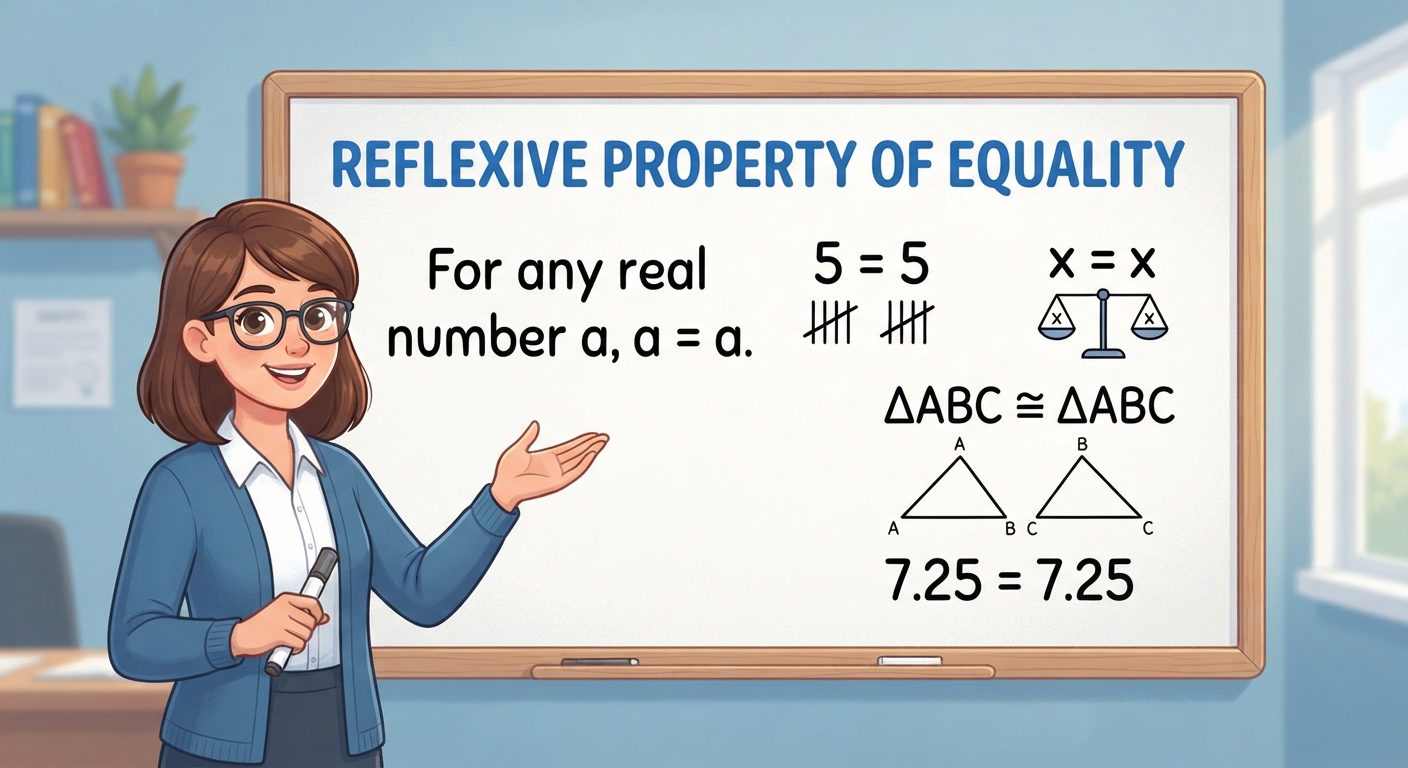
What Is The Reflexive Property? Examples And Proofs
The short version
- The reflexive property says anything is equal to itself: a = a. For shapes it reads AB ≅ AB, so every segment and angle is congruent to itself.
- You’ll see it most in geometry proofs, as the reason for a side or angle that two triangles share.
- It’s one of three partner properties. Reflexive is a = a, symmetric is “if a = b, then b = a,” and transitive is “if a = b and b = c, then a = c.”
- A relation is reflexive only if every single item is related to itself. “Is equal to” and “≤” pass. “Is less than” fails, because 5 < 5 is false.
The reflexive property says any number, expression, or shape is equal to itself: for any a, a = a. It sounds too obvious to need a name, but it earns one in geometry proofs, where it’s the official reason you can say a side two triangles share is congruent to itself. In algebra it’s the reason 7 = 7 counts as a true statement.
Below we cover the reflexive property of equality and of congruence, how to use it in a two-column proof, how to tell it apart from the symmetric and transitive properties, and what “reflexive” means for relations in later math. There are practice problems with answers near the end.
What is the reflexive property?
In words: a thing is always the same as itself. In symbols there are two common versions.
| Version | Symbols | Examples |
|---|---|---|
| Reflexive property of equality | a = a | 12 = 12, x = x, 3y + 1 = 3y + 1 |
| Reflexive property of congruence | AB ≅ AB, ∠A ≅ ∠A | A segment, angle, or figure is congruent to itself |
Equality (=) is for numbers and expressions. Congruence (≅) is for figures, meaning same size and same shape. Some textbooks also write the segment version as AB = AB, meaning the lengths are equal. Either way, the idea doesn’t change.
The word “reflexive” comes from the same root as “reflect.” Picture looking in a mirror: what you see is you. That’s the whole idea.
Reflexive, symmetric, and transitive properties compared
These three almost always show up together in a textbook, usually in a list called “properties of equality.” Kids mix them up because the names don’t describe what they do. Here’s the side by side.
| Property | Rule | Example | How many things? |
|---|---|---|---|
| Reflexive | a = a | 9 = 9 | One thing, compared with itself |
| Symmetric | If a = b, then b = a | If x = 4, then 4 = x | Two things, order flipped |
| Transitive | If a = b and b = c, then a = c | If ∠1 = ∠2 and ∠2 = ∠3, then ∠1 = ∠3 | Three things, chained |
A quick way to sort them: count the different things in the statement. One thing means reflexive. Two things swapping sides means symmetric. Three things linked through a middle one means transitive.
How to use the reflexive property in a geometry proof
This is where students actually need it. When two triangles share a side or an angle, you can’t just say “they’re the same.” You write it as a statement and give the reflexive property as the reason.
Worked example 1: a shared side
Quadrilateral ABCD has a diagonal BD. You’re given AB ≅ CB and AD ≅ CD. Prove △ABD ≅ △CBD.
Look at the diagonal. It’s a side of both triangles. That’s your clue.
| Statement | Reason |
|---|---|
| 1. AB ≅ CB | Given |
| 2. AD ≅ CD | Given |
| 3. BD ≅ BD | Reflexive property of congruence |
| 4. △ABD ≅ △CBD | SSS (side, side, side) |
Without step 3 you only have two pairs of sides, and SSS needs three. The reflexive property supplies the missing pair for free.
Worked example 2: a shared angle
In △ABC, point D is on AB and point E is on AC, with DE parallel to BC. Show △ADE is similar to △ABC.
1. ∠A ≅ ∠A (reflexive property). Both triangles use the same corner at A.
2. ∠ADE ≅ ∠ABC (corresponding angles, because DE ∥ BC).
3. Two pairs of angles match, so △ADE ~ △ABC by AA similarity.
Overlapping triangles like these are where students most often forget the reflexive step. The shared angle is hiding in plain sight.
The reflexive property in algebra
In algebra you rarely write “reflexive property” as a step, but it’s working in the background. Here’s the spot where it matters most.
Worked example 3: equations that are always true
Solve 2(x + 3) = 2x + 6.
2(x + 3) = 2x + 6
2x + 6 = 2x + 6 (distribute)
6 = 6 (subtract 2x from both sides)
The variable vanished and left 6 = 6. By the reflexive property that’s always true, so every value of x works. The equation has infinitely many solutions. It’s called an identity.
Compare 2(x + 3) = 2x + 5. Following the same steps gives 6 = 5, which is false, so there’s no solution at all. Knowing that a = a is always true, and that 6 = 5 never is, is what lets a student read these results correctly.
Reflexive relations in higher math
In discrete math and some high school courses, “reflexive” describes a relation, a rule that pairs things up. A relation is reflexive if every item is related to itself. One exception breaks it.
| Relation | Reflexive? | Symmetric? | Transitive? |
|---|---|---|---|
| is equal to (=) | Yes | Yes | Yes |
| is congruent to (≅) | Yes | Yes | Yes |
| is less than or equal to (≤) | Yes, 5 ≤ 5 | No | Yes |
| is less than (<) | No, 5 < 5 is false | No | Yes |
| divides (positive whole numbers) | Yes, 6 divides 6 | No | Yes |
| is perpendicular to (lines) | No | Yes | No |
A relation that has all three properties is called an equivalence relation. Equality and congruence are the two every student meets first.
For a relation on a small set, check it pair by pair. On the set {1, 2, 3}, the relation {(1, 1), (2, 2), (3, 3), (1, 2)} is reflexive because all three self pairs are there. Drop (3, 3) and it no longer is.
Common mistakes with the reflexive property
- Calling “if x = 4, then 4 = x” reflexive. It looks like a mirror, but it involves two things swapping places. That’s symmetric.
- Skipping the step in a proof. Students see the shared side, know it matches, and jump straight to SSS or SAS. Most teachers will take points off. The shared part needs its own line.
- Using it on parts that only look shared. The reflexive property only works for the exact same segment or angle. Two different sides that happen to line up in a drawing need a real reason.
- Naming a shared angle loosely. In overlapping triangles, writing ∠B ≅ ∠B is fine only if B is the vertex of just one angle in the figure. If several angles meet at B, use three letters, like ∠ABC ≅ ∠ABC.
- Assuming every “nice” relation is reflexive. “Is less than” is transitive but not reflexive. Always test an item against itself.
Practice problems
For problems 1 to 4, name the property: reflexive, symmetric, or transitive.
1. 15 = 15
2. If y = 8, then 8 = y.
3. ∠PQR ≅ ∠PQR
4. If AB = CD and CD = EF, then AB = EF.
5. Is the relation “is less than or equal to” reflexive? Explain with a number.
6. Is the relation “is taller than” reflexive? Explain.
7. Triangles JKL and MKL share side KL. You know JK ≅ MK and JL ≅ ML. What reason goes next to KL ≅ KL, and which congruence shortcut finishes the proof?
8. Solve 3(x – 2) = 3x – 6. How many solutions are there, and which property explains your answer?
Answers
1. Reflexive. One number, compared with itself.
2. Symmetric. Two things, sides flipped.
3. Reflexive (of congruence).
4. Transitive. CD is the middle link.
5. Yes. Any number is less than or equal to itself, for example 7 ≤ 7 is true.
6. No. Nobody is taller than themselves.
7. Reflexive property of congruence. With JK ≅ MK, JL ≅ ML, and KL ≅ KL, the triangles are congruent by SSS.
8. 3(x – 2) = 3x – 6 becomes 3x – 6 = 3x – 6, then -6 = -6. That’s always true by the reflexive property, so there are infinitely many solutions.
If your child is stuck on the reflexive property
The reflexive property itself takes about a minute to learn. When a student keeps getting it wrong, the trouble is usually somewhere else.
In geometry, the usual culprit is reading diagrams and naming parts. A student who isn’t sure what ∠ABC refers to, or can’t spot which side two triangles share, will struggle with every proof, and this step is only where it shows first. Angle relationships matter too; if a kid can’t say why two angles along a line add to 180°, our guide to supplementary angles is a good place to check.
In algebra, confusion about x = x often traces back to what the equal sign means. Plenty of kids learn early that “=” means “write the answer next,” not “both sides have the same value.” That habit makes identities like 6 = 6 feel like a trick. It also causes a lot of the trouble we describe in Struggling With Algebra? The Real Problem Is Usually Fourth Grade Fractions.
If you’re not sure whether this is one shaky topic or a sign of a bigger gap, these signs by grade level can help you tell the difference.
Frequently asked questions
What is the reflexive property in simple terms?
It means anything equals itself. A number equals itself (4 = 4), a variable equals itself (x = x), and a segment or angle is congruent to itself (AB ≅ AB).
What is the reflexive property of congruence?
It’s the geometry version: any segment, angle, or figure is congruent to itself. You use it in proofs when two triangles share a side or an angle.
What’s the difference between the reflexive and symmetric property?
Reflexive involves one thing: a = a. Symmetric involves two things and lets you flip the order: if a = b, then b = a.
When do students learn the reflexive property?
Most meet the properties of equality in pre-algebra or Algebra 1, around grades 7 to 9. The congruence version gets real use in high school geometry, once two-column proofs start.
Is 5 < 5 an example of the reflexive property?
No. 5 < 5 is false, which is exactly why “is less than” isn’t a reflexive relation. 5 ≤ 5 is true, so “is less than or equal to” is reflexive.
Find the actual gap
When a geometry proof falls apart, the missing piece is rarely the one on the page. Math Anon begins with a short adaptive assessment that tests the skills underneath, like angle facts, equation sense, and diagram reading, then gives you a written report on exactly what’s missing.
From there your child gets about 20 minutes a day of practice aimed at those gaps, and you get a progress report each week. The assessment is $49, and that’s credited back in full on your first month. Start the assessment or look over pricing first.





