
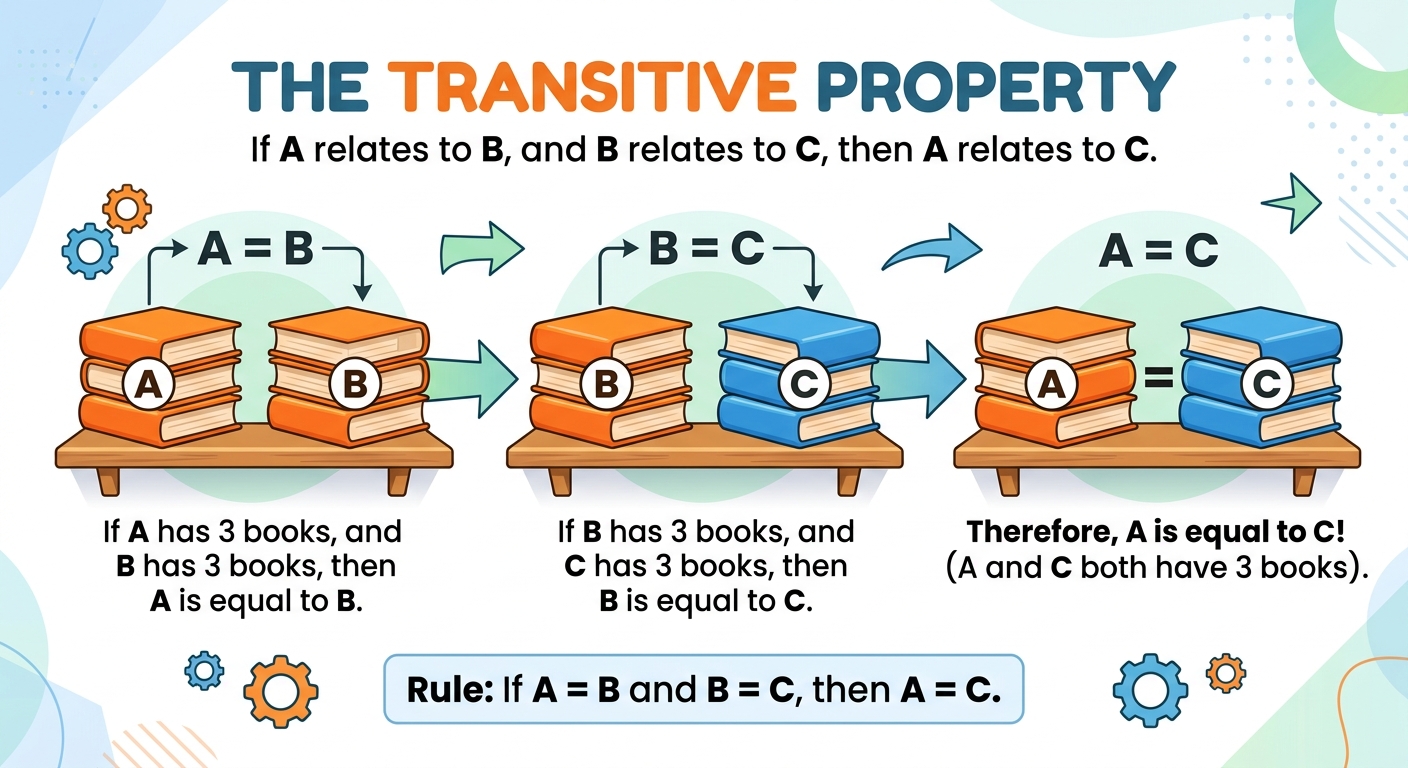
The Transitive Property: Equality, Inequality And Geometry
The short version
- The transitive property says that if a = b and b = c, then a = c. Two things equal to the same thing are equal to each other.
- It also works for inequalities that point the same way: if a < b and b < c, then a < c.
- In geometry it applies to congruence: if angle A ≅ angle B and angle B ≅ angle C, then angle A ≅ angle C.
- Not every relationship is transitive. “Is 1 more than” and “is not equal to” both break the chain, and so do inequalities that point in opposite directions.
- It’s one of three properties of equality, along with reflexive (a = a) and symmetric (if a = b, then b = a).
The transitive property says that if a = b and b = c, then a = c. In plain words, if two things are each equal to the same third thing, they’re equal to each other. For example, 3 × 4 = 12 and 12 = 6 + 6, so 3 × 4 = 6 + 6. The same idea works for “less than,” “greater than” and “congruent to.”
It sounds too obvious to need a name, and in a way it is. But it’s the step that lets kids chain facts together, which is how equations get solved and how geometry proofs work. Below we’ll cover the equality version, the inequality version, geometry, how it differs from substitution, and the relationships where it doesn’t hold.
The transitive property of equality
The formal statement:
If a = b and b = c, then a = c.
The middle quantity, b, is the link. Once you’ve shown both a and c match it, you can drop it and connect a and c directly.
Example 1: arithmetic
2 + 8 = 10
10 = 5 × 2
So 2 + 8 = 5 × 2
Example 2: measurement
1 yard = 3 feet
3 feet = 36 inches
So 1 yard = 36 inches
Example 3: algebra
y = 2x + 1
y = 7
Both expressions equal y, so 2x + 1 = 7.
Subtract 1 from both sides: 2x = 6
Divide by 2: x = 3
That third example is how kids solve systems of equations later on. If y equals one expression and also equals another, those two expressions equal each other.
It works for longer chains too
If a = b, b = c and c = d, then a = d. You just apply the property twice. Each time you work a problem line by line, like this:
4(3 + 2) = 4 × 5
= 20
= 2 × 10
you’re using the transitive property to conclude that 4(3 + 2) = 2 × 10.
The transitive property of inequality
Inequalities follow the same pattern, as long as they point the same way.
If a < b and b < c, then a < c.
If a > b and b > c, then a > c.
Example: 0.4 < 0.5 and 0.5 < 5/8 (since 5/8 = 0.625). So 0.4 < 5/8, and you didn’t have to compare them directly.
Heights work the same way. If a desk is shorter than a door and the door is shorter than the ceiling, the desk is shorter than the ceiling.
When the signs point opposite ways
If a < b and b > c, you can’t conclude anything about a and c. Two cases show why:
a = 2, b = 5, c = 3. Here 2 < 5 and 5 > 3, and a < c.
a = 4, b = 5, c = 1. Here 4 < 5 and 5 > 1, but a > c.
Same setup, opposite results. So there’s no rule.
The transitive property in geometry
In geometry, the transitive property shows up with congruent segments and angles. If segment AB ≅ segment CD and segment CD ≅ segment EF, then AB ≅ EF. Same for angles.
It’s also the key step in a classic proof: angles that are supplementary to the same angle are equal. Say angle 1 and angle 2 are supplementary, and angle 2 and angle 3 are supplementary.
angle 1 + angle 2 = 180°
angle 2 + angle 3 = 180°
By the transitive property: angle 1 + angle 2 = angle 2 + angle 3
Subtract angle 2 from both sides: angle 1 = angle 3
With numbers: if angle 2 is 65°, then angle 1 = 180° – 65° = 115° and angle 3 = 180° – 65° = 115°. They match. If supplementary angles are new to your child, our post on supplementary angles covers them from scratch.
Transitive, reflexive, symmetric and substitution
The transitive property belongs to a small family called the properties of equality. Geometry classes use all of them as reasons in two-column proofs.
| Property | Rule | Example |
|---|---|---|
| Reflexive | a = a | 7 = 7 |
| Symmetric | If a = b, then b = a | If x = 4, then 4 = x |
| Transitive | If a = b and b = c, then a = c | If x = y and y = 9, then x = 9 |
| Substitution | If a = b, a can replace b in any expression | If x = 3, then x + 5 = 3 + 5 |
Transitive vs substitution: they’re closely related, and some textbooks treat them almost interchangeably. The difference is scope. Transitive links two whole equations that share a side. Substitution swaps a value into the middle of a bigger expression. “x = y and y = 9, so x = 9” is transitive. “y = 9, so 2y + 1 = 2(9) + 1” is substitution.
Relationships that aren’t transitive
Knowing where the transitive property fails is what separates understanding from memorizing. A few examples:
- “Is 1 more than.” 5 is 1 more than 4, and 4 is 1 more than 3. But 5 is 2 more than 3.
- “Is not equal to.” 3 ≠ 5 and 5 ≠ 3, but that doesn’t mean 3 ≠ 3.
- “Is perpendicular to.” In a flat plane, if line a is perpendicular to line b and b is perpendicular to line c, then a and c are parallel, not perpendicular.
- Rock, paper, scissors. Rock beats scissors and scissors beats paper, but rock loses to paper.
On the other hand, “is a factor of” is transitive. 3 is a factor of 6, 6 is a factor of 24, and 3 is a factor of 24. That always holds.
Common mistakes with the transitive property
- Chaining mixed inequalities. Concluding a < c from a < b and b > c. As shown above, that tells you nothing.
- Assuming every relationship is transitive. “Is next to,” “is 1 more than” and “is perpendicular to” all fail.
- Mislabeling in proofs. Calling “If x = 4, then 4 = x” transitive. That’s symmetric. Transitive needs two statements that share a middle term.
- Using the equals sign as “the answer is.” A kid who writes 3 + 4 = 7 + 2 = 9 has a chain that claims 3 + 4 = 9. Each equals sign has to be true on its own.
That last one is worth watching for. It’s a sign the child sees “=” as a signal to compute rather than a statement that two sides match, and that view causes real trouble once algebra starts.
Practice problems
- If x = 9 and 9 = y, what can you conclude?
- 5 × 6 = 30 and 30 = 15 × 2. What does the transitive property tell you?
- If a < b and b < 12, what can you say about a and 12?
- If angle A = angle B and angle B = 47°, what’s the measure of angle A?
- y = 3x – 2 and y = 13. Use the transitive property to write one equation, then solve for x.
- If p > q and q < r, can you conclude anything about p and r? Explain with numbers.
- Is “is 2 more than” transitive? Give an example.
- Is “is a factor of” transitive? Check it with 4, 12 and 36.
Answers
- x = y.
- 5 × 6 = 15 × 2.
- a < 12.
- 47°.
- 3x – 2 = 13. Add 2: 3x = 15. Divide by 3: x = 5.
- No. With p = 5, q = 1, r = 3, p > r. With p = 2, q = 1, r = 4, p < r.
- No. 7 is 2 more than 5, and 5 is 2 more than 3, but 7 is 4 more than 3.
- Yes. 4 is a factor of 12 (12 = 4 × 3), 12 is a factor of 36 (36 = 12 × 3), and 4 is a factor of 36 (36 = 4 × 9).
If your child is stuck on the transitive property
When the transitive property confuses a child, the usual root is how they read the equals sign. Many kids learn “=” as “now write the answer” instead of “both sides have the same value.” If that’s the case, the transitive property looks like a meaningless rule. The fix is working with equations like 8 + 4 = __ + 5, which force them to treat both sides as balanced.
For inequalities, the gap is often comparing numbers, especially fractions and decimals. Our math skills by grade level guide shows when those skills are expected, and why algebra struggles start years earlier explains how these small gaps stack up.
Frequently asked questions
What is the transitive property in simple terms?
If two things are both equal to a third thing, they’re equal to each other. If a = b and b = c, then a = c.
What’s the difference between the transitive property and substitution?
Transitive links two equations that share a term to make a new equation. Substitution replaces a quantity with its equal inside an expression. They’re close cousins and often lead to the same result.
Does the transitive property work with inequalities?
Yes, when both inequalities point the same direction. If a < b and b < c, then a < c. Mixed directions give no conclusion.
What is the transitive property of congruence?
If figure A is congruent to figure B, and B is congruent to C, then A is congruent to C. It’s used for segments, angles and whole shapes in geometry proofs.
What grade learns the transitive property?
Kids use the idea informally in early grades when comparing lengths. The name usually appears in middle school pre-algebra, and it’s used heavily in high school geometry proofs.
Find the actual gap
If properties like this one feel slippery, the missing piece is usually earlier: what the equals sign means, or how to compare numbers. Math Anon starts with a short adaptive assessment that finds which skills are actually missing and puts it in a written report for you.
Then it’s about 20 minutes a day of targeted practice on those exact skills, with a progress report every week. The assessment costs $49, and you get it credited back in full on the first month. Start the assessment or see pricing first.





