
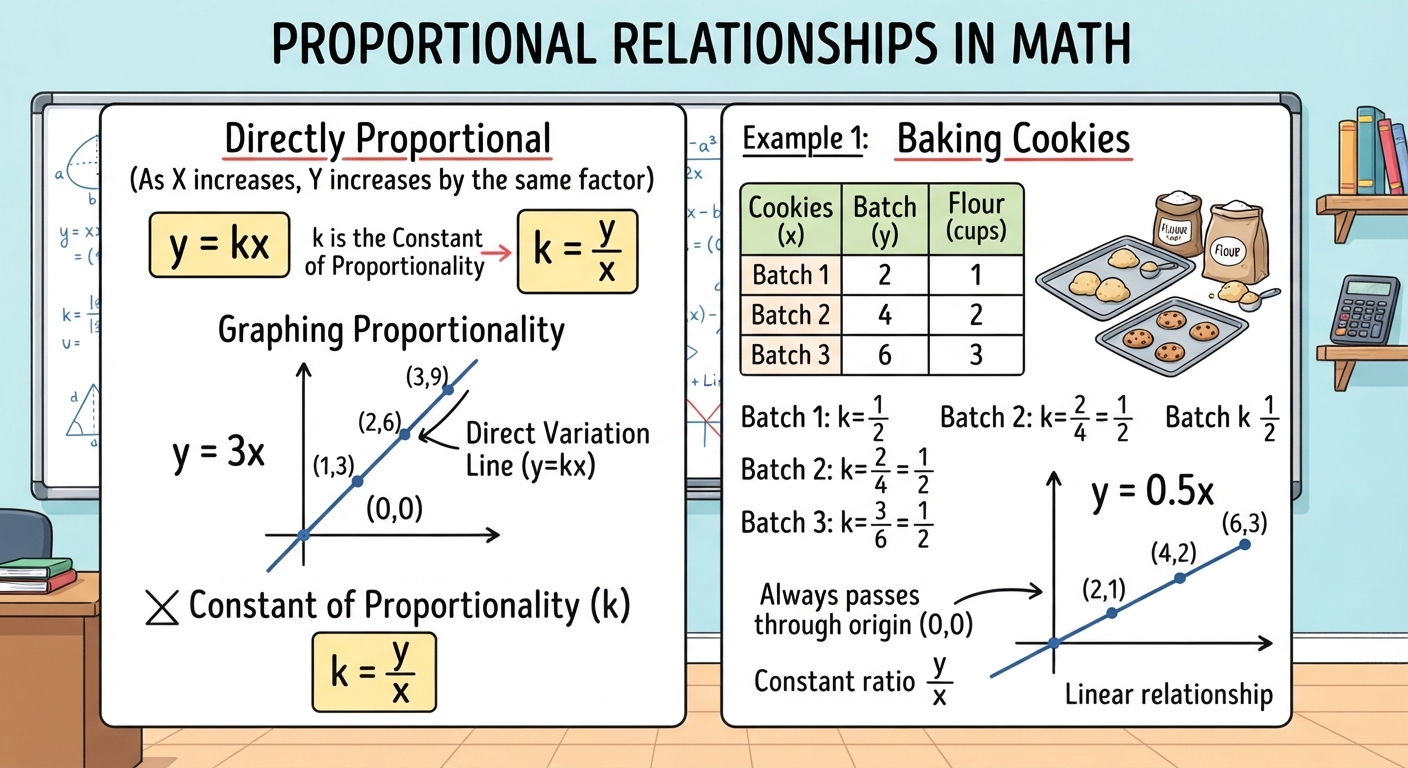
What Does Proportional Mean In Math? Tables And Graphs
The short version
- Proportional means two quantities always change by the same factor: double one and the other doubles, cut one in half and the other halves.
- In a table, a relationship is proportional when y ÷ x gives the same number in every row. That number is the constant of proportionality, k.
- Every proportional relationship can be written as y = kx, and its graph is a straight line that passes through the origin (0, 0).
- A straight line that doesn’t go through (0, 0), like y = 2x + 3, is linear but not proportional.
In math, proportional means two quantities stay in the same ratio. If y is proportional to x, then y is always the same multiple of x, which you can write as y = kx. Buy 2 pounds of apples for $3 and 4 pounds cost $6, because the price per pound never changes. That fixed multiple, k, is called the constant of proportionality.
Seventh graders spend a lot of time on this, usually in three forms: tables, graphs, and equations. Below we show how to test each one, how to find k, and where kids get tripped up. We keep the focus on recognizing proportional relationships. Solving proportion equations is a separate skill.
What does proportional mean in math, exactly?
Two quantities are proportional when their ratio is constant. Put another way, one is always a fixed number times the other.
Gas at $3.50 a gallon is a clean example. Every gallon adds exactly $3.50, and 0 gallons costs $0. The cost is proportional to the gallons. Now think about a taxi that charges $3 just to get in, plus $2 a mile. The cost goes up at a steady rate, but a 0 mile ride still costs $3. That starting fee breaks the pattern, so taxi cost is not proportional to miles.
Those two situations are worth keeping in mind, because nearly every proportional or not question your child sees is a version of one or the other.
How to tell if a table is proportional
Divide y by x in every row. If you get the same answer every time, the relationship is proportional, and that answer is k.
Example 1: gas
| Gallons (x) | Cost (y) | y ÷ x |
|---|---|---|
| 2 | $7.00 | 3.50 |
| 5 | $17.50 | 3.50 |
| 8 | $28.00 | 3.50 |
Every row gives 3.50. Proportional, with k = 3.50 dollars per gallon.
Example 2: taxi
| Miles (x) | Cost (y) | y ÷ x |
|---|---|---|
| 1 | $5 | 5 |
| 2 | $7 | 3.5 |
| 3 | $9 | 3 |
| 4 | $11 | 2.75 |
The ratios change, so it’s not proportional, even though cost goes up by $2 each row. A steady increase alone doesn’t make a relationship proportional. The ratio has to stay the same.
A quick shortcut: if a table includes x = 0, the y value must be 0 for the relationship to be proportional.
How to tell if a graph is proportional
A proportional graph passes two tests:
- It’s a straight line.
- It goes through the origin, the point (0, 0).
The gas graph starts at (0, 0) and rises in a straight line, so it passes. The taxi graph is a straight line too, but it starts at (0, 3), so it fails. A curve fails no matter where it starts.
You can read k straight off a proportional graph. Find the point where x = 1. Its y value is k. Or pick any point (x, y) on the line and divide y by x.
Example 3: finding k from a point
A proportional graph goes through (6, 15). What’s k, and what’s the equation?
k = y ÷ x
k = 15 ÷ 6
k = 2.5
Equation: y = 2.5x
The constant of proportionality
The constant of proportionality is the k in y = kx. In real problems it’s the unit rate: the cost for one item, the distance in one hour, the pay for one hour of work. Kids who already understand unit rates tend to find this topic easy, because k is the same idea with a new name.
Example 4: using k to predict
A car drives 150 miles in 3 hours at a steady speed. How far does it go in 5 hours?
k = 150 ÷ 3 = 50 miles per hour
Equation: d = 50t
When t = 5: d = 50 × 5 = 250 miles
Example 5: percent as a proportional relationship
Sales tax is proportional to price. With an 8% tax rate, k = 0.08, so tax = 0.08 × price. A $40 item has 0.08 × 40 = $3.20 in tax. A $0 item has $0 tax, which is exactly what a proportional relationship predicts.
Is the equation proportional?
An equation is proportional if it can be written as y = kx, with nothing added or subtracted.
| Equation | Proportional? | Why |
|---|---|---|
| y = 4x | Yes | k = 4 |
| y = x/2 | Yes | Same as y = 0.5x, so k = 0.5 |
| y = 4x + 1 | No | The + 1 means x = 0 gives y = 1 |
| y = x² | No | Not a straight line; y ÷ x changes |
| y = 10 | No | y doesn’t change with x at all |
Inversely proportional, briefly
Some quantities move in opposite directions by the same factor. If 6 workers take 10 hours to finish a job, 12 workers take 5 hours. Double the workers, halve the time. That’s called inversely proportional, and the thing that stays constant is the product: 6 × 10 = 60 and 12 × 5 = 60. When a problem just says “proportional,” it means the direct kind, y = kx.
Common mistakes
- Calling any straight line proportional. It also has to pass through (0, 0).
- Checking the difference instead of the ratio. The taxi table goes up by 2 every row, but that’s a constant difference. Proportional needs a constant ratio.
- Dividing x by y. The standard is k = y ÷ x. Flipping it gives the reciprocal, which is a different number.
- Checking only one or two rows. A table can match in the first two rows and break in the third. Check them all.
- Reading k from the wrong point on a graph. k is the y value at x = 1, not where the line crosses some other grid line.
Practice problems
- Is this proportional? x: 2, 4, 6 and y: 10, 20, 30. If so, find k.
- Is this proportional? x: 1, 2, 3 and y: 4, 7, 10.
- Is y = 7x proportional? If so, what’s k?
- Is y = 2x + 3 proportional?
- Three pounds of apples cost $5.40. What’s the constant of proportionality, and what do 8 pounds cost?
- A proportional graph passes through (4, 10). Find k, then find y when x = 10.
- It takes 6 painters 10 hours to paint a house. At the same pace, how long would 12 painters take?
Answers
- Yes. 10 ÷ 2 = 5, 20 ÷ 4 = 5, 30 ÷ 6 = 5, so k = 5.
- No. 4 ÷ 1 = 4 and 7 ÷ 2 = 3.5, so the ratio changes.
- Yes, k = 7.
- No. The + 3 means that when x = 0, y = 3, so the graph misses the origin.
- k = 5.40 ÷ 3 = $1.80 per pound. 8 pounds: 1.80 × 8 = $14.40.
- k = 10 ÷ 4 = 2.5. When x = 10, y = 2.5 × 10 = 25.
- 5 hours. This is inversely proportional: 6 × 10 = 60 painter hours, and 60 ÷ 12 = 5.
If your child is stuck on proportional relationships
Proportional relationships sit on top of a stack of older skills: multiplication and division fluency, equivalent fractions, ratios, and unit rates. When a seventh grader can’t tell whether a table is proportional, the real trouble is usually that dividing 17.50 by 5 feels like a mountain, or that 2/4 and 5/10 don’t obviously look equal to them. We walk through why that fraction gap matters so much later on in struggling with algebra.
If you’re not sure whether your child is behind or just having a rough unit, the signs your child is behind in math can help you sort it out, and a math assessment can show exactly which of those earlier skills is missing.
Frequently asked questions
What does proportional mean in simple terms?
It means two things grow or shrink together at the same rate, so one is always a fixed multiple of the other. Double one, and the other doubles.
What is the constant of proportionality?
It’s the fixed number k in y = kx. You find it by dividing y by x. In word problems it’s usually the unit rate, like price per item or miles per hour.
How do you know if a graph is proportional?
It has to be a straight line, and it has to pass through the origin (0, 0). If either one fails, the relationship isn’t proportional.
What’s the difference between linear and proportional?
Every proportional relationship is linear, but not every linear one is proportional. A linear graph is any straight line. A proportional graph is a straight line that also goes through the origin.
What grade learns proportional relationships?
Ratios and unit rates start in sixth grade. Proportional relationships in tables, graphs, and equations are a major topic in seventh grade, and they lead into slope and linear functions in eighth grade.
Find the actual gap
Proportional relationships are where a lot of older gaps finally show. Math Anon starts with a short adaptive assessment that checks the skills underneath, like fractions, ratios, and division, and gives you a written report on exactly what’s missing.
From there it’s about 20 minutes a day of practice built around those gaps, plus a progress report every week. Start the assessment for $49, credited back in full on the first month. More details are on the pricing page.





