
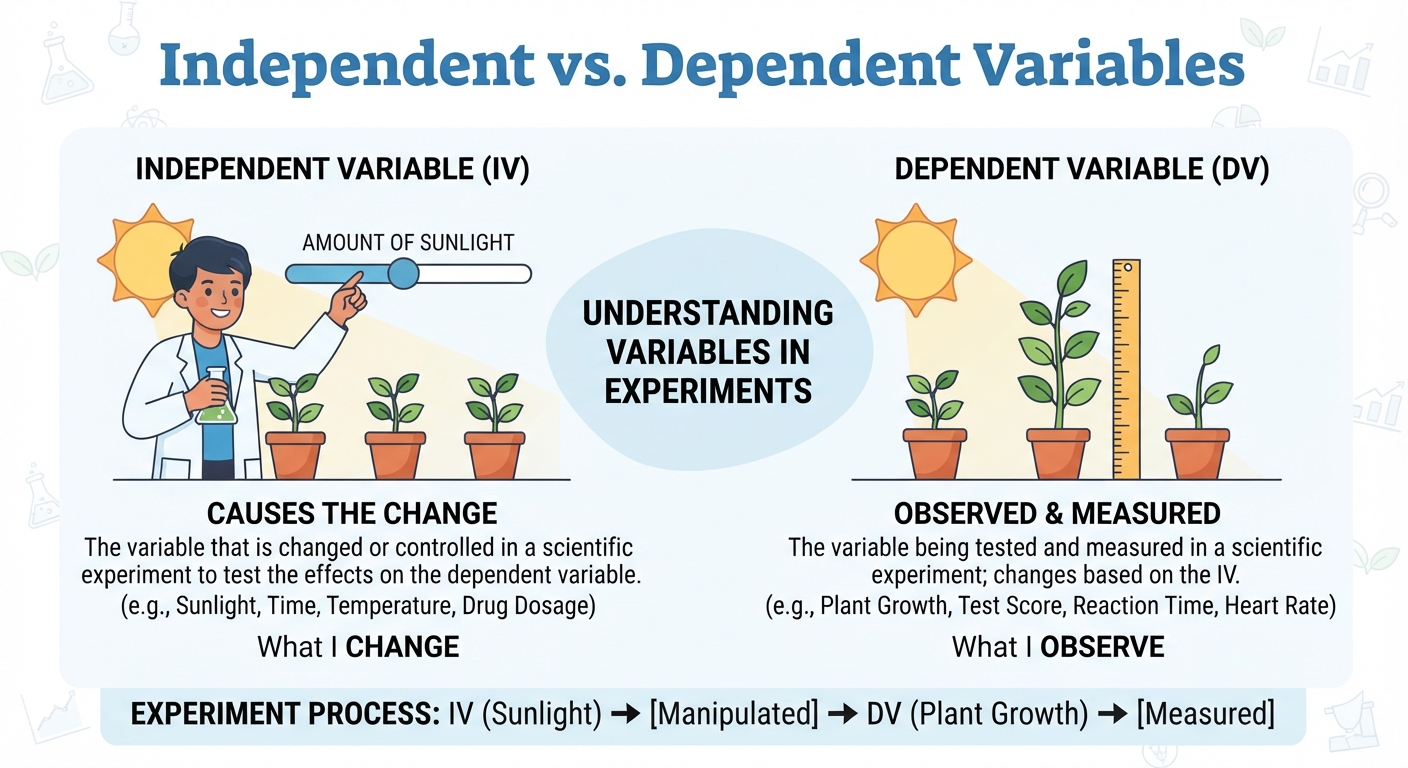
Independent Variable And Dependent Variable, Explained
The short version
- The independent variable is the input: the thing you choose, change, or control. The dependent variable is the output that changes because of it.
- Test it with a sentence: “[dependent] depends on [independent].” Test score depends on hours studied, so hours studied is the independent variable.
- On a graph, the independent variable goes on the horizontal x axis and the dependent variable goes on the vertical y axis.
- In y = 2x + 1 and most school equations, x is the independent variable. It’s a convention, so check which value you plug in and which one you get out.
An independent variable is the value you pick or change on purpose, and a dependent variable is the value that responds. If you earn $15 an hour, the number of hours you work is the independent variable and your pay is the dependent variable, because your pay depends on the hours, not the other way around. In most algebra problems, x is the independent variable and y is the dependent variable.
Kids meet these terms twice, once in math class with equations and graphs and once in science class with experiments. The meaning is the same in both places. Below we cover how to spot each one, how they work in tables, graphs, and function notation, and the cases where x isn’t the independent variable.
How to identify the independent variable
Ask which quantity causes or controls the other. That one is independent. The one that’s being affected is dependent. A fill in the blank sentence makes it easy:
The ______ depends on the ______.
If the sentence sounds right, the second blank is the independent variable. If it sounds backward, swap them.
| Situation | Independent (input) | Dependent (output) |
|---|---|---|
| Buying tickets | Number of tickets | Total cost |
| Driving at a steady speed | Time driven | Distance traveled |
| Growing a plant | Amount of sunlight | Plant height |
| Studying for a quiz | Hours studied | Quiz score |
| Selling lemonade | Outdoor temperature | Cups sold |
“Total cost depends on the number of tickets” sounds right. “The number of tickets depends on total cost” sounds odd in most problems. That’s the check.
Independent and dependent variables in an equation
In an equation written as y = (something with x), you pick x and calculate y. That makes x the independent variable and y the dependent one.
Example 1: pay per hour
You earn $15 an hour. Pay = 15 × hours, or p = 15h.
| Hours worked (h) | Pay (p) |
|---|---|
| 1 | $15 |
| 2 | $30 |
| 3 | $45 |
| 4 | $60 |
Hours is independent. Pay is dependent. Notice the letters here are h and p, not x and y. The roles are what count.
Example 2: plugging in
For y = 2x + 1, find y when x = 3.
y = 2(3) + 1
y = 6 + 1
y = 7
We chose x = 3 (independent) and got y = 7 (dependent).
Is x the independent variable?
Usually, yes. By convention, x is the independent variable and y is the dependent variable, and almost every textbook equation and graph follows that. The setup of the problem decides the role. Three situations break the pattern:
- The equation is solved for x. In x = 3y – 4, you’d pick a y and calculate x, so y is acting as the input.
- Other letters are used. In d = 60t, t (time) is the independent variable and d (distance) is dependent. There’s no x at all.
- A science graph is labeled with real quantities. The axis labels tell you which is which. Look for what was changed on purpose.
So if your child asks “is x always the independent variable?” the real answer is “it’s the usual setup, but check which one you’re choosing.”
On a graph: which axis is which
The independent variable goes on the horizontal x axis. The dependent variable goes on the vertical y axis. Many science teachers use the memory trick DRY MIX:
- Dependent, Responding, Y axis
- Manipulated, Independent, X axis
Time is almost always on the x axis, because time keeps moving no matter what, and other things change as it passes.
Function notation: f(x)
In middle and high school, y is often replaced with f(x), read “f of x.” It means “the output of the function when the input is x.” The x inside the parentheses is the independent variable, and f(x) is the dependent variable.
Example 3
If f(x) = 3x – 2, find f(4).
f(4) = 3(4) – 2
f(4) = 12 – 2
f(4) = 10
The input 4 goes in, the output 10 comes out. The set of allowed inputs is called the domain, and the set of outputs is the range, but the input and output idea is the part to get solid first.
Independent variables in science experiments
A science experiment changes one thing on purpose and measures what happens. The thing you change is the independent variable. The thing you measure is the dependent variable. Everything else you keep the same, and those are called controlled variables (or constants).
Say a student tests how the amount of fertilizer affects how tall bean plants grow. Fertilizer amount is independent, plant height is dependent, and things like water, pot size, light, and type of bean are controlled. If two things change at once, you can’t tell which one caused the result, which is why a fair test changes only one independent variable.
Common mistakes
- Swapping the axes. Putting the dependent variable on the x axis flips the graph and confuses anyone reading it.
- Assuming x is always independent. In x = 3y – 4, y is the input. Look at which value you choose.
- Calling time dependent. In almost every problem, time is independent. Things depend on time; time doesn’t depend on them.
- Mixing up controlled and independent variables in science. The independent variable changes on purpose. Controlled variables are held steady.
- Reading f(x) as f times x. It’s function notation, not multiplication.
Practice problems
- A class orders pizzas for a party. Which is the independent variable: the number of pizzas or the total cost?
- A snack stand tracks how many ice cream cones it sells at different temperatures. Name the independent and dependent variables.
- For y = 4x – 1, find y when x = 0, x = 2, and x = 5.
- Muffins cost $2.50 each, so c = 2.5m. Which variable is independent? How much do 6 muffins cost?
- A train travels at 55 miles per hour, so d = 55t. How far does it go in 3 hours, and which axis should t go on?
- A student tests whether hours of sunlight affect how tall a sunflower grows. Name the independent variable, the dependent variable, and one controlled variable.
- If f(x) = x² + 1, find f(3) and f(-2).
Answers
- The number of pizzas is independent. Total cost depends on it.
- Independent: temperature. Dependent: cones sold.
- x = 0: y = -1. x = 2: y = 7. x = 5: y = 19.
- m (number of muffins) is independent. Cost: 2.5 × 6 = $15.
- 55 × 3 = 165 miles. Time goes on the horizontal x axis.
- Independent: hours of sunlight. Dependent: sunflower height. Controlled: any one of water amount, soil type, pot size, or type of seed.
- f(3) = 9 + 1 = 10. f(-2) = 4 + 1 = 5.
If your child is stuck on independent and dependent variables
When kids mix these up, it’s often a reading and reasoning issue more than a math one: they haven’t learned to ask “what causes what?” But when they can name the variables and still get the tables and graphs wrong, the gap is usually earlier. Plugging values into y = 4x – 1 needs solid multiplication and comfort with negative numbers, and graphing needs a feel for the coordinate plane. Those skills are laid out in math skills by grade level.
This is also one of the first places where letters and functions pile up, and that’s where we see a lot of kids start to feel lost. If that sounds familiar, read struggling with algebra, and look over the signs a child is behind in math for their grade.
Frequently asked questions
What is an independent variable in simple terms?
It’s the thing you change or choose. The dependent variable is the thing that changes as a result. Input and output is another way to say it.
Is x always the independent variable?
Not always, but usually. In y = 2x + 1 and most school problems, x is independent. If an equation is solved for x, or the problem uses different letters, look at which value is being chosen and which is being calculated.
Does the independent variable go on the x or y axis?
The x axis, which is horizontal. The dependent variable goes on the y axis, which is vertical.
Can there be more than one independent variable?
Yes, in more advanced math, a formula like area = length × width has two inputs. In a school science experiment, though, you should change only one independent variable at a time so the results are clear.
What’s an example of a dependent variable?
Your phone’s battery level depends on how long you’ve been using it. Battery level is the dependent variable and time is the independent variable.
Find the actual gap
Trouble with inputs, outputs, and graphs usually means something earlier didn’t stick. Math Anon begins with a short adaptive assessment that pinpoints which skills are missing, from negative numbers to reading a coordinate grid, and you get a written report on the results.
Your child then practices about 20 minutes a day on exactly those skills, and you get a weekly progress report. Start the assessment. It’s $49 and fully credited back on the first month; see pricing for plan details.





