
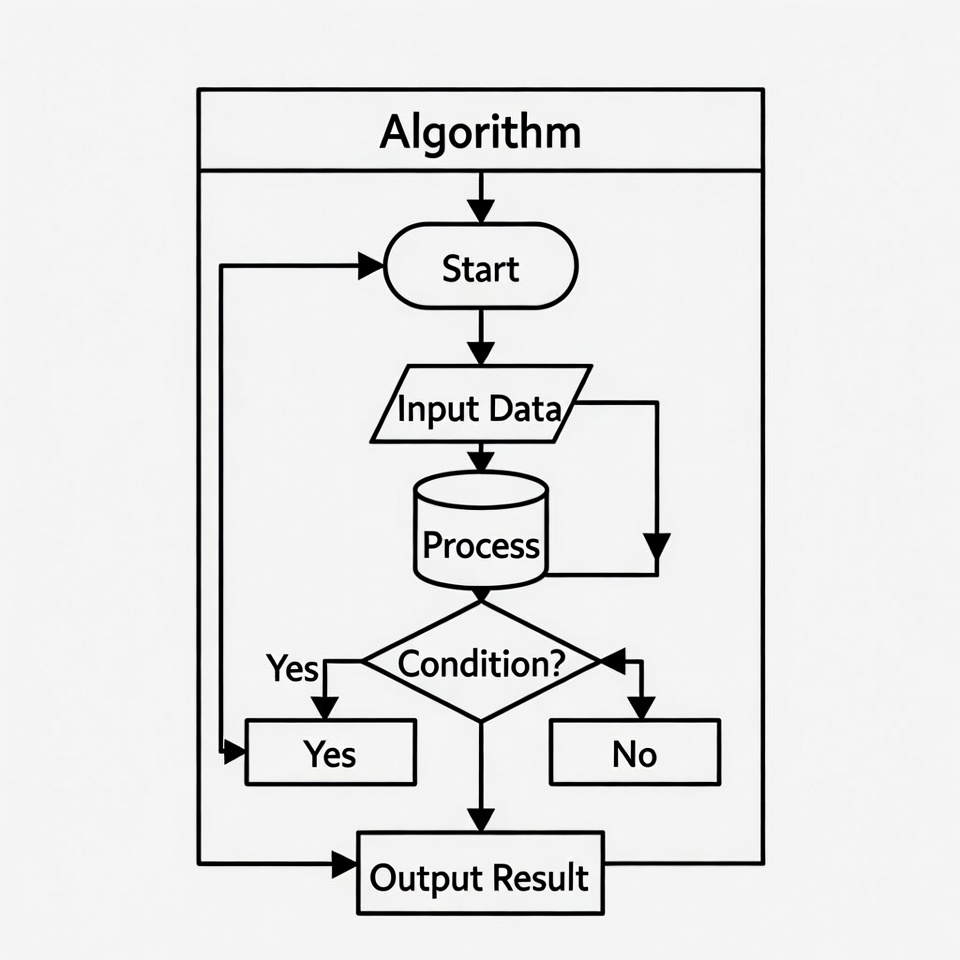
What Is An Algorithm In Math? Steps And Examples
The short version
- An algorithm is a set of steps that solves a problem the same way every time. Follow the steps and you get the right answer without having to reinvent the method.
- In school math, “the standard algorithm” means the column methods for adding, subtracting, multiplying, and dividing that kids learn in grades 2 to 5.
- Computers use the same idea. A program is an algorithm written in a language a machine can follow.
- Algorithms are the reason you can do 4,829 + 3,176 without thinking hard. The steps carry the work.
- A kid who can’t run an algorithm usually has a fact fluency or place value gap, not an algorithm gap.
An algorithm is a step by step procedure that always produces the right answer when you follow it correctly. That’s the definition in math, in computer science, and in a pancake recipe. The steps are fixed, they’re in order, and they finish.
Most people searching for the word have heard it about computers or social feeds. Same meaning: a feed’s algorithm is a list of steps a program follows to pick what to show you. In math class the word points at something more concrete, the column methods your child uses for arithmetic. Here’s both, with every standard algorithm worked step by step.
What makes something an algorithm
Three things have to be true. The steps must be clear enough that two people get the same result. They must be in a definite order. And the process must stop.
“Add 3 to a number, then double the result” is an algorithm. Feed it 7 and you get (7 + 3) × 2 = 20. Feed it 12 and you get 30. Same steps, any input, a guaranteed answer.
“Guess a number and see if it’s right” is not an algorithm. No rule says what to guess next, and nothing promises it ends.
The standard algorithms for arithmetic
When a teacher says “use the standard algorithm,” they mean one of four column procedures. Here’s each one worked out.
Addition with regrouping: 367 + 485
Line the numbers up by place value, then work right to left.
Ones: 7 + 5 = 12. Write the 2, carry the 1 into the tens.
Tens: 6 + 8 = 14, plus the carried 1 makes 15. Write the 5, carry the 1 into the hundreds.
Hundreds: 3 + 4 = 7, plus the carried 1 makes 8. Write the 8.
Answer: 852
The carry is not a trick. Twelve ones is one ten and two ones, so the ten moves to the tens column where it belongs.
Subtraction with regrouping: 802 – 347
This one trips kids up because of the zero.
Ones: 2 – 7 doesn’t work with whole numbers, so borrow. The tens digit is 0, so go one more place left.
Take 1 hundred from the 8. Now there are 7 hundreds and 10 tens.
Take 1 ten from those 10 tens. Now there are 9 tens and 12 ones.
Ones: 12 – 7 = 5
Tens: 9 – 4 = 5
Hundreds: 7 – 3 = 4
Answer: 455
Check it by adding back: 455 + 347 = 802. Teach your kid to do that check every time.
Multiplication: 46 × 27
Break the bottom number into its places, multiply by each, then add.
46 × 7 = 322
46 × 20 = 920
322 + 920 = 1,242
Answer: 1,242
The “extra zero” kids are told to write in the second row is just the 20. You’re multiplying by 2 tens, so the result lands one place to the left.
Long division: 738 ÷ 6
Four steps on repeat: divide, multiply, subtract, bring down.
7 ÷ 6 = 1 with 1 left. Write 1 above the 7. Multiply 6 × 1 = 6, subtract 7 – 6 = 1, bring down the 3 to make 13.
13 ÷ 6 = 2 with 1 left. Write 2. Multiply 6 × 2 = 12, subtract 13 – 12 = 1, bring down the 8 to make 18.
18 ÷ 6 = 3 exactly. Write 3. Multiply 6 × 3 = 18, subtract 18 – 18 = 0. Nothing left to bring down.
Answer: 123
Check by multiplying back: 123 × 6 = 738.
Algorithms in computing vs algorithms in math
The word means the same thing in both places. The difference is who runs the steps.
| Question | In math class | In computing |
|---|---|---|
| Who follows the steps? | A person with a pencil | A machine |
| Written as | A worked column procedure | Code |
| Typical example | Long division | Sorting a list of names |
| What counts as success | The right answer | The right answer, fast enough |
Every algorithm your child learns in elementary school is also something a computer can be programmed to do. Worth saying out loud to a kid who thinks arithmetic has nothing to do with the phone in their pocket.
Why schools still teach the standard algorithm
Modern curricula start with strategies that show what’s happening: number lines, partial sums, area models. The standard algorithm comes later on purpose. It’s fast, but it hides the reasoning, so teaching it too early produces kids who push digits around without knowing why.
The order matters. Understand first, then compress into the algorithm. A student who only has the steps gets stuck the second a problem looks unfamiliar.
Common mistakes
Misaligned columns. Adding 1,205 + 897 with the digits shifted one place gives nonsense. Lined paper turned sideways keeps each column put.
Forgetting the carried digit. Kids write the small 1 and then add the column without it. Say the carried number out loud as part of the sum.
Borrowing across a zero. This is the single biggest subtraction error. Practice 500 – 263 and 3,004 – 1,258 until the double borrow feels normal.
Dropping the placeholder in multiplication. Leaving out the shift in the second row turns 46 × 27 into 46 × 2 + 46 × 7. The answer comes out around 400 instead of 1,242.
Skipping the subtract step in long division. Kids who rush jump straight from multiply to bring down and lose the remainder.
Never checking. Addition checks with subtraction, division checks with multiplication. A ten second check catches most errors.
Practice problems
1. 248 + 176
2. 500 – 263
3. 34 × 12
4. 896 ÷ 7
5. 1,205 + 897
6. 63 × 45
7. 945 ÷ 8, with a remainder
8. Run this algorithm on the number 9: add 3, double it, then subtract 6. What do you get? Try it on 20 as well and describe what the algorithm does in plain words.
Answers
1. 424. Ones: 8 + 6 = 14, write 4 carry 1. Tens: 4 + 7 = 11, plus 1 is 12, write 2 carry 1. Hundreds: 2 + 1 = 3, plus 1 is 4.
2. 237. Borrow across the zero: 5 hundreds becomes 4 hundreds and 10 tens, then 9 tens and 10 ones. Ones 10 – 3 = 7, tens 9 – 6 = 3, hundreds 4 – 2 = 2.
3. 408. 34 × 2 = 68, 34 × 10 = 340, and 68 + 340 = 408.
4. 128. 8 ÷ 7 = 1 remainder 1, bring down 9 to make 19. 19 ÷ 7 = 2 remainder 5, bring down 6 to make 56. 56 ÷ 7 = 8 exactly.
5. 2,102. Line up the places carefully: 1,205 + 897 = 2,102.
6. 2,835. 63 × 5 = 315, 63 × 40 = 2,520, and 315 + 2,520 = 2,835.
7. 118 remainder 1. Check: 8 × 118 = 944, and 944 + 1 = 945.
8. Starting with 9: 9 + 3 = 12, 12 × 2 = 24, 24 – 6 = 18. Starting with 20: 20 + 3 = 23, 23 × 2 = 46, 46 – 6 = 40. The algorithm doubles whatever number you start with.
What it means if your child is stuck here
A child who can’t run the standard algorithm almost never has an algorithm problem. Watch which step breaks and the real gap shows itself.
If they stall inside a step, counting on fingers for 8 + 6 or 6 × 7, the gap is fact fluency. The algorithm is fine. Their working memory is spent on the facts, so there’s nothing left for the procedure. If the columns drift and the digits end up in the wrong places, the gap is place value, usually a second or third grade skill. If they can do 500 – 263 with blocks but not on paper, they never connected the written steps to the meaning, and going back to the concrete version for a week usually fixes it.
Math skills by grade level for grades 3 to 5 lays out when each algorithm is supposed to land, and 12 signs your child is behind in math by grade level covers the warning signs at each age. These gaps compound quietly. A kid who is shaky on long division in fifth grade will be shaky on dividing polynomials later, which is part of the pattern described in why algebra trouble usually traces back to fourth grade fractions.
Frequently asked questions
What is the definition of an algorithm?
An algorithm is a finite list of clear, ordered steps that solves a problem or completes a calculation. Anyone who follows the same steps on the same input gets the same result.
What is an example of an algorithm in math?
Long division is the classic one: divide, multiply, subtract, bring down, repeat. Column addition, column subtraction, and the standard multiplication method are algorithms too, as is the procedure for finding a greatest common factor.
Is an algorithm the same as a formula?
No. A formula is a relationship, like A = lw. An algorithm is a procedure with steps in order. Using a formula can be part of an algorithm, but the formula by itself doesn’t tell you what to do first.
What grade do kids learn algorithms in math?
The standard addition and subtraction algorithms usually land in grades 2 to 4, standard multiplication around grade 5, and long division in grades 4 to 6, depending on the curriculum.
Why do computers use algorithms?
A computer can only follow instructions, so any task it performs has to be broken into exact steps first. Writing those steps down is writing an algorithm, and the code is that algorithm in a language the machine reads.
Does my child need to memorize the standard algorithm?
They need to be able to use it accurately and know why it works. Memorizing the steps without the meaning is the version that falls apart under pressure, usually on a timed test.
Find the actual gap
If your child is struggling with a written algorithm, more repetitions of the same worksheet rarely help. The missing piece is usually one grade level down, and it’s hard to spot from the outside. Math Anon begins with a short adaptive assessment that adjusts as your child works, then gives you a written report naming the exact skills that are missing.
What follows is about 20 minutes a day of practice aimed at those gaps, with a weekly progress report so you can watch the holes close. Start the assessment for $49. That $49 is credited back in full on your first month, and the pricing page spells out the rest.





