
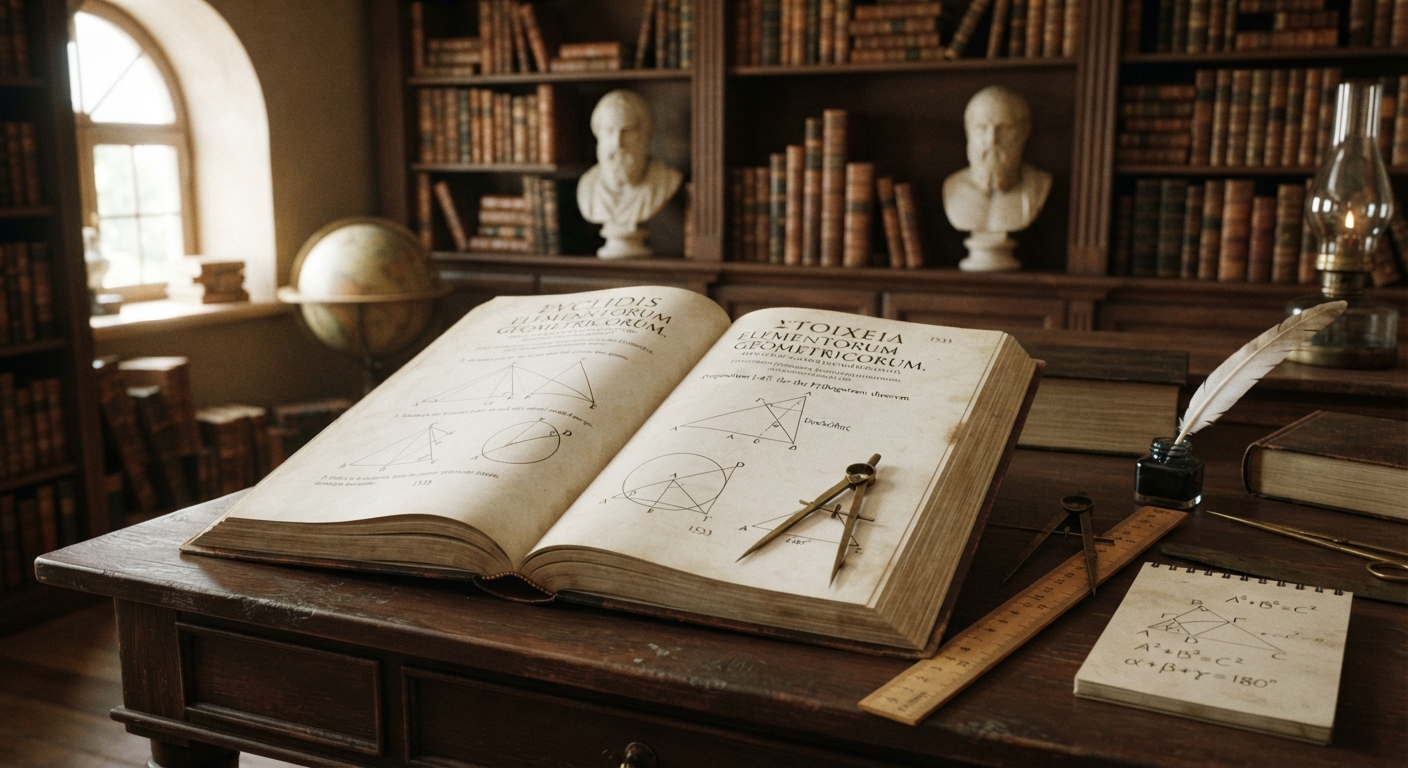
Who Was Euclid? The Father Of Geometry
The short version
- Euclid was a Greek mathematician who taught in Alexandria, Egypt around 300 BCE. He’s called the father of geometry because of one book.
- That book, the Elements, is a 13 volume set that gathers the geometry and number theory known at the time and arranges it so every result is proved from a handful of starting assumptions.
- Those starting assumptions include five postulates. Four are obvious. The fifth, about parallel lines, bothered mathematicians for two thousand years and eventually produced whole new geometries.
- Your child’s high school geometry course is still built on Euclid’s structure: definitions first, then postulates, then theorems proved in order.
- Almost nothing is known about Euclid personally. Most confident sounding biographies of him are guesswork stacked on later sources.
Euclid was a mathematician working in Alexandria around 300 BCE who wrote the Elements, the textbook that defined how geometry gets taught. He didn’t discover most of the math in it. What he did was organize it, starting from a short list of definitions and assumptions and proving everything else step by step from there. That structure is why geometry class looks the way it does 2,300 years later.
Beyond the math, the historical record on Euclid is thin. We have no reliable dates for his birth or death and no contemporary account of his life. The details below separate what’s reasonably well supported from what’s tradition.
Who Euclid was, as far as anyone knows
Most of what gets repeated about Euclid traces back to Proclus, a commentator writing roughly 750 years after Euclid lived. Proclus places him in Alexandria during the reign of Ptolemy I, which puts his working life around 300 BCE, and says he studied with students of Plato. That’s about the extent of the reliable record.
Two famous stories come from that later tradition. In one, Ptolemy asks for a shortcut through geometry and Euclid replies that there’s no royal road. In the other, a student asks what he’ll gain from learning this, and Euclid tells a servant to give the boy a coin, since he has to profit from what he learns. Good stories, no way to confirm them.
Medieval European scholars also spent centuries confusing him with Euclid of Megara, a philosopher who lived about a hundred years earlier. That mix-up shows up in old printed editions of the Elements.
The Elements, and why it mattered so much
The Elements runs to 13 books. The first six cover plane geometry, the next three handle number theory, book ten deals with irrational quantities, and the last three cover solid geometry, ending with the five regular solids.
The content wasn’t new. Pythagoras, Eudoxus, Theaetetus and others had worked most of it out. Euclid’s contribution was the architecture. He opens with definitions, states a small set of assumptions, and then proves proposition after proposition, each one allowed to use only the definitions, the assumptions and the propositions already proved.
That method, called the axiomatic method, spread far past geometry. It’s how mathematics has been written ever since, and it’s why a geometry proof feels so different from an algebra exercise.
The Euclidean algorithm
Book VII contains something your child may meet without hearing Euclid’s name: a fast method for finding the greatest common factor of two numbers. You divide, keep the remainder, and repeat.
Find the greatest common factor of 48 and 18.
48 ÷ 18 = 2 with remainder 12
18 ÷ 12 = 1 with remainder 6
12 ÷ 6 = 2 with remainder 0
The last nonzero remainder is 6, so 6 is the greatest common factor.
It beats listing every factor of both numbers, and it works just as well on numbers far too big to factor by hand.
Euclid’s five postulates
A postulate is a starting rule you accept without proof. Euclid needed five of them, stated here in plain modern language.
| Postulate | What it says |
|---|---|
| 1 | You can draw a straight line from any point to any other point. |
| 2 | You can extend any straight line segment as far as you want in either direction. |
| 3 | You can draw a circle with any center and any radius. |
| 4 | All right angles are equal to each other. |
| 5 | Given a line and a point not on it, there is exactly one line through that point parallel to the first line. |
The first four read like instructions for a compass and a straightedge, which is exactly what they are. Euclid’s own wording of the fifth is longer and clunkier, about two lines meeting on the side where the interior angles add to less than two right angles. The version in the table, known as Playfair’s axiom, says the same thing more clearly.
The fifth postulate is the interesting one. It sounds less self-evident than the others, and for roughly two thousand years mathematicians tried to prove it from the first four. Every attempt failed or quietly assumed the thing it was proving.
What happened when people dropped the fifth postulate
In the 1800s, several mathematicians tried assuming the fifth postulate was false and looking for a contradiction. They didn’t find one. They found consistent geometries instead.
On a sphere, “straight lines” are great circles, and any two of them cross, so there are no parallels at all. In hyperbolic geometry, infinitely many lines through a point run parallel to a given line. In both, triangle angles stop adding to 180 degrees.
None of this made Euclid wrong. It showed that his fifth postulate is a choice about what kind of space you’re describing, not a fact forced by logic. Flat paper obeys Euclid. The surface of the Earth doesn’t, which is why long flights follow curved looking routes. General relativity uses non-Euclidean geometry to describe space and time.
Every result your child studies in high school geometry, including the fact that a triangle’s angles sum to 180 degrees and the properties of supplementary angles, depends on that fifth postulate holding.
Common mistakes and mix-ups
Thinking Euclid invented the math in the Elements. He collected, corrected and organized results that were already circulating. The proof structure is his achievement.
Mixing up postulates and theorems. Postulates are assumed. Theorems are proved from them. “All right angles are equal” is assumed. “The angles of a triangle sum to 180 degrees” is proved.
Believing non-Euclidean geometry disproved Euclid. It didn’t. It described different surfaces. Euclidean geometry still gives the right answers for flat figures, which covers essentially all of K-12 work.
Treating the Pythagorean theorem as Euclid’s. It predates him. It appears as Proposition 47 in Book I, with a proof, but the result is older.
Stating Euclid’s biography with confidence. Sources written centuries later are the only ones we have. “Probably” belongs in almost every sentence about his life.
Practice problems
1. Which of Euclid’s postulates lets you draw a circle of any size around any point?
2. Is “all right angles are equal to one another” a postulate or a theorem in the Elements?
3. Two angles of a triangle measure 47 degrees and 68 degrees. Find the third.
4. Two angles are supplementary and one measures 118 degrees. Find the other.
5. Use the Euclidean algorithm to find the greatest common factor of 84 and 36.
6. A right triangle has legs of 6 and 8. Find the hypotenuse.
7. Two straight lines cross and one of the four angles is 35 degrees. Find the other three.
8. On a sphere, a triangle’s angles can add to more than 180 degrees. Which of Euclid’s five postulates fails there?
Answers
1. The third. It allows a circle with any center and any radius.
2. A postulate. It’s the fourth, assumed rather than proved.
3. 65 degrees. 47 + 68 = 115, and 180 – 115 = 65.
4. 62 degrees. Supplementary angles add to 180, and 180 – 118 = 62.
5. 12. 84 ÷ 36 = 2 remainder 12, then 36 ÷ 12 = 3 remainder 0, so the last nonzero remainder is 12.
6. 10. 6 squared is 36 and 8 squared is 64, and 36 + 64 = 100, whose square root is 10.
7. 145, 35 and 145 degrees. The angle opposite the 35 is also 35, and each neighboring angle is 180 – 35 = 145.
8. The fifth, the parallel postulate. On a sphere there are no parallel lines at all, so the whole flat geometry result set changes.
What it means if your child is struggling in geometry
Geometry is the course where a lot of students hit a wall, and Euclid is part of the reason. The subject asks for proof, which means holding a chain of reasoning together rather than running a procedure. That’s a different demand than algebra makes.
When a kid can’t write proofs, the gap is usually one of two things. Either the basic angle and line facts aren’t automatic, so every step requires a hunt through the notes, or the algebra needed to finish a step is weak. Our post on supplementary angles covers one of the facts that has to be instant, and Struggling with algebra? The real problem is usually fourth grade fractions explains how far back the algebra piece often goes.
If proof writing is fine but the arithmetic inside it keeps going wrong, that’s an older gap showing up in new clothes. The grade by grade checklist in math skills by grade level and the warning signs in Is my child behind in math are the places to start.
Frequently asked questions
Why is Euclid called the father of geometry?
Because the Elements set the pattern that geometry has followed ever since: define your terms, state your assumptions, then prove everything else in order. He organized the field rather than discovering most of it.
When did Euclid live?
Around 300 BCE, in Alexandria. Exact dates aren’t known, and the estimate comes from a commentary written centuries after his death.
What is Euclidean geometry?
The geometry of flat surfaces, built on Euclid’s definitions and five postulates. It’s the geometry of school textbooks: parallel lines stay the same distance apart, and a triangle’s angles add to 180 degrees.
What did Euclid actually discover?
Historians credit him mainly with the organization and the proofs rather than the results. Some proofs in the Elements do appear to be his own, including the argument that there are infinitely many prime numbers.
Do students still study Euclid today?
Not the original text, usually. High school geometry teaches his content and his method through a modern textbook, so students learn Euclidean geometry without ever opening the Elements.
Find the actual gap
Geometry trouble almost always has a cause further back, and finding it beats reteaching the current chapter. Math Anon starts with a short adaptive assessment that adjusts as your child works, then hands you a written report naming the exact skills that are missing, from angle basics to the algebra used inside proofs. Start the assessment and you’ll see the list.
From there it’s about 20 minutes of daily practice targeted at those skills, plus a weekly progress report so you can watch it close. The assessment is $49, credited back in full on your first month, and the pricing page spells it out. We explain the daily format in Why 20 minutes a day beats a 90 minute tutoring session.





