
Complementary Angles: Definition, Examples And Practice
The short version
- Complementary angles are two angles whose measures add up to 90°.
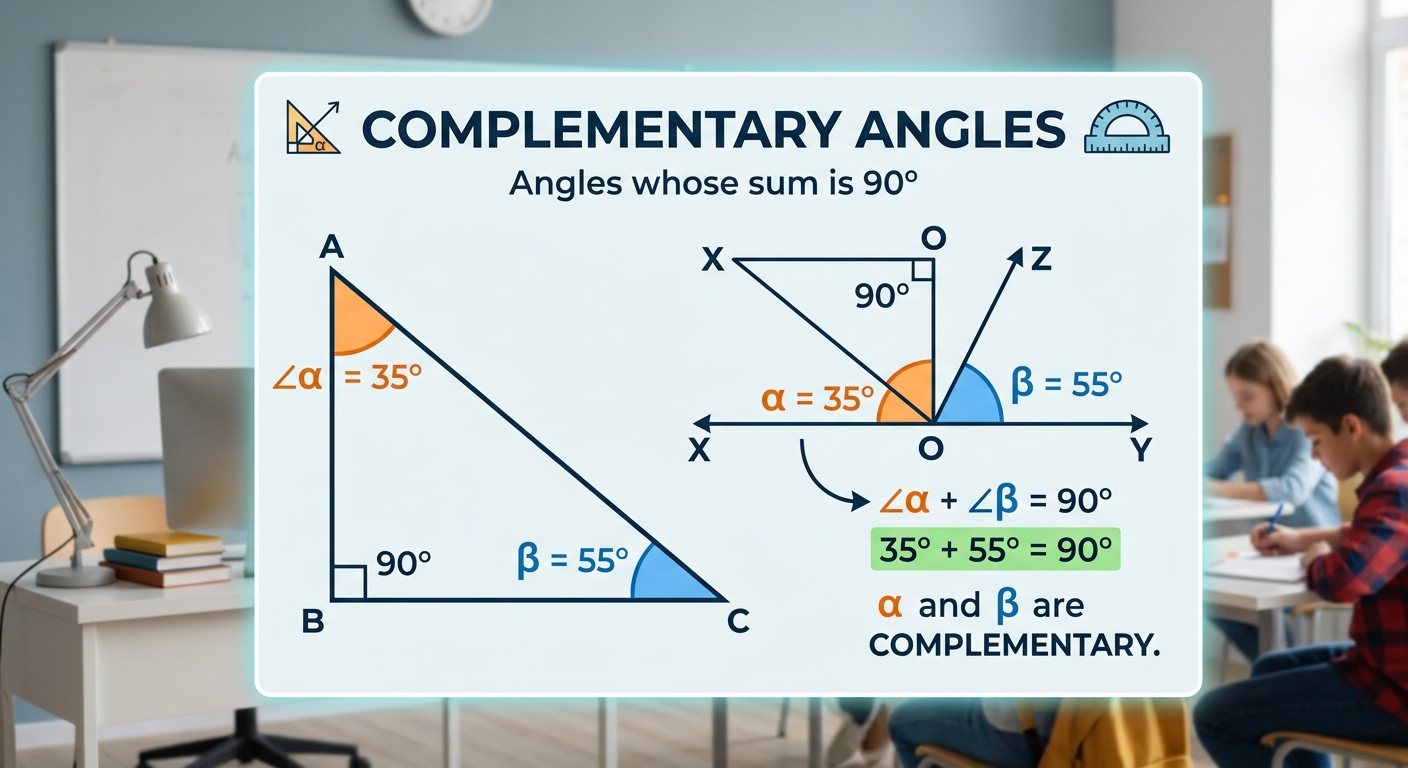
- To find the complement of an angle, subtract it from 90. The complement of 35° is 90 – 35 = 55°.
- The two angles don’t have to touch. They only have to add to 90°.
- Only acute angles have complements. A 90° or bigger angle has nothing left to pair with.
- Memory trick: C comes before S in the alphabet, and 90 comes before 180. Complementary is 90, supplementary is 180.
Complementary angles are any two angles that add up to exactly 90°, the size of a right angle. So 30° and 60° are complementary, and so are 1° and 89°. To find the missing angle, subtract the one you know from 90.
That’s the definition kids need for a worksheet. Below, we cover the harder stuff teachers put on tests: algebra problems, right triangles, the difference from supplementary angles, and the mistakes that cost the most points. There’s a practice set with answers at the end.
Complementary angles definition
Picture the corner of a sheet of paper. That corner is a right angle, 90°. Now draw a line from the corner out across the page. You’ve split the right angle into two smaller angles, and those two angles are complementary. However you tilt the line, the two pieces still add to 90°.
That’s one kind, called adjacent complementary angles: they share a vertex and a side, and together they form a right angle.
The other kind is non-adjacent. A 25° angle in one corner of a diagram and a 65° angle somewhere else are still complementary, because 25 + 65 = 90. Only the sum matters.
Each angle in the pair is called the complement of the other. The complement of 25° is 65°, and the complement of 65° is 25°.
How to find a complementary angle
The formula is short:
complement = 90° – angle
| Angle | Work | Complement |
|---|---|---|
| 10° | 90 – 10 | 80° |
| 35° | 90 – 35 | 55° |
| 45° | 90 – 45 | 45° |
| 58° | 90 – 58 | 32° |
| 81° | 90 – 81 | 9° |
| x° | 90 – x | (90 – x)° |
Notice 45°. It’s the only angle that’s its own complement.
To check whether two angles are complementary, add them. 28° and 62°: 28 + 62 = 90, so yes. 40° and 55°: 40 + 55 = 95, so no.
Worked examples with algebra
By 7th grade, complementary angle problems usually come with a variable. The setup is always the same: the two angles add to 90, so write an equation that says so.
Example 1: x and 2x
Two angles are complementary. One is x and the other is 2x. Find both.
x + 2x = 90
3x = 90
x = 30
The angles are 30° and 60°. Check: 30 + 60 = 90.
Example 2: expressions on both angles
Two complementary angles measure (2x + 10)° and (x + 20)°. Find each angle.
(2x + 10) + (x + 20) = 90
3x + 30 = 90
3x = 60
x = 20
First angle: 2(20) + 10 = 50°. Second angle: 20 + 20 = 40°.
Check: 50 + 40 = 90.
A lot of kids stop at x = 20 and call that the answer. The question asked for the angles, so plug x back in.
Example 3: “an angle is 4 times its complement”
Let the complement be x. The angle is 4x.
x + 4x = 90
5x = 90
x = 18
The complement is 18° and the angle is 72°. Check: 72 is 4 × 18, and 72 + 18 = 90.
Example 4: right triangles
Every triangle’s angles add to 180°. In a right triangle, one angle is 90°, which leaves 90° for the other two. So the two acute angles of any right triangle are complementary.
If a right triangle has a 37° angle, the third angle is 90 – 37 = 53°. No need to subtract from 180 twice.
Complementary vs. supplementary angles
These two get mixed up more than anything else in middle school geometry. Here they are side by side. We go deeper on the second one in Supplementary Angles, Explained.
| Complementary | Supplementary | |
|---|---|---|
| Sum | 90° | 180° |
| Together they make | A right angle (a corner) | A straight line |
| Find the partner | 90 – angle | 180 – angle |
| Partner of 40° | 50° | 140° |
| Which angles have one? | Only acute angles | Any angle under 180° |
Two memory tricks that stick: C for corner (complementary makes a corner) and S for straight (supplementary makes a straight line). Or just alphabetical order: C before S, 90 before 180.
For older students, there’s a bonus. The “co” in cosine stands for complement. The cosine of an angle equals the sine of its complement, so cos 30° = sin 60°. That connection is why complementary angles keep showing up in trigonometry.
Common mistakes with complementary angles
- Subtracting from 180. The classic mix-up. A kid asked for the complement of 40° writes 140°. Quick check: a complement has to be smaller than 90°.
- Thinking they must be next to each other. Adjacent angles can be complementary, but so can angles on opposite sides of a page.
- Calling three angles complementary. 20°, 30° and 40° add to 90°, but the term means a pair of angles.
- Trying to find the complement of an obtuse angle. 120° has no complement. 90 – 120 would be negative, and angles in this context can’t be.
- Stopping at x. In algebra problems, finding x is halfway. Substitute back to get the actual angles.
- Arithmetic slips. 90 – 58 needs regrouping, and a kid who writes 42 made a subtraction slip. The geometry was fine.
Practice problems
- Find the complement of 40°.
- Find the complement of 73°.
- Are 28° and 62° complementary?
- Find the complement of 89.5°.
- A right triangle has an angle of 24°. What’s the other acute angle?
- Two complementary angles measure x° and (x + 14)°. Find both angles.
- An angle is 5 times its complement. Find the angle.
- The supplement of an angle is 3 times its complement. Find the angle.
Answers
- 50° (90 – 40)
- 17° (90 – 73)
- Yes. 28 + 62 = 90.
- 0.5° (90 – 89.5)
- 66° (90 – 24)
- x + x + 14 = 90, so 2x = 76 and x = 38. The angles are 38° and 52°.
- x + 5x = 90, so x = 15. The angle is 5 × 15 = 75°.
- 180 – x = 3(90 – x), so 180 – x = 270 – 3x, which gives 2x = 90 and x = 45°. Check: the supplement is 135° and the complement is 45°, and 135 = 3 × 45.
If your kid is stuck on complementary angles
The idea itself is small. When a kid keeps missing these, the cause is usually one layer down:
- They don’t have a solid sense of what a degree is, or what 90° looks like. That comes from 4th grade angle work.
- Subtracting from 90 trips them up because regrouping across a zero was never secure.
- The algebra versions fall apart because combining like terms and two-step equations aren’t there yet.
Angle measurement starts in 4th grade, and our guide to math skills by grade level shows what should be in place before middle school geometry. If the trouble is really the equations, this post on struggling with algebra explains why the root cause often goes back to fractions. And if you’d like to see exactly which skill is missing instead of guessing, read our parent’s guide to math assessment.
Frequently asked questions
What is a complementary angle?
A complementary angle is the angle that, added to a given angle, makes 90°. The complementary angle to 70° is 20°.
Do complementary angles have to be adjacent?
No. They can share a side and form a right angle together, or they can sit apart. Any two angles that add to 90° count.
Can an obtuse angle have a complement?
No. An obtuse angle is already more than 90°, so there’s nothing left to add. Only acute angles, between 0° and 90°, have complements.
Can two acute angles be supplementary?
No. Two acute angles are each under 90°, so their sum is always under 180°. Two acute angles can be complementary, though, and usually that’s what the question is getting at.
What’s the difference between complementary and supplementary angles?
Complementary angles add to 90°. Supplementary angles add to 180°. Complementary pairs form a corner, and supplementary pairs form a straight line.
What grade learns complementary angles?
In most US schools, 7th grade. Students use complementary, supplementary, vertical and adjacent angles to write and solve equations for unknown angles.
Find the actual gap
A kid who mixes up 90 and 180 once is having a normal week. A kid who can’t set up the equation, or can’t subtract 58 from 90, is missing something earlier. Math Anon’s short adaptive assessment tracks down which earlier skills are shaky and gives you a written report.
After that, it’s roughly 20 minutes of targeted practice a day, with a progress report every week so you can see it working. The assessment costs $49 and is fully credited toward your first month. Start the assessment, or check pricing first.





