
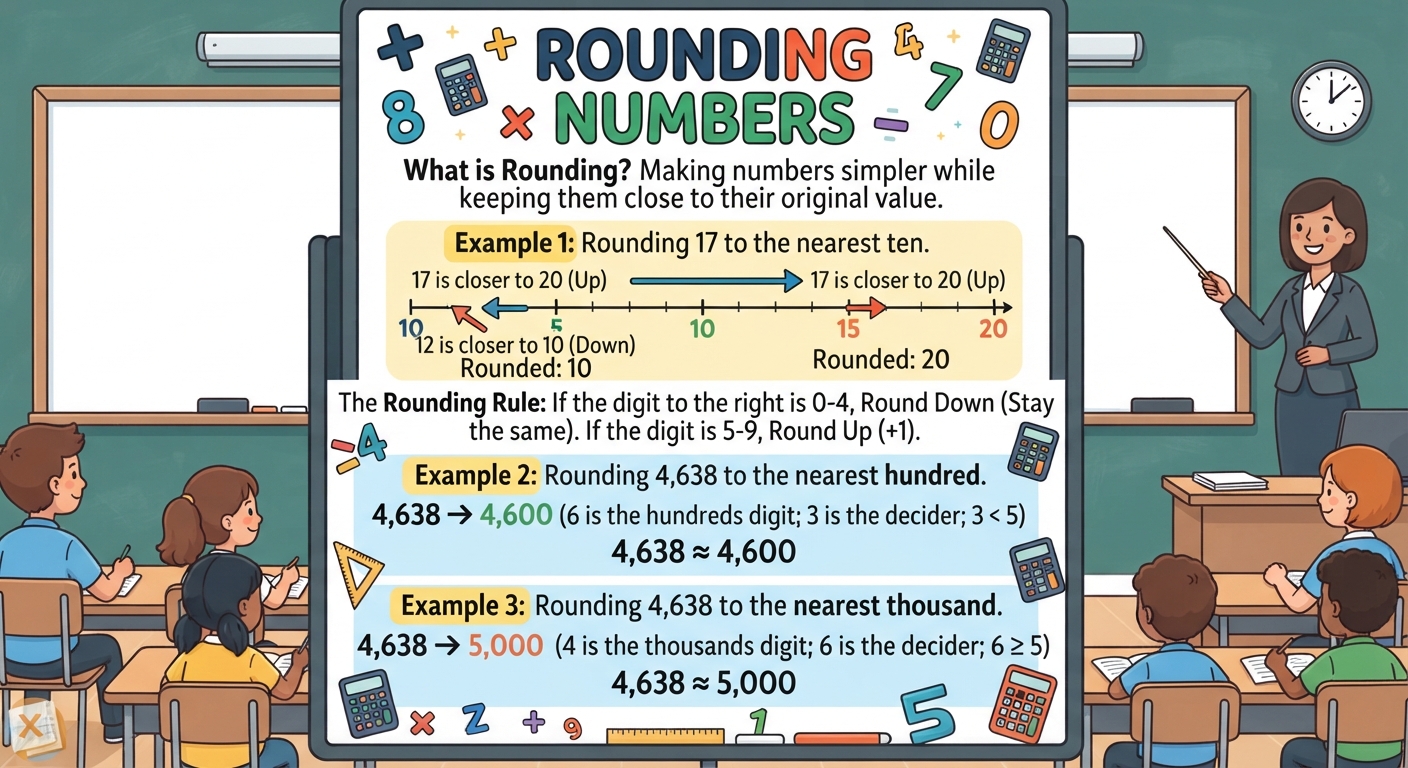
Rounding Numbers: Rules, Examples And Practice
The short version
- To round a number, find the place you’re rounding to, then look at the single digit to its right. If that digit is 5 or more, round up. If it’s 4 or less, keep the rounding digit the same.
- Everything to the right of the rounding place turns into zeros. Nothing to the left changes unless the round up spills over, like 596 rounding to 600.
- Look at one digit only. Rounding 2,749 to the nearest hundred gives 2,700, because the tens digit is 4. The 9 on the end doesn’t get a vote.
- Kids who round wrong usually have a place value gap, not a rounding gap. They can’t name the tens or hundreds digit, so the rule has nothing to grab onto.
Rounding numbers means replacing a number with a nearby number that’s easier to work with, usually one ending in zeros. You pick a place value, check the digit just to the right of it, and round up if that digit is 5 or more or leave it alone if it’s 4 or less. So 47 rounded to the nearest ten is 50, and 4,382 rounded to the nearest thousand is 4,000.
That’s the whole rule. The trouble is that the rule only works if a kid can point to the tens place, the hundreds place and the thousands place without guessing. Below we’ll walk through the rule, several worked examples, the cases that trip kids up, and practice problems with a full answer key.
What rounding numbers actually does
Picture a number line marked at every ten: 40, 50, 60, and so on. Now drop 47 onto it. It sits between 40 and 50, but it’s much closer to 50. Rounding numbers to the nearest ten just means naming the closer mark.
Try 43 instead. Same two marks, but closer to 40, so it rounds to 40. And 45 sits exactly in the middle, which is why there’s a tie-breaker rule at all. The digit test is just a faster version of that number line.
The rule for rounding numbers
Step 1. Find the digit in the place you’re rounding to. Underline it.
Step 2. Look at the one digit directly to its right.
Step 3. If that digit is 5, 6, 7, 8 or 9, add 1 to the underlined digit. If it’s 0, 1, 2, 3 or 4, leave the underlined digit alone.
Step 4. Replace every digit to the right of the underlined one with a zero. Leave everything to the left as it is.
Why 5 rounds up
A number ending in 5 is exactly halfway between the two landmarks, so distance can’t decide it. Math class picks one direction and sticks with it, and the pick is up. So 45 rounds to 50, 250 rounds to 300 at the nearest hundred, and 3,500 rounds to 4,000 at the nearest thousand.
Some fields use a different tie-breaker that sends halfway values to the nearest even number. Your child won’t meet that in K-12 homework. There, 5 goes up.
Rounding to tens, hundreds and thousands
Round 47 to the nearest ten.
Rounding digit: the 4 in the tens place.
Digit to its right: 7. That’s 5 or more, so round up.
4 becomes 5, the ones digit becomes 0.
Answer: 50
Round 4,382 to the nearest hundred.
Rounding digit: the 3 in the hundreds place.
Digit to its right: 8. Round up.
3 becomes 4, and the last two digits become zeros.
Answer: 4,400
Round 4,382 to the nearest thousand.
Rounding digit: the 4 in the thousands place.
Digit to its right: 3. That’s 4 or less, so it stays.
Answer: 4,000
Same number, different answers. The question always has to say which place you’re rounding to, and a kid who skips that half of the question gets half the problems wrong no matter how well they know the rule.
Here’s one number rounded to four different places so you can see the pattern.
| Round 46,392 to the nearest | Digit you check | Up or stay | Answer |
|---|---|---|---|
| Ten | 2 (ones) | Stay | 46,390 |
| Hundred | 9 (tens) | Up | 46,400 |
| Thousand | 3 (hundreds) | Stay | 46,000 |
| Ten thousand | 6 (thousands) | Up | 50,000 |
When rounding up spills over
Sometimes adding 1 to the rounding digit pushes it past 9, and the change carries left. This is the part that throws kids, because the digits they were told not to touch end up changing anyway.
Round 596 to the nearest ten.
Rounding digit: the 9 in the tens place.
Digit to its right: 6, so round up.
9 plus 1 is 10, which won’t fit in one place, so the tens go to 0 and the hundreds go from 5 to 6.
Answer: 600
Round 9,962 to the nearest hundred.
Rounding digit: the 9 in the hundreds place.
Digit to its right: 6, so round up.
99 hundreds plus 1 hundred is 100 hundreds, which is 10,000.
Answer: 10,000
Rounding decimals
The rule doesn’t change when a decimal point shows up. Find the place, check the digit to its right, round, and drop the digits after the rounding place instead of turning them into zeros.
3.68 to the nearest tenth: the next digit is 8, so round up to 3.7. And 12.04 to the nearest tenth: the next digit is 4, so the 0 stays, giving 12.0. Keep that trailing zero. It shows you rounded to tenths on purpose.
Rounding numbers to estimate
The reason schools teach this at all is estimation. A rounded answer tells you whether the exact answer is anywhere near sensible.
Take 38 × 21. Round to 40 × 20 and you get 800. The exact answer is 798, so a kid who writes 7,980 or 79 knows instantly that something slipped.
Same idea at the store. Items at $4.89, $3.15 and $11.40 round to $5, $3 and $11, which is about $19. The real total is $19.44. Close enough to catch a mis-scanned price.
Common mistakes
Rounding twice. Asked for 2,749 to the nearest hundred, a kid rounds 49 up to 50, turns the number into 2,750, then rounds that to 2,800. Wrong. You check the tens digit, which is 4, and the answer is 2,700. Look at one digit, once.
Rounding to the wrong place. The most common cause of a wrong answer isn’t the rule, it’s reading “nearest hundred” and rounding to the nearest ten. Have your child circle the place word in the question before touching the number.
Forgetting the zeros. Rounding 4,382 to the nearest hundred gives 4,400, not 44. The digits to the right become zeros, they don’t disappear.
Thinking 5 is closer to the lower number. It isn’t closer to either one. It’s a tie, and the convention sends it up.
Practice problems
1. Round 63 to the nearest ten.
2. Round 148 to the nearest ten.
3. Round 2,735 to the nearest hundred.
4. Round 8,509 to the nearest thousand.
5. Round 596 to the nearest ten.
6. Round 24,981 to the nearest hundred.
7. Estimate 612 – 289 by rounding both numbers to the nearest hundred.
8. A whole number rounds to 700 when rounded to the nearest hundred. What is the smallest it could be, and what is the largest?
Answers
1. 60. The ones digit is 3, so the tens digit stays.
2. 150. The ones digit is 8, so 4 tens becomes 5 tens.
3. 2,700. Check the tens digit, which is 3. The 5 at the end is not the digit you check.
4. 9,000. The hundreds digit is 5, so 8 thousands becomes 9 thousands.
5. 600. The ones digit is 6, so 59 tens becomes 60 tens.
6. 25,000. The tens digit is 8, so 249 hundreds becomes 250 hundreds.
7. About 300. 612 rounds to 600 and 289 rounds to 300, and 600 – 300 = 300. The exact answer is 323.
8. Smallest 650, largest 749. 650 is a tie that rounds up to 700, and 749 rounds down to 700. One more, 750, would round to 800.
What it means if your child is stuck on rounding
Rounding is almost never the real problem. Most kids can repeat the rule back to you after one lesson. When the homework keeps coming back marked wrong, the gap is underneath it.
The usual culprit is place value. If your child can’t instantly point to the hundreds digit in 46,392, the rule has nothing to attach to, and they end up counting digits and losing track. Place value quietly powers rounding, regrouping, decimals and long division, so a hole there shows up again and again. Our guide to math skills by grade level lays out what should be solid by the end of each year.
The second suspect is number sense, meaning a rough feel for where 4,382 lives. Kids without it are running a procedure they can’t sanity check. If that sounds familiar, the signs in Is my child behind in math are worth reading, and if the frustration has turned into avoidance, math anxiety in children covers what that looks like at home.
Frequently asked questions
What is the rule for rounding numbers?
Find the digit in the place you’re rounding to, then look at the single digit immediately to its right. If that digit is 5 or higher, add 1 to the rounding digit. If it’s 4 or lower, leave the rounding digit as it is. Then replace every digit to the right with a zero.
Does 5 always round up?
In K-12 math, yes. A number ending in 5 is exactly halfway between two landmarks, so there’s no closer option and math class uses a fixed convention that sends it up. Some scientific and financial settings use a different tie-breaker, but that isn’t what your child’s worksheet wants.
How do you round to the nearest hundred?
Look at the tens digit. If it’s 5 or more, bump the hundreds digit up by one. If it’s 4 or less, leave the hundreds digit alone. Either way the tens and ones become zeros. So 2,735 becomes 2,700 and 2,751 becomes 2,800.
What grade do kids learn rounding numbers?
Most students round to the nearest ten and hundred in third grade, extend to larger whole numbers in fourth grade, and start rounding decimals in fifth grade. Estimation problems that use rounding keep showing up through middle school.
Why does my child round the same problem differently every time?
Usually because they’re identifying the place value by counting rather than by knowing it, so a long number throws off the count. Drilling rounding harder won’t fix it. Shoring up place value will.
Find the actual gap
Guessing at which skill is missing wastes weeks. Math Anon starts with a short adaptive assessment that adjusts as your child answers, then hands you a written report naming the specific skills that are shaky, whether that’s place value, subtraction with regrouping or something two grades back. Start the assessment and you’ll know what you’re dealing with instead of guessing.
From there your child gets about 20 minutes of targeted daily practice aimed at those gaps, and you get a weekly progress report showing what moved. The assessment is $49 and we credit the full amount back on your first month, so see pricing for the details. Short daily sessions work better than one long weekly cram, which we get into in Why 20 minutes a day beats a 90 minute tutoring session.





