
What Is A Function In Math?
The short version
- A function in math is a rule that takes an input and gives back exactly one output. Same input, same answer, every single time.
- The one output rule is the whole test. If one input can produce two different outputs, the rule isn’t a function.
- f(x) is a name, not a multiplication. f(3) means “run 3 through the rule f,” so if f(x) = 2x + 3 then f(3) = 9.
- On a graph, use the vertical line test. If any vertical line crosses the curve more than once, one input has two outputs and you don’t have a function.
- Kids who stall on functions usually aren’t confused by functions. They’re shaky on substituting a number into an expression, especially with negatives.
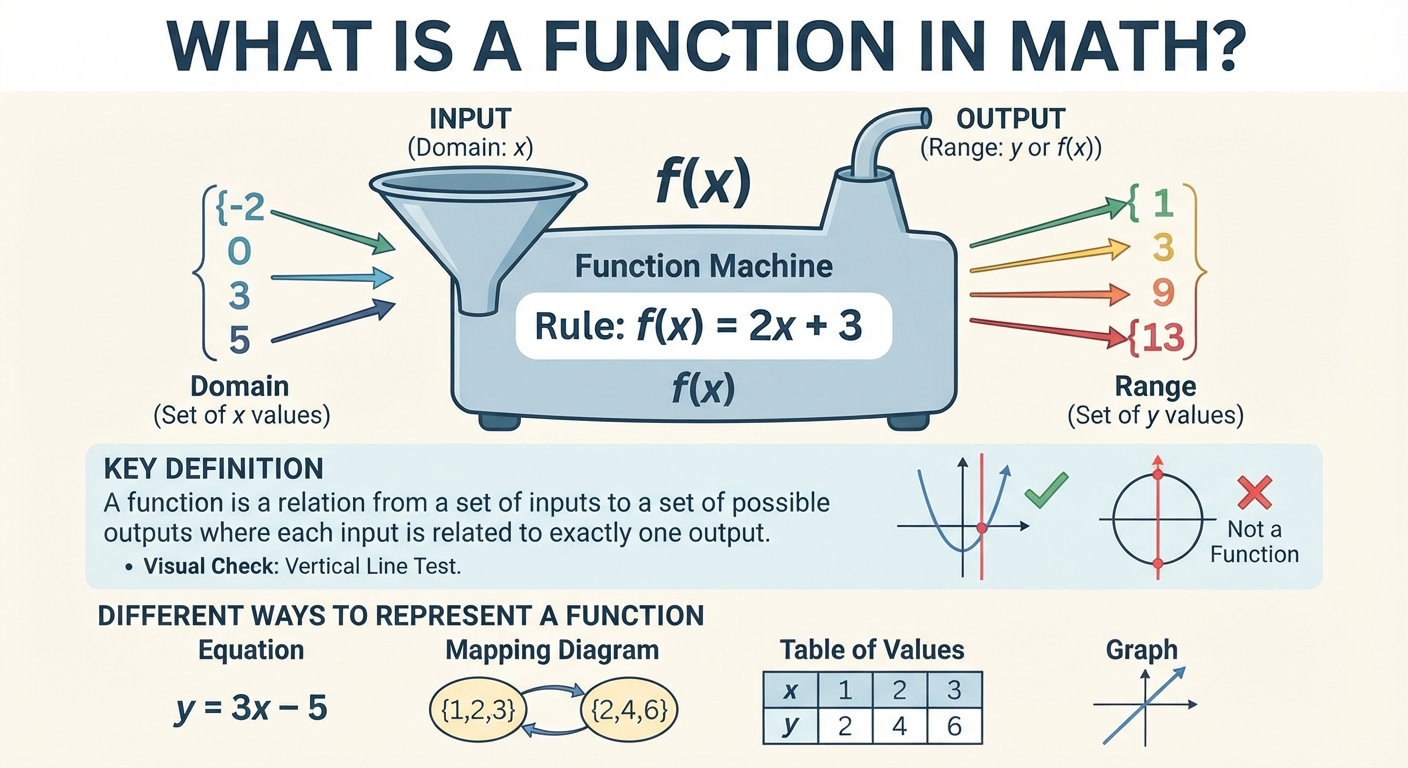
A function in math is a rule that pairs each input with exactly one output. Feed it a number, it hands back one answer, and it hands back that same answer every time you feed it that number. The rule “double it, then add 3” is a function: give it 4 and you always get 11.
That “exactly one” is doing all the work. A rule that could hand back 11 or 12 for the same input isn’t a function. Everything else about functions, the f(x) notation, the tables, the vertical line test, is just different ways of checking or using that one condition.
What a function in math actually is
The usual picture is a machine. A number goes in the top, the machine does something fixed to it, and a number comes out the bottom. The machine never changes its mind, so the same number in always gives the same number out.
Take the machine “multiply by 3, then subtract 1.” Put in 0 and you get -1. Put in 2 and you get 5. Put in 2 again tomorrow and you still get 5. That reliability is what makes it a function.
Now try “give me a number whose square is 9.” Hand it 9 and it could answer 3 or -3. Two outputs for one input, so that rule fails.
The allowed inputs are called the domain and the possible outputs are called the range. Those words matter later, but the definition of a function in math doesn’t depend on them.
Function notation: what f(x) means
f(x) is read “f of x.” The f is the name of the function, and the x in parentheses is the input. f(x) does not mean f times x, which is the single biggest source of wrong answers in this unit.
So f(x) = 2x + 3 says: whatever you put in the parentheses, double it and add 3.
f(4) = 2(4) + 3 = 8 + 3 = 11
f(0) = 2(0) + 3 = 0 + 3 = 3
f(-2) = 2(-2) + 3 = -4 + 3 = -1
The letters don’t matter. g(t) = 5t and h(n) = 5n are the same rule with different names, and teachers swap them on purpose so students read the structure instead of one memorized shape.
You can also run the rule backward. If h(x) = 2x + 6 and you’re told h(x) = 20, then 2x + 6 = 20, so 2x = 14 and x = 7. Same function, you just know the output and want the input.
How to tell if something is a function
From a list of pairs
Look at the first number in each pair, which is the input. If any input shows up twice with different partners, it’s not a function.
{(1, 2), (2, 4), (3, 6)} is a function. Every input appears once.
{(1, 2), (1, 5), (3, 6)} is not. The input 1 points to both 2 and 5.
{(1, 7), (2, 7), (3, 7)} is a function. Repeated outputs are fine. Only repeated inputs with different outputs break the rule.
That last one surprises students. A function can send many inputs to the same output. “Multiply by 0” sends everything to 0 and is still a perfectly good function.
From a table
Same check, in columns. Scan the input column for a repeat, then see whether the two outputs match.
| Input x | Output f(x) = 3x – 1 |
|---|---|
| 0 | -1 |
| 1 | 2 |
| 2 | 5 |
| 3 | 8 |
No input repeats, so this table describes a function.
From a graph: the vertical line test
Imagine sliding a vertical line across the graph from left to right. If that line ever touches the curve in two or more places at once, the graph shows one input with two outputs, so it isn’t a function.
A line like y = 2x + 3 passes. A parabola like y = x squared passes, since a vertical line hits it once. A circle fails, because a vertical line through the middle hits the top and the bottom.
Four ways the same function shows up
Algebra questions flip between these four forms constantly, and part of the skill is seeing that they all describe one rule.
| Form | Looks like | Used for |
|---|---|---|
| Words | “Triple the number, then subtract 1” | Word problems and setup |
| Equation | f(x) = 3x – 1 | Computing any output fast |
| Table | Input and output columns | Spotting a pattern |
| Graph | A line or curve on axes | Seeing the overall shape |
Where functions show up outside class
A phone plan that charges $20 plus $5 a line is the function C(n) = 20 + 5n, so three lines gives C(3) = 20 + 15 = $35. The area of a square is A(s) = s squared, so a 6 inch square has area 36 square inches. Hourly pay, temperature conversion and distance at a steady speed all work the same way.
Common mistakes
Reading f(x) as multiplication. f(3) is not f times 3. Writing it out as “f of 3” a few times usually fixes this for good.
Checking outputs instead of inputs. Students see 7 appear three times in a list of pairs and call it not a function. Repeated outputs are allowed. Only a repeated input with two different outputs disqualifies it.
Losing the sign on negative inputs. With f(x) = 2x + 3, f(-2) is 2(-2) + 3 = -1. Kids who write 2 – 2 + 3 = 3 dropped the multiplication. Putting the input in parentheses when you substitute prevents most of these.
Assuming every equation is a function. x = y squared is a fine equation and not a function of x, because x = 9 gives y = 3 and y = -3.
Practice problems
1. If f(x) = 4x + 1, find f(3).
2. Using the same rule, find f(0) and f(-2).
3. Is {(2, 5), (3, 5), (4, 5)} a function?
4. Is {(1, 3), (1, 4), (2, 5)} a function?
5. If g(x) = x squared + 2, find g(4) and g(-4).
6. Build a table for h(x) = 5x – 3 using x = 0, 1 and 2.
7. A graph is a full circle centered at the origin. Is it a function? Say which test you used.
8. If h(x) = 2x + 6 and h(x) = 20, what is x?
Answers
1. 13. 4(3) + 1 = 12 + 1 = 13.
2. f(0) = 1 and f(-2) = -7. 4(0) + 1 = 1, and 4(-2) + 1 = -8 + 1 = -7.
3. Yes. The inputs 2, 3 and 4 each appear once. The shared output of 5 is allowed.
4. No. The input 1 is paired with both 3 and 4.
5. Both are 18. 16 + 2 = 18 either way, since squaring -4 gives 16.
6. -3, 2 and 7. 5(0) – 3 = -3, 5(1) – 3 = 2, and 5(2) – 3 = 7.
7. No. The vertical line test fails, because a vertical line through the middle of the circle crosses it twice.
8. x = 7. From 2x + 6 = 20, subtract 6 to get 2x = 14, then divide by 2.
What it means if your child is stuck on functions
Functions land in sixth through eighth grade and get heavy use in algebra. When a student struggles here, the concept is rarely the obstacle. Most kids get the machine idea in five minutes.
The breakdown is almost always in substitution. Plugging -4 into x squared + 2 requires solid integer rules, order of operations and comfort with exponents. Miss any of those and every function problem comes out wrong even though the student knows exactly what a function in math is. If the errors cluster around negatives and fractions, that points back several grades, which is the pattern we lay out in Struggling with algebra? The real problem is usually fourth grade fractions.
The other blocker is graphing. Reading a coordinate plane and plotting points are their own skills. Our guide to math skills by grade level shows when those are supposed to be locked in, and Is my child behind in math lists the signs that a gap has been open for a while.
Frequently asked questions
What is the meaning of a function in math?
It’s a rule that assigns exactly one output to each input. You can describe that rule with words, an equation, a table or a graph, and it stays the same function in every form.
What does f(x) mean?
It’s read “f of x” and names the output of the function f when the input is x. The parentheses hold the input, so f(5) means the result of running 5 through the rule. It never means f multiplied by x.
How do you know if a graph is a function?
Use the vertical line test. Slide an imaginary vertical line across the graph. If it ever hits the curve in two places at the same time, that input has two outputs and the graph isn’t a function.
Can two inputs have the same output?
Yes. The rule only limits outputs per input, not inputs per output. The function f(x) = x squared sends both 3 and -3 to 9, and it’s still a function.
What grade do kids learn functions?
Formal function language usually starts in eighth grade, with input and output tables and simple rules appearing as early as sixth. Algebra 1 leans on functions constantly, so a weak start in middle school tends to show up loudly the next year.
What’s the difference between a relation and a function?
A relation is any set of input and output pairs. A function is a relation with the extra condition that no input repeats with a different output. Every function is a relation, and plenty of relations are not functions.
Find the actual gap
If function homework keeps coming back wrong, the useful question is which underlying skill is missing. Math Anon begins with a short adaptive assessment that adjusts to your child’s answers and produces a written report naming the specific gaps, whether that’s integer operations, order of operations or plotting points. Start the assessment and you’ll get a real list instead of a hunch.
Then your child practices about 20 minutes a day on exactly those skills, and a weekly progress report shows you what’s improving. The assessment runs $49 and we credit it back in full on your first month. The pricing page has the rest, and Why 20 minutes a day beats a 90 minute tutoring session explains why we build it around short daily work.
Related reading
- Struggling With Algebra? The Real Problem Is Usually Fourth Grade Fractions
- Is My Child Behind In Math? 12 Signs By Grade Level
- Math Skills By Grade Level: What Your Child Should Know
- Mind The Gap: A Parent’s Guide To Math Assessment For Kids
- Math Anxiety In Children: What It Looks Like And What Helps





