
Math Enrichment: What It Is, Activities And What To Look For
The short version
- Math enrichment is extra math that goes deeper and wider than the grade-level curriculum: puzzles, multi-step problems, patterns and reasoning. The focus is depth. Moving ahead early is a separate thing.
- It fits kids who finish classwork fast, ask “why,” or seem bored. It can also help an average student who likes puzzles, since enrichment isn’t only for kids labeled gifted.
- Good enrichment problems have more than one path to the answer and make a kid explain their thinking. Worksheets from next year’s textbook are acceleration, which is a different thing.
- Check for gaps first. A bright kid with a missing skill (fractions are the usual one) will hit a wall in enrichment, and it’ll look like a motivation problem.
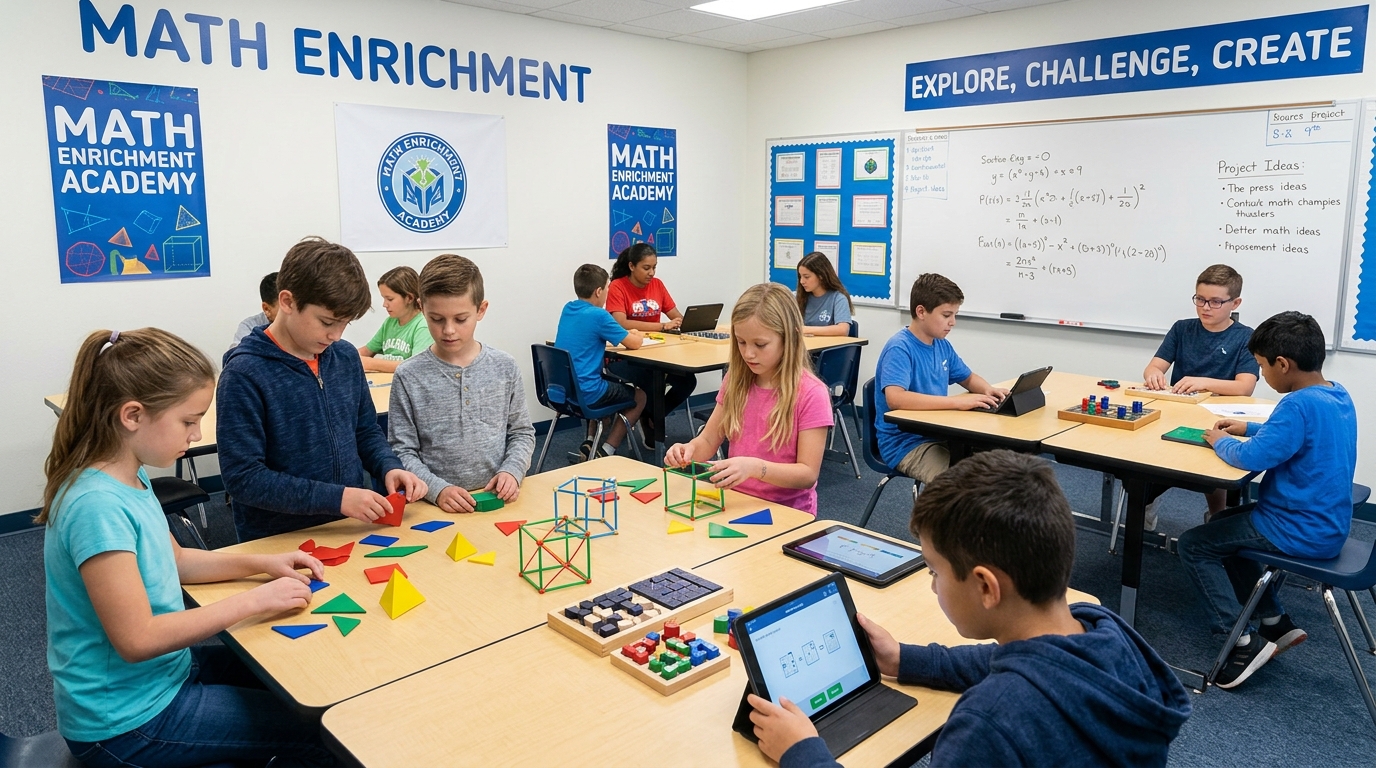
Math enrichment means giving a child math that goes beyond the regular curriculum in depth and variety, instead of just moving faster through it. Think logic puzzles, open-ended problems, number patterns, math games and competition-style questions that ask a kid to reason, not just compute. The goal is stronger problem-solving and a real feel for how numbers behave.
Below we’ll cover how enrichment differs from acceleration and tutoring, how to tell if your child is ready, real sample problems by grade with full solutions, and what to look for in a math enrichment program.
Enrichment vs acceleration vs remediation
Parents often use these words as if they mean the same thing. They don’t, and picking the wrong one can backfire.
| Enrichment | Acceleration | Remediation | |
|---|---|---|---|
| What it does | Goes deeper and wider at or near grade level | Moves to next year’s content early | Fills in skills that were missed |
| Typical work | Puzzles, proofs, patterns, multi-step problems | Next grade’s textbook, skipping a grade in math | Targeted practice on earlier skills |
| Best for | Kids who get the material and want more | Kids who’ve truly mastered their grade | Kids with gaps |
| Risk if misused | Frustration if gaps exist | Shallow understanding, gaps later | Boredom if there’s no real gap |
Many strong students need a mix. A fifth grader can be ready for enrichment in geometry and still need remediation on dividing fractions. That’s normal, and it’s why a skill-level check beats a single “advanced” label.
Signs your child is ready for math enrichment
- They finish classwork early and get it right, most of the time.
- They ask why a rule works, not just how to use it.
- They find shortcuts on their own, like adding 99 by adding 100 and taking 1 away.
- They enjoy puzzles, strategy games or building things.
- They say math is “boring” but light up on a hard problem.
- Their test scores are high but their homework looks rushed.
That last one needs a closer look. Rushed homework can mean boredom, or it can mean a kid is covering for something that’s hard. The difference matters before you pick an enrichment plan.
Math enrichment activities by grade, with worked examples
Good enrichment problems share a few traits. They’re easy to state, they can be solved more than one way, and the best solution usually involves spotting a pattern. Here’s one for each grade band, solved step by step.
Grades K to 2: Ways to make 10
Problem: How many ways can you make 10 by adding two whole numbers, if 3 + 7 and 7 + 3 count as the same?
List them in order so none get missed:
0 + 10, 1 + 9, 2 + 8, 3 + 7, 4 + 6, 5 + 5
That’s 6 ways.
The enrichment part is the follow-up question: why did the list stop at 5 + 5? Because after that the pairs just flip. A kid who can explain that is reasoning about numbers.
Grades 3 to 5: Add 1 through 100 fast
Problem: What is 1 + 2 + 3 + … + 100?
Pair the first number with the last: 1 + 100 = 101.
Then the next pair: 2 + 99 = 101.
Every pair makes 101, and 100 numbers make 50 pairs.
50 × 101 = 5,050
Once a kid sees the pairing trick, ask them to try 1 through 50 or 1 through 20 without help. That’s where the learning sticks.
Grades 3 to 5: The handshake problem
Problem: Six friends meet and every person shakes hands with every other person once. How many handshakes?
Person 1 shakes 5 hands. Person 2 has already shaken with Person 1, so 4 new ones. Then 3, 2, 1, 0.
5 + 4 + 3 + 2 + 1 = 15 handshakes
Another route: each of the 6 people shakes 5 hands, which gives 6 × 5 = 30, but that counts every handshake twice. 30 ÷ 2 = 15. Two methods, same answer. That’s exactly what enrichment is for.
Grades 6 to 8: The last digit of a huge power
Problem: What is the ones digit of 7100?
Nobody should multiply that out. Look at the ones digits of the first few powers:
7¹ = 7
7² = 49, ends in 9
7³ = 343, ends in 3
7⁴ = 2,401, ends in 1
7⁵ ends in 7 again
The pattern 7, 9, 3, 1 repeats every 4 powers. 100 ÷ 4 = 25 with no remainder, so 7100 lands at the end of a cycle, like 7⁴. The ones digit is 1.
What a good math enrichment program looks like
Classes, clubs, apps and puzzle books all count as enrichment. Here’s what to check in any of them:
- It asks for explanations. “How do you know?” matters more than the final number.
- Problems are non-routine. A kid shouldn’t know which formula to use the moment they read the question.
- It’s okay to be stuck. Productive struggle is the point. A program that jumps in with the answer after 30 seconds isn’t enrichment.
- It checks the foundation. Some way of spotting missing skills before piling harder problems on top.
- It’s sustainable. Short, regular sessions beat a long Saturday block your kid dreads. We lay out why in why 20 minutes a day beats a 90-minute tutoring session.
Free options are solid too: library puzzle books, logic games, math circles run by local colleges, and competitions like Math Kangaroo (grades 1 to 12) or MATHCOUNTS (grades 6 to 8). Past competition problems are a cheap source of high-quality enrichment math.
Common mistakes with math enrichment
- Treating it as acceleration. Handing a third grader fourth grade worksheets covers more ground but doesn’t build deeper thinking.
- Skipping the gap check. A strong student who never quite got equivalent fractions will stall on enrichment problems and decide they’re “not a math person.”
- Rewarding speed only. Timed drills have a place, but enrichment should reward the kid who takes ten minutes and finds a clever method.
- Giving the answer too soon. Try a hint question instead: “What would happen with smaller numbers?”
- Doing too much. Enrichment should feel like a good puzzle, not a second school day.
Practice problems
These are enrichment-style problems, roughly from easiest to hardest. Let your child try them with no calculator.
- Using the digits 1, 2 and 3 once each, how many different three-digit numbers can you make?
- What is 1 + 2 + 3 + … + 50?
- Eight people each shake hands once with everyone else. How many handshakes are there?
- A farm has chickens and cows. There are 10 heads and 28 legs. How many of each animal?
- Three consecutive even numbers add up to 78. What are they?
- How many squares of any size are on a 4 by 4 grid?
- What is the ones digit of 350?
- What is the smallest whole number greater than 1 that leaves a remainder of 1 when divided by 2, 3, 4, 5 or 6?
Answers
- 6: 123, 132, 213, 231, 312, 321.
- 25 pairs that each add to 51, so 25 × 51 = 1,275.
- 8 × 7 = 56, then 56 ÷ 2 = 28 handshakes.
- 6 chickens and 4 cows. If all 10 were chickens there’d be 20 legs. The extra 8 legs come from cows, 2 extra each, so 4 cows. Check: 6 × 2 + 4 × 4 = 12 + 16 = 28.
- 24, 26 and 28. The middle number is 78 ÷ 3 = 26.
- 30: sixteen 1 by 1, nine 2 by 2, four 3 by 3 and one 4 by 4. 16 + 9 + 4 + 1 = 30.
- 9. The ones digits cycle 3, 9, 7, 1. 50 ÷ 4 = 12 remainder 2, so it matches 3², which ends in 9.
- 61. The smallest number that 2, 3, 4, 5 and 6 all divide is 60, and 60 + 1 = 61.
If your child struggles with enrichment problems
Some struggle is the whole idea. A kid who’s stuck for five minutes and then finds a way in is doing exactly what enrichment is built for. But if your child freezes, guesses, or gets upset fast, look for a skill gap before you decide enrichment “isn’t for them.”
The gaps that trip up strong students most are fractions, place value and multiplication fluency. A kid who has to count on fingers to get 7 × 8 spends all their energy on arithmetic and has nothing left for the puzzle. Our parent’s guide to math assessment for kids explains how to find what’s actually missing. If the frustration looks more like dread than confusion, math anxiety in children is worth a read, since pushing harder problems on an anxious kid tends to make it worse.
Frequently asked questions
What is math enrichment?
Math enrichment is extra math that goes beyond the standard curriculum in depth and variety. It uses puzzles, games, open-ended questions and multi-step problems to build reasoning, instead of moving a student into next year’s content.
Is math enrichment only for gifted kids?
No. Any child who’s solid on grade-level skills and enjoys a challenge can benefit. Many enrichment problems can be scaled down so a younger or average student can work on them too.
What’s the difference between math enrichment and tutoring?
Tutoring usually targets what’s hard right now, like homework, tests or missing skills. Enrichment adds challenge for a child who already has the basics. Some kids need both at once in different topics.
How much time should kids spend on math enrichment?
A little, often. Two or three short sessions a week of 15 to 30 minutes works well for most elementary and middle schoolers, as long as it stays enjoyable.
What are good math enrichment activities at home?
Logic puzzles, strategy games, pattern problems like the ones above, estimation challenges while cooking or shopping, and old competition problems. The best ones ask “how do you know?” at the end.
Find the actual gap
Before adding enrichment, it helps to know exactly where your child stands. Math Anon begins with a short adaptive assessment that goes up and down the grade levels, so it finds missing skills and also shows where a child is working ahead. You get a written report that lists both.
Then it’s about 20 minutes a day of practice pitched at the right level, filling holes where they exist and pushing further where your child is ready, with a progress report each week. Start the assessment. It’s $49, and that’s credited back in full on your first month. See pricing for plan details.





