
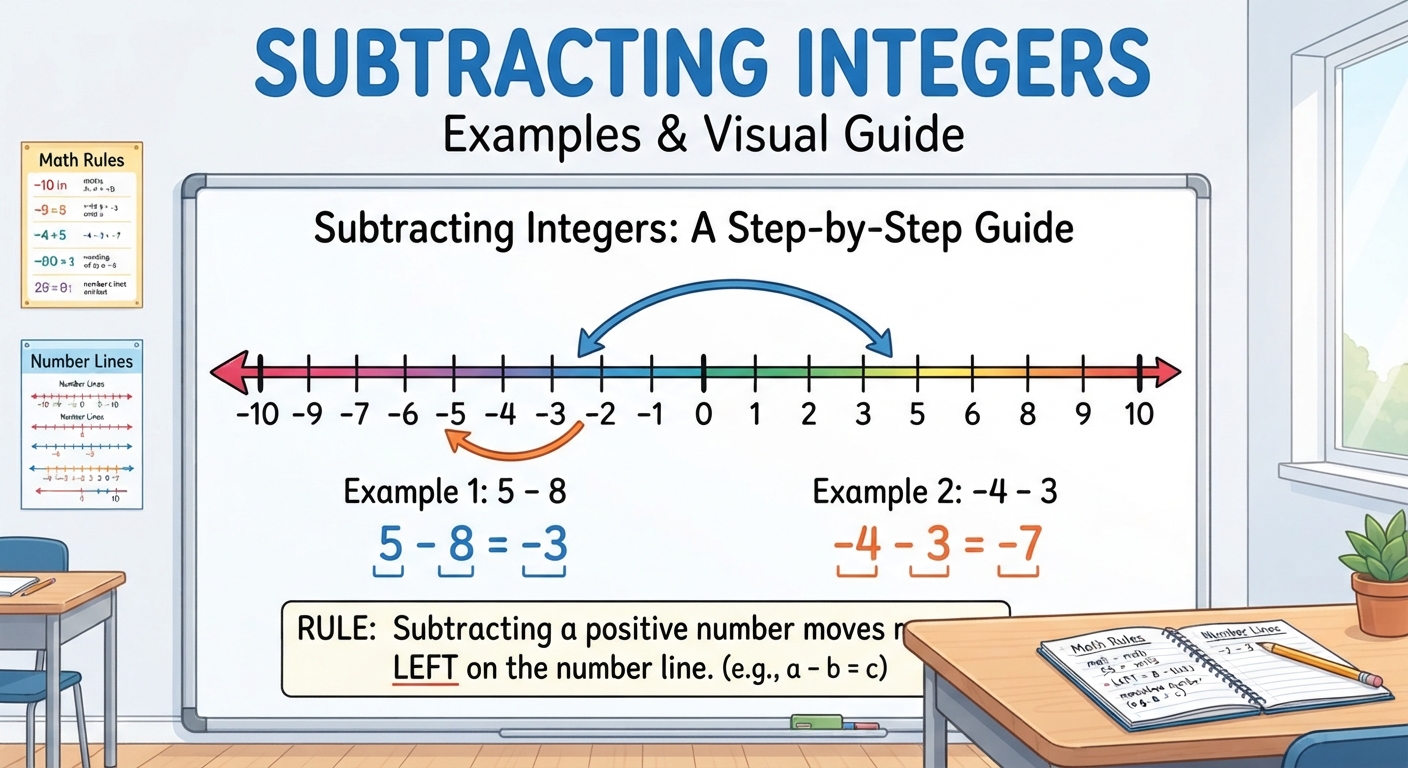
Subtracting Integers, Including Negative Minus Negative
The short version
- To subtract an integer, add its opposite. 7 – (-4) becomes 7 + 4 = 11, and -6 – 9 becomes -6 + (-9) = -15.
- Only two things change: the minus sign becomes a plus, and the second number flips its sign. The first number never changes.
- Negative minus negative turns into negative plus positive. -12 – (-5) = -12 + 5 = -7, but -5 – (-12) = -5 + 12 = 7.
- Subtracting a negative makes the answer bigger. Taking away a debt leaves you better off.
- Order matters. 3 – 8 = -5 but 8 – 3 = 5.
Subtracting integers uses one rule: add the opposite. Keep the first number, change the minus to a plus, and change the sign of the second number. Then follow the rules for adding integers. So 5 – (-3) = 5 + 3 = 8, and -5 – 3 = -5 + (-3) = -8.
This guide shows why that rule works, gives a full section on negative minus negative (the version that confuses the most kids), walks through worked examples with real numbers, and ends with practice problems and answers.
The rule for subtracting integers: add the opposite
Many classrooms call this “keep, change, change.”
- Keep the first number exactly as it is.
- Change the subtraction sign to addition.
- Change the second number to its opposite.
Then add, using the adding integers rules: same signs, add and keep the sign; different signs, subtract the absolute values and keep the sign of the number farther from zero.
| Problem | Rewrite as addition | Answer |
|---|---|---|
| 9 – 4 | 9 + (-4) | 5 |
| 4 – 9 | 4 + (-9) | -5 |
| 9 – (-4) | 9 + 4 | 13 |
| -9 – 4 | -9 + (-4) | -13 |
| -9 – (-4) | -9 + 4 | -5 |
| -4 – (-9) | -4 + 9 | 5 |
Look down the answer column. The same two numbers, 9 and 4, give four different answers depending on signs and order. That’s why the rewrite step is worth writing out every time.
Why subtracting a negative is the same as adding
“Minus a negative equals plus” is easy to memorize and easy to forget. Here are two ways to see it.
Taking away debt
Say your balance is $10, but that includes a $4 charge that was a mistake. The bank removes it. Removing a -4 raises your balance to $14. So 10 – (-4) = 14, the same as 10 + 4.
Distance on a number line
Subtraction can also mean “how far apart are these?” 8 – 3 = 5 because 8 is 5 steps to the right of 3.
Now try 8 – (-3). From -3 to 0 is 3 steps, and from 0 to 8 is 8 more. That’s 11 steps total, so 8 – (-3) = 11. The answer matches 8 + 3 = 11.
This distance view is also the fastest way to handle temperature and altitude problems, which almost always ask “what’s the difference?”
Negative minus negative
Negative minus negative is the one kids search for most, because it feels like it should be negative and sometimes it isn’t. Apply the rule and it rewrites as a negative plus a positive:
-a – (-b) = -a + b
Now it’s a different signs addition problem, so the answer’s sign depends on which number is farther from zero.
| Problem | Rewrite | Answer | Why |
|---|---|---|---|
| -8 – (-3) | -8 + 3 | -5 | 8 is bigger than 3, and it’s the negative |
| -3 – (-8) | -3 + 8 | 5 | 8 is bigger, and now it’s the positive |
| -4 – (-4) | -4 + 4 | 0 | Anything minus itself is 0 |
Quick check you can do in your head: if the number you’re subtracting is more negative than the first number, the answer is positive. -3 – (-8) is positive because -8 is more negative than -3.
Worked examples of subtracting integers
Example 1: positive minus negative
7 – (-4)
Keep 7, change to plus, change -4 to 4.
7 + 4 = 11
Example 2: negative minus positive
-6 – 9
Keep -6, change to plus, change 9 to -9.
-6 + (-9). Same signs, so add 6 + 9 = 15 and keep the negative.
Answer: -15
Example 3: small minus big
14 – 31
14 + (-31). Different signs: 31 – 14 = 17, and -31 is farther from zero.
Answer: -17
Example 4: a mixed string
3 – 8 – (-6) + (-4)
Rewrite every subtraction as addition: 3 + (-8) + 6 + (-4).
Positives: 3 + 6 = 9. Negatives: -8 + (-4) = -12.
9 + (-12) = -3
Example 5: temperature difference
One winter day the high was 14°F and the low was -9°F. How much warmer was the high?
High minus low: 14 – (-9) = 14 + 9 = 23 degrees.
A kid who writes 5 here has subtracted 14 – 9 and dropped the negative. On a number line, the gap from -9 up to 0 is 9, and from 0 up to 14 is another 14. Total: 23.
Example 6: solving an equation
x – (-3) = 10
Rewrite: x + 3 = 10.
Subtract 3 from both sides: x = 7.
Check: 7 – (-3) = 7 + 3 = 10. Correct.
Common mistakes when subtracting integers
- Changing the first number. The first number stays put. -5 – 2 is -5 + (-2) = -7, and turning it into 5 + (-2) gives the wrong answer of 3.
- Changing only one thing. A kid who switches minus to plus but leaves the second sign alone turns -6 – 9 into -6 + 9 = 3. The correct answer is -15.
- Thinking subtraction always makes things smaller. Subtracting a negative makes the answer larger. 2 – (-10) = 12.
- Swapping the order. Subtraction isn’t commutative. 4 – 11 = -7, while 11 – 4 = 7.
- Using a multiplication rule. “Two negatives make a positive” is about multiplying. In -8 – (-3) the answer is -5, which is negative.
- Losing track in long strings. Rewrite the whole line as addition first, then group positives and negatives.
Practice problems
1. 9 – 14
2. 8 – (-6)
3. -7 – 5
4. -10 – (-4)
5. -4 – (-10)
6. -15 – (-15)
7. 12 – (-3) – 20
8. A submarine is at -250 feet. A bird is flying at 40 feet above sea level. How far apart are they vertically?
Answers
1. 9 + (-14). Different signs: 14 – 9 = 5, negative wins. -5
2. 8 + 6 = 14
3. -7 + (-5). Same signs: -12
4. -10 + 4. Different signs: 10 – 4 = 6, negative wins. -6
5. -4 + 10. Different signs: 10 – 4 = 6, positive wins. 6
6. -15 + 15 = 0
7. 12 + 3 + (-20). 15 + (-20) = -5
8. 40 – (-250) = 40 + 250 = 290 feet
If your child is stuck on subtracting integers
Subtracting integers is usually the hardest of the four integer operations for kids, and it’s typically taught in seventh grade. When it won’t stick, look underneath before drilling “keep, change, change” harder.
First check adding integers. The subtraction rule turns every problem into an addition problem, so a kid who’s shaky on -9 + 4 will miss subtraction too, and it’ll look like a subtraction problem. Then check whether they have a picture of negative numbers at all: can they put -3 and -8 on a number line and say which is bigger? If not, the rule is just a string of words.
These gaps carry straight into algebra, where nearly every equation has a signed number in it. Our guide to struggling with algebra covers how that plays out. If you’re wondering whether this is one tricky unit or a sign your child is further behind, Is My Child Behind In Math? has a grade by grade checklist.
Frequently asked questions
What is a negative minus a negative?
Rewrite it as a negative plus a positive. -7 – (-2) = -7 + 2 = -5. If the second number is more negative, the answer is positive: -2 – (-7) = 5.
Is a negative minus a positive always negative?
Yes. -6 – 4 becomes -6 + (-4) = -10. Both parts push in the negative direction, so the answer is always negative.
What is a positive minus a negative?
Always positive. 5 – (-3) = 5 + 3 = 8. Subtracting a negative is the same as adding.
What does keep, change, change mean?
Keep the first number, change subtraction to addition, and change the sign of the second number. Then add.
How is subtracting integers different from adding integers?
It’s one extra step. You rewrite the subtraction as adding the opposite, then use the adding integers rules: add when signs match, subtract when they differ.
Find the actual gap
Sign errors can come from integers, from adding, or from a missing sense of what negative numbers mean, and they look the same on a worksheet. Math Anon’s short adaptive assessment pulls those apart and writes up exactly which skills your child is missing.
Then your child practices just those skills for about 20 minutes a day, and you get a report on progress every week. It’s $49 to start, and that amount comes back to you in full on your first month. Start the assessment or see pricing.





