
What Does Per Mean In Math?
The short version
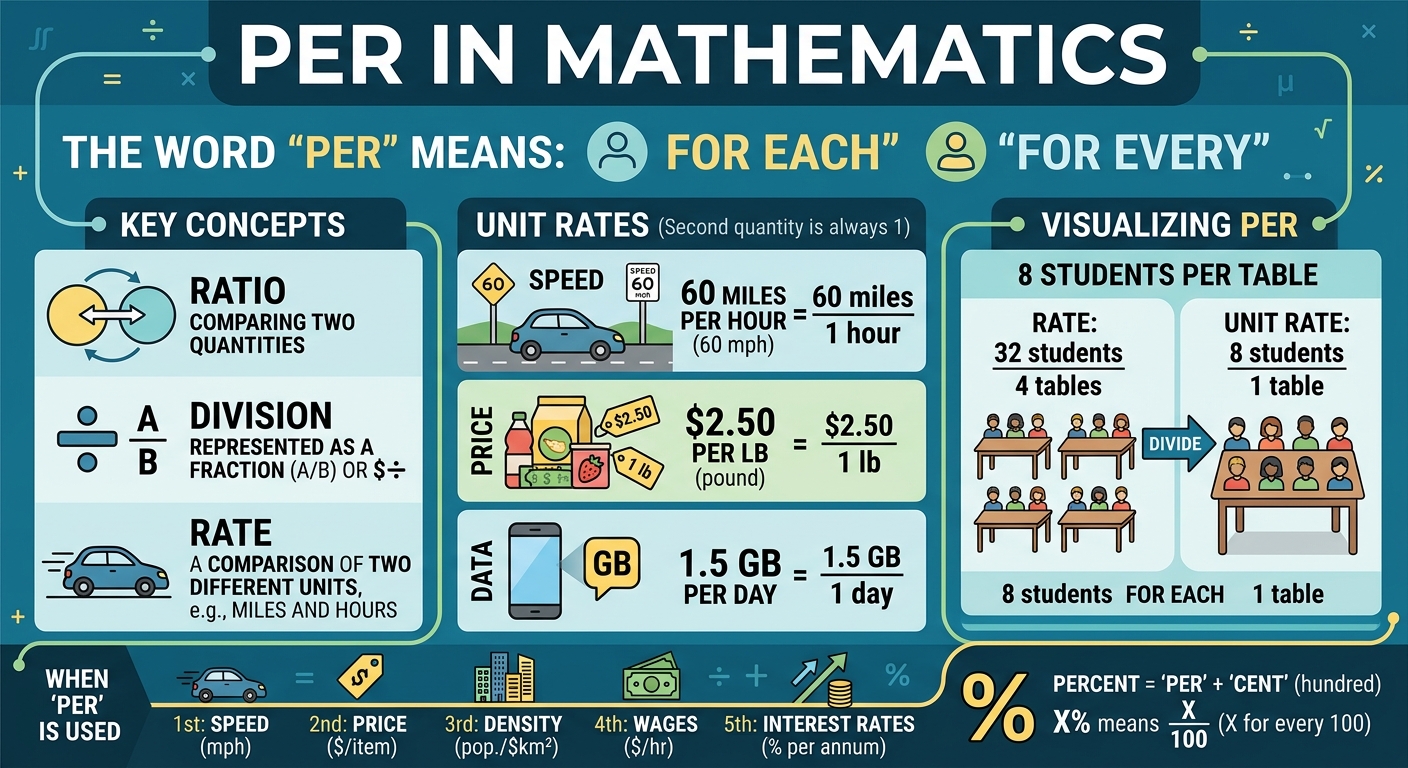
- In math, per means “for each” or “for every,” and it tells you to divide.
- The order is fixed: “A per B” means A divided by B. Miles per hour is miles divided by hours, so 180 miles in 3 hours works out to 180 ÷ 3 = 60 mph.
- The answer to a per question always describes one unit. Sixty miles an hour is how far you’d travel in one hour.
- Per cent literally breaks down to “for every hundred,” so 45 percent is 45 out of each 100.
- Kids who miss these problems almost always divide backward. They can divide fine, they just can’t tell which number goes inside the box.
Per means “for each.” When you see it in a math problem, it’s a signal to divide, and the word order tells you which way. “A per B” means A divided by B, so price per pound is the price divided by the number of pounds, and pages a minute is pages divided by minutes.
That’s the rule that solves most of these problems. If 12 apples cost $4.80, the price per apple is 4.80 ÷ 12 = $0.40. Below we’ll work through the common phrases, the division order that trips kids up, percent, and practice problems with answers.
What per means in math
Per comes from Latin and shows up all over everyday life, usually attached to a measurement. Each phrase below is a comparison between two amounts, scaled down so the second amount equals 1.
| Phrase | Means | Divide |
|---|---|---|
| Miles per hour | Miles traveled in one hour | Miles ÷ hours |
| Price per pound | Cost of one pound | Cost ÷ pounds |
| Words per minute | Words typed in one minute | Words ÷ minutes |
| Miles per gallon | Miles driven on one gallon | Miles ÷ gallons |
| Cost per person | What one person pays | Total ÷ people |
| Per cent | How many for every hundred | Part ÷ whole, times 100 |
Notice the pattern in that last column. Whatever is named before the word per goes on top, and whatever comes after it goes on the bottom. That holds every time, which makes it one of the most reliable signal words in word problems.
Per means divide, in this order
Write the phrase out, then stack the words the way you’d stack a fraction. Miles per hour becomes miles over hours. Then divide.
A car travels 180 miles in 3 hours. Find the miles per hour.
That phrase means miles ÷ hours.
180 ÷ 3 = 60
The car averaged 60 miles per hour, meaning it covered 60 miles in each hour.
Five pounds of chicken cost $12.50. Find the price per pound.
That phrase means dollars ÷ pounds.
12.50 ÷ 5 = 2.50
It costs $2.50 per pound.
A car uses 12 gallons of gas to drive 384 miles. Find the miles per gallon.
That phrase means miles ÷ gallons.
384 ÷ 12 = 32
The car gets 32 miles per gallon.
Check the answer by asking whether it describes one unit. Thirty-two is how far the car goes on a single gallon. If a student answers 0.03125, they divided gallons by miles and got gallons per mile, which is a real measure but not the one asked for.
When flipping it is actually useful
Both directions can be worth knowing. Four pizzas for 16 people gives 4 ÷ 16 = 0.25 pizza per person, which is a quarter of a pizza each. Flip it and 16 ÷ 4 = 4 people per pizza. Same situation, two different questions. Read carefully which one the problem wants.
Using a per amount to scale up
Once you know the per amount, multiplying gets you any quantity you want. That’s where the word becomes useful rather than just vocabulary.
A heart beats 72 times per minute. How many beats in 5 minutes?
72 × 5 = 360 beats.
Gas costs $3.40 per gallon. What do 14 gallons cost?
3.40 × 14 = $47.60.
So division gets you the rate, and multiplication uses it. Kids who keep both moves in view stop guessing at which operation a word problem wants.
Comparing two options
Rates like these exist mostly so you can compare things that aren’t the same size. A 24 ounce bottle costs $4.08, and a 16 ounce bottle costs $2.88. Which is the better deal?
4.08 ÷ 24 = $0.17 per ounce
2.88 ÷ 16 = $0.18 per ounce
The 24 ounce bottle is the cheaper one by the ounce, even though it costs more at the register.
Per cent means per hundred
Percent is per plus cent, and cent means hundred, the same root as century. So 45 percent means 45 for every hundred.
That reading makes percent problems easier to set up. “45 percent of 80 seats” means 45 out of every 100, so each 1 percent is 80 ÷ 100 = 0.8 seats, and 45 percent is 0.8 × 45 = 36 seats.
Other Latin phrases work the same way. Per capita means for each person, per annum means each year, and per diem means each day. Same structure, different second word.
Common mistakes
Dividing backward. This causes most wrong answers here. For miles per hour with 180 miles and 3 hours, a kid who writes 3 ÷ 180 gets 0.0167. Reading the phrase left to right and stacking it as a fraction prevents it.
Dividing by the bigger number every time. Some students assume division always puts the larger number first. Then 0.25 pizza per person looks wrong to them, so they flip it. An answer smaller than 1 is fine.
Multiplying when the problem wants a per amount. “What is the cost per ticket if 6 tickets cost $54?” wants 54 ÷ 6 = $9, not 54 × 6. That one word is the tell.
Dropping the units. An answer of 60 means nothing on its own. Sixty miles per hour and 60 minutes per mile describe very different trips. Writing the unit is part of the answer.
Treating percent as a whole number. Forty-five percent is 45 per hundred, which is 0.45. Multiplying by 45 instead of 0.45 gives an answer a hundred times too big.
Practice problems
1. A runner covers 12 miles in 2 hours. How many miles per hour?
2. Eight notebooks cost $20. What is the price per notebook?
3. A printer prints 90 pages in 3 minutes. How many pages per minute?
4. Three pounds of grapes cost $7.50. What is the cost per pound?
5. A heart beats 72 times per minute. How many beats in 5 minutes?
6. A car uses 12 gallons to travel 384 miles. What is its miles per gallon?
7. Which is the better buy, 24 ounces for $4.08 or 16 ounces for $2.88?
8. A theater has 80 seats and 45 percent are filled. How many seats are filled?
Answers
1. 6 miles per hour. 12 ÷ 2 = 6.
2. $2.50 per notebook. 20 ÷ 8 = 2.50.
3. 30 pages per minute. 90 ÷ 3 = 30.
4. $2.50 per pound. 7.50 ÷ 3 = 2.50.
5. 360 beats. This one multiplies, since you already have the per amount: 72 × 5 = 360.
6. 32 miles per gallon. 384 ÷ 12 = 32.
7. The 24 ounce bottle. 4.08 ÷ 24 = $0.17 per ounce, and 2.88 ÷ 16 = $0.18 per ounce.
8. 36 seats. 45 percent is 0.45, and 0.45 × 80 = 36.
What it means if your child is stuck on per problems
These questions look like vocabulary, and the vocabulary takes two minutes to teach. When a kid keeps missing them, look at what’s underneath.
The first thing to check is whether they understand division as sharing. A student who only knows division as a procedure has no way to decide which number goes where, so they guess and get half of them right. Division meaning is a third and fourth grade topic, and our guide to math skills by grade level shows where it belongs.
The second thing is fractions and decimals. These answers come out as $0.17 or 0.25 pizza constantly, and a kid who distrusts numbers below 1 will reject a correct answer. That discomfort follows students into algebra, which we cover in Struggling with algebra? The real problem is usually fourth grade fractions. If word problems in general are the sticking point, the signs in Is my child behind in math are worth a look.
Frequently asked questions
Does per always mean divide?
When you’re finding a per amount, yes. When a problem hands you one already, like 72 beats a minute, you multiply to scale it up. The word signals a rate either way.
What does per mean in a word problem?
For each, or for every. It sets up a comparison where the second quantity equals one. “Cost per ticket” is the cost of exactly one ticket.
Which number do you divide by?
The one named after the word per. In miles per hour you divide by the hours. In price per pound you divide by the pounds. The quantity named first goes on top.
What does per cent mean?
Per hundred. Cent comes from the Latin word for hundred, so 30 percent is 30 for every 100, or 0.30 as a decimal.
What grade do students learn per and unit rates?
Per shows up informally in third and fourth grade division problems, becomes a named skill with unit rates in sixth grade, and carries into proportional reasoning and slope after that.
Is a per amount the same as a unit rate?
Nearly always, yes. A unit rate is a rate with a denominator of 1, which is exactly what that division gives you.
Find the actual gap
If per problems keep going wrong, more drilling won’t fix it. Math Anon starts with a short adaptive assessment that shifts difficulty based on your child’s answers, then gives you a written report listing the specific skills that are missing, whether that’s the meaning of division, decimals or something earlier. Start the assessment and you’ll know where to aim.
After that, your child gets about 20 minutes of daily practice built around those gaps, and you get a weekly progress report showing what’s closing. The assessment is $49 and we credit it back in full on the first month. See pricing for the details, and Why 20 minutes a day beats a 90 minute tutoring session for why we keep sessions short.





