
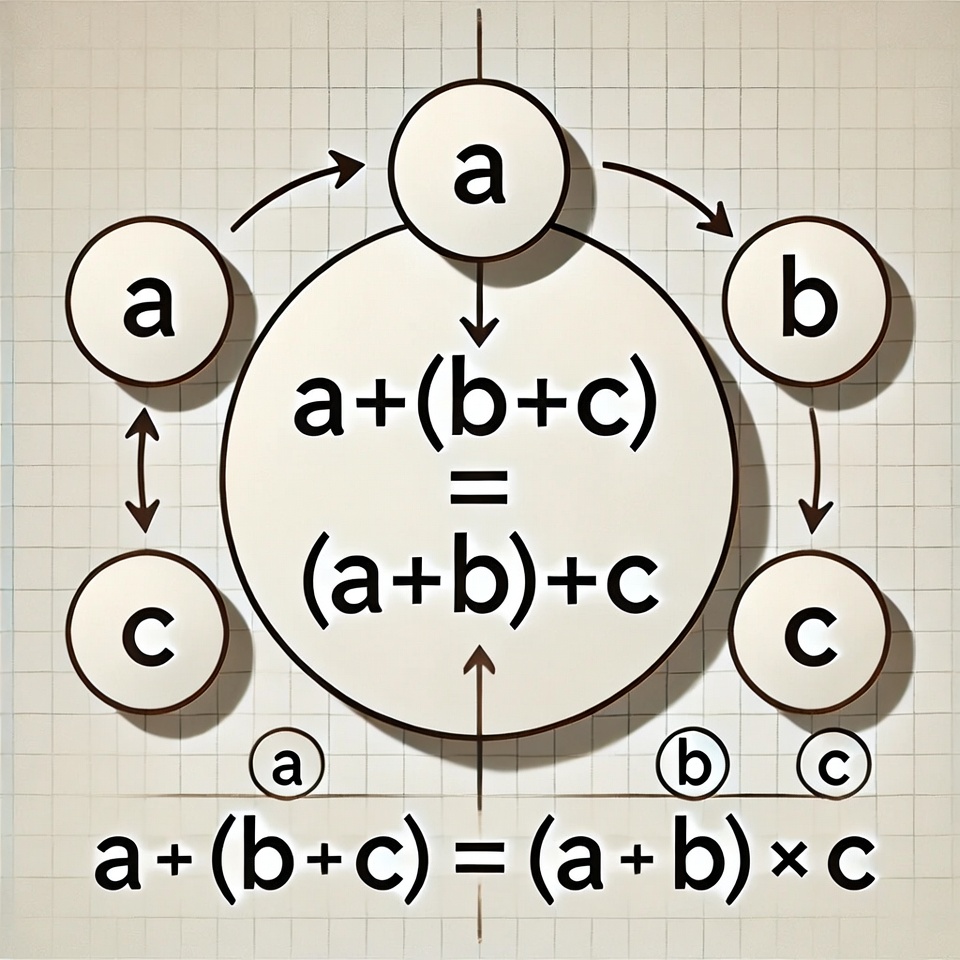
The Associative Property Of Addition And Multiplication
The short version
- The associative property says you can change how numbers are grouped in addition or multiplication without changing the answer: (a + b) + c = a + (b + c) and (a × b) × c = a × (b × c).
- Only the parentheses move. The numbers stay in the same order. Swapping the order is a different rule, the commutative property.
- It fails for subtraction and division. (10 – 4) – 2 = 4, but 10 – (4 – 2) = 8.
- Its real use is mental math: 9 × (4 × 25) is 9 × 100 = 900, much easier than 36 × 25.
The associative property says that when you add three or more numbers, or multiply three or more numbers, you can group them however you like and the answer stays the same. In symbols, (a + b) + c = a + (b + c) for addition and (a × b) × c = a × (b × c) for multiplication. The word comes from “associate,” as in which numbers hang out together first.
That’s the whole rule. The part that trips kids up is telling it apart from the commutative property and knowing where it stops working, so we’ll spend most of our time there, with worked examples and practice problems at the end.
The associative property of addition
When you add, the grouping doesn’t matter. Take 8 + 7 + 3:
(8 + 7) + 3 = 15 + 3 = 18
8 + (7 + 3) = 8 + 10 = 18
Same answer both ways. The second grouping is easier because 7 + 3 makes a ten. Kids use this idea long before they learn its name. A first grader who adds 2 + 6 + 4 by doing 6 + 4 first is using the associative property.
It scales up to bigger numbers:
(37 + 48) + 52 = 85 + 52 = 137
37 + (48 + 52) = 37 + 100 = 137
And it works with decimals and fractions too:
(2.5 + 0.8) + 0.2 = 3.3 + 0.2 = 3.5
2.5 + (0.8 + 0.2) = 2.5 + 1 = 3.5
The associative property of multiplication
The associative property of multiplication works the same way. With three factors, you can multiply either pair first.
(6 × 5) × 2 = 30 × 2 = 60
6 × (5 × 2) = 6 × 10 = 60
A picture helps here. Think of a box of sugar cubes 6 long, 5 wide and 2 tall. You can count it as 30 cubes on the bottom layer times 2 layers, or as 6 rows of a 5 × 2 slice. Either way it’s 60 cubes. The box doesn’t care how you count it.
Here’s where it pays off for mental math:
(9 × 4) × 25 = 36 × 25 = 900
9 × (4 × 25) = 9 × 100 = 900
The first way needs a two-digit multiplication. The second way is done in your head.
It holds for negative numbers and fractions as well:
(-3 × 4) × 5 = -12 × 5 = -60
-3 × (4 × 5) = -3 × 20 = -60
(½ × 4) × 3 = 2 × 3 = 6
½ × (4 × 3) = ½ × 12 = 6
Associative property vs commutative property
These two get mixed up constantly, and plenty of worksheets ask kids to name which one is being used. The quick test: did the parentheses move, or did the numbers swap places?
| Associative property | Commutative property | |
|---|---|---|
| What changes | The grouping (parentheses) | The order of the numbers |
| Addition example | (2 + 5) + 1 = 2 + (5 + 1) | 2 + 5 = 5 + 2 |
| Multiplication example | (3 × 4) × 2 = 3 × (4 × 2) | 3 × 4 = 4 × 3 |
| How many numbers | At least three | Two is enough |
| Works for subtraction or division? | No | No |
A memory hook: you associate with the friends in your group, and you commute when you move from place to place.
In real problems, you often use both together. To work out 25 × 7 × 4 in your head, you swap to 7 × 25 × 4 (commutative), then group 7 × (25 × 4) (associative), which is 7 × 100 = 700.
Why it doesn’t work for subtraction or division
Subtraction and division are not associative. Try it:
(10 – 4) – 2 = 6 – 2 = 4
10 – (4 – 2) = 10 – 2 = 8
(24 ÷ 4) ÷ 2 = 6 ÷ 2 = 3
24 ÷ (4 ÷ 2) = 24 ÷ 2 = 12
Different answers, so the property fails. One counterexample is enough to prove that.
There’s a workaround kids see in middle school. Rewrite subtraction as adding a negative, and the associative property works again: 10 – 4 – 2 is 10 + (-4) + (-2). Group the negatives, 10 + (-6), and you get 4, the correct answer. The same trick works for division by turning it into multiplying by a reciprocal.
Where the associative property shows up in algebra
Students use the associative property all the time in algebra, often without saying so.
Simplifying a product: 5(3x) means 5 × (3 × x). Regroup as (5 × 3) × x, which is 15x.
Combining constants: (x + 6) + 4 regroups to x + (6 + 4), which is x + 10.
A student who writes 5(3x) = 15 × 5x, or gets stuck on (x + 6) + 4 because “you can’t add x and 6,” hasn’t yet seen that grouping is flexible. That’s the kind of small gap that makes algebra feel harder than it is.
Common mistakes
- Calling a swap “associative.” 4 × 7 = 7 × 4 is commutative. Nothing got regrouped.
- Using it with subtraction or division. 20 – (8 – 3) is 15, and (20 – 8) – 3 is 9. Kids who regroup freely in subtraction get the wrong answer.
- Mixing operations. The property is about all addition or all multiplication. (2 + 3) × 4 = 20, but 2 + (3 × 4) = 14. Grouping across two different operations falls under order of operations, where parentheses really do change the answer.
- Moving numbers along with the parentheses. If the order changes too, you’ve used both properties. That’s fine for solving, but name them correctly on a worksheet.
Practice problems
- Fill in the blank: (4 + 9) + 1 = 4 + (___ + 1).
- Show that (3 × 2) × 5 = 3 × (2 × 5) by working out both sides.
- Which property is shown: 7 + (8 + 2) = (7 + 8) + 2?
- Which property is shown: 11 × 6 = 6 × 11?
- Use the associative property to find 46 + 27 + 3 in your head.
- Find 17 × 2 × 50 by grouping the easiest pair.
- Does (20 ÷ 5) ÷ 2 equal 20 ÷ (5 ÷ 2)? Show both sides.
- Simplify 4(6y) and (x + 13) + 7.
Answers
- 9. Both sides equal 14: 13 + 1 = 14 and 4 + 10 = 14.
- (3 × 2) × 5 = 6 × 5 = 30, and 3 × (2 × 5) = 3 × 10 = 30.
- Associative property of addition. The grouping changed and the order didn’t.
- Commutative property of multiplication. The order changed.
- 46 + (27 + 3) = 46 + 30 = 76.
- 17 × (2 × 50) = 17 × 100 = 1,700.
- No. (20 ÷ 5) ÷ 2 = 4 ÷ 2 = 2, but 20 ÷ (5 ÷ 2) = 20 ÷ 2.5 = 8.
- 4(6y) = (4 × 6)y = 24y, and (x + 13) + 7 = x + (13 + 7) = x + 20.
If your kid is stuck on the associative property
Most kids who struggle here can follow the idea of regrouping just fine. What trips them is the arithmetic that comes before it. If adding 27 + 3 or multiplying 4 × 25 isn’t automatic, there’s no benefit to regrouping, so the property feels like pointless busywork. The gap is usually fact fluency and making tens and hundreds, which are third and fourth grade skills. Our guide to math skills by grade level lays out where those sit.
The other common gap is not knowing what parentheses mean. If a child reads (10 – 4) – 2 and 10 – (4 – 2) as the same thing, they need work on order of operations before properties will make sense. And for older students, trouble simplifying expressions like 5(3x) often traces back to shaky number sense, which we cover in why kids struggle with algebra. Short daily practice on these older skills tends to fix it faster than long weekend sessions, for reasons we explain in why 20 minutes a day works.
Frequently asked questions
What is the associative property in simple terms?
It means that when you’re only adding, or only multiplying, you can group the numbers any way you want and get the same answer.
What is the associative property of multiplication?
It’s the rule that (a × b) × c = a × (b × c). For example, (2 × 3) × 4 = 24 and 2 × (3 × 4) = 24.
What’s the difference between the associative and commutative property?
Associative changes the grouping. Commutative changes the order. (1 + 2) + 3 = 1 + (2 + 3) is associative. 1 + 2 = 2 + 1 is commutative.
Does the associative property work for subtraction?
No. (9 – 5) – 1 = 3, but 9 – (5 – 1) = 5. It also fails for division.
What grade learns the associative property?
Under the Common Core standards, kids use it informally in first grade to add three numbers, and third graders apply it as a strategy for multiplying. The formal name and the algebra uses usually come in middle school.
Find the actual gap
When a property like this won’t stick, more worksheets on the property itself rarely help. Finding the older skill underneath does. Math Anon starts with a short adaptive assessment that works out exactly which skills are missing and hands you a written report on what it found.
Then your child practices those specific skills for about 20 minutes a day, and you get a progress report each week so you can see what’s changing. The assessment costs $49 and is credited back in full on your first month. Start the assessment, or check pricing first.
Related reading
- Struggling With Algebra? The Real Problem Is Usually Fourth Grade Fractions
- Math Skills By Grade Level: What Your Child Should Know
- Why 20 Minutes A Day Beats A 90-Minute Tutoring Session
- Mind The Gap: A Parent’s Guide To Math Assessment For Kids
- The Transitive Property: Equality, Inequality And Geometry





