
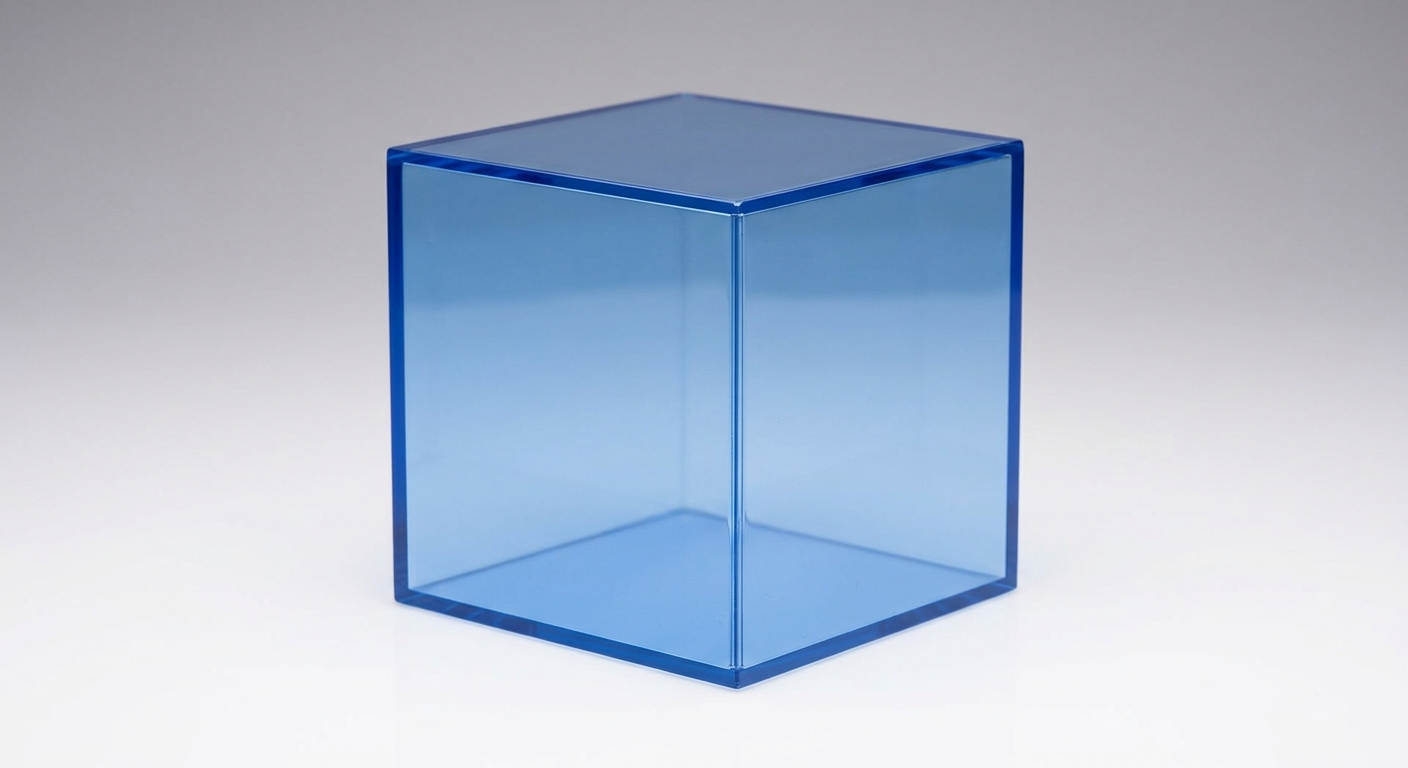
How Many Sides Does A Cube Have? Faces, Edges And Vertices
The short version
- A cube has 6 sides, which mathematicians call faces. Each face is a square, and all six are the same size.
- A cube also has 12 edges (where two faces meet) and 8 vertices (corners).
- “Sides” is ambiguous. On a flat shape, a side is a line segment. On a 3D shape, most people mean faces, but some worksheets mean edges. If the answer should be 12, the question wants edges.
- Surface area = 6 × s², and volume = s³, where s is the length of one edge.
- Faces + vertices – edges = 2 for a cube (6 + 8 – 12 = 2), a handy way to check your count.
How many sides does a cube have? A cube has 6 sides, or faces, and every one of them is an identical square. It also has 12 edges and 8 vertices (corners). A standard die is a good model: six faces, numbered 1 to 6.
The word “sides” is where the confusion starts, so we’ll sort that out first. Then we’ll cover how to count faces, edges and vertices without losing track, how a cube compares with other 3D shapes, the surface area and volume formulas with worked examples, and practice problems with answers.
How many sides does a cube have? Faces, edges and vertices
| Part | What it is | How many on a cube |
|---|---|---|
| Face | A flat surface | 6 (all squares) |
| Edge | A line where two faces meet | 12 (all the same length) |
| Vertex | A corner where edges meet | 8 |
Why “sides” causes trouble
For a flat (2D) shape, a side is a line segment. A square has 4 sides. When kids move to solids, some teachers keep the word “side” for faces and some switch it to edges. Neither is wrong in everyday speech, but in math class the clear words are face, edge and vertex.
So when a worksheet asks “How many sides does a cube have?”, 6 is the usual answer, since it means faces. If the answer key says 12, the worksheet means edges. When in doubt, a kid can write “6 faces” and be both correct and clear.
A related trap: a drawing of a cube only shows 3 faces at most. A kid who counts what’s on the page gets 3. The hidden faces still count.
How to count them without losing track
Faces: top, bottom and around
1 top + 1 bottom + 4 around the middle = 6 faces. Same as a box: lid, floor, and four walls.
Edges: three groups of four
The top square has 4 edges. The bottom square has 4 edges. Then 4 vertical edges connect them. 4 + 4 + 4 = 12.
Vertices: top four and bottom four
The top face has 4 corners, and so does the bottom face. There aren’t any corners in between. 4 + 4 = 8.
Check it with Euler’s formula
For any solid with flat faces and no holes, faces + vertices – edges = 2. For a cube: 6 + 8 – 12 = 2. If your count doesn’t give 2, something got missed or counted twice.
A cube compared with other 3D shapes
| Shape | Faces | Edges | Vertices | F + V – E |
|---|---|---|---|---|
| Cube | 6 | 12 | 8 | 2 |
| Rectangular prism | 6 | 12 | 8 | 2 |
| Triangular prism | 5 | 9 | 6 | 2 |
| Square pyramid | 5 | 8 | 5 | 2 |
| Triangular pyramid | 4 | 6 | 4 | 2 |
| Octahedron | 8 | 12 | 6 | 2 |
A cube is a special rectangular prism where every edge is the same length. So every cube is a rectangular prism, but a cereal box is a rectangular prism that isn’t a cube. It’s the same relationship as squares and rectangles.
Spheres, cylinders and cones have curved surfaces, so the faces, edges and vertices idea doesn’t fit them neatly, and Euler’s formula doesn’t apply.
Cube nets
A net is the flat pattern you’d cut out and fold to make a solid. A cube’s net is always six squares joined edge to edge. The familiar one is a cross shape: a column of four squares with one square sticking out on each side of the second square.
There are 11 different nets that fold into a cube. Some arrangements of six squares don’t work. A straight row of six just rolls into a tube, and a 2 by 3 rectangle of squares folds up with faces overlapping. Cutting out a paper net and folding it up is one of the best ways for a younger kid to see why the answer is 6 faces.
Surface area and volume of a cube
Because all six faces are identical squares, the formulas are short. Let s be the length of one edge.
Area of one face = s × s = s²
Surface area = 6 × s²
Volume = s × s × s = s³
Total length of all edges = 12 × s
Worked example 1
A cube has edges of 4 cm.
One face: 4 × 4 = 16 cm²
Surface area: 6 × 16 = 96 cm²
Volume: 4 × 4 × 4 = 64 cm³
Surface area is in square units because it covers flat faces. Volume is in cubic units because it fills space.
Worked example 2: working back from volume
A cube holds 125 cm³. Find its surface area.
Which number cubed is 125? 5 × 5 × 5 = 125, so s = 5 cm.
One face: 5 × 5 = 25 cm²
Surface area: 6 × 25 = 150 cm²
Worked example 3: working back from surface area
A cube has a surface area of 54 in². Find its volume.
One face: 54 ÷ 6 = 9 in²
Edge: s × s = 9, so s = 3 in
Volume: 3 × 3 × 3 = 27 in³
Common mistakes
- Counting only the faces you can see. A drawing shows three faces. There are three more behind.
- Answering 4. That’s the number of sides of one square face, not of the cube.
- Counting edges twice. Each edge is shared by two faces. Counting 4 edges per face gives 6 × 4 = 24, which is exactly double the real 12.
- Mixing up surface area and volume. For s = 6, the two numbers are both 216 (6 × 36 = 216 and 6³ = 216), which convinces some kids they’re the same thing. They aren’t. One is square units, the other cubic. Try s = 3 and you get 54 and 27.
- Writing s × 3 for s³. A 4 cm cube has volume 4 × 4 × 4 = 64, not 4 × 3 = 12.
Practice problems
- How many edges does a cube have?
- How many vertices does a cube have?
- A cube has edges of 7 cm. Find its volume.
- Find the surface area of a cube with 6 in edges.
- A cube has a volume of 64 m³. Find its surface area.
- The 12 edges of a cube add to 96 cm. Find the volume.
- A 3 × 3 × 3 cube is built from 27 small cubes, and the whole outside is painted. How many small cubes have paint on exactly two faces?
- In the same painted cube, how many small cubes have no paint at all?
Answers
- 12
- 8
- 343 cm³ (7 × 7 × 7)
- 216 in² (6 × 6² = 6 × 36)
- 96 m². s = 4 because 4 × 4 × 4 = 64, one face is 16, and 6 × 16 = 96.
- 512 cm³. s = 96 ÷ 12 = 8, and 8 × 8 × 8 = 512.
- 12. Each edge of the big cube has one middle cube with two painted faces, and there are 12 edges. (The 8 corner cubes have three painted faces.)
- 1, the single cube in the very center. Check: 8 corners + 12 edge cubes + 6 face centers + 1 center = 27.
If your child is stuck on 3D shapes
Naming cubes starts in kindergarten, counting faces and edges comes in the early grades, volume shows up in 5th grade, and nets and surface area in 6th. When a kid is stuck, the gap is usually spatial reasoning (picturing the hidden faces) or the arithmetic underneath: squaring, cubing and multiplying by 6. A kid who answers “how many sides does a cube have” with 3 is counting the drawing, which is a spatial issue.
Hands-on fixes work well for the first kind. Sugar cubes, dice or a paper net make the hidden faces real. For the second kind, fact practice helps more than more geometry. Our guide to math skills by grade level shows what’s expected in grades 3 to 5, and 12 signs a child is behind in math can help you judge whether this is a blip or a pattern.
Frequently asked questions
Does a cube have 6 or 12 sides?
6 faces and 12 edges. If “sides” means flat surfaces, it’s 6. If a teacher uses “sides” for edges, it’s 12. Using the words face and edge avoids the mix-up.
How many faces, edges and vertices does a cube have?
6 faces, 12 edges and 8 vertices.
How many sides does a square have compared with a cube?
A square is flat and has 4 sides. A cube is made of 6 squares, so it has 6 square faces.
Is a cube a prism?
Yes. It’s a rectangular prism with all edges equal, and a square prism too.
How many sides does a die have?
A standard six-sided die is a cube with 6 faces. On a standard die, opposite faces add to 7: 1 and 6, 2 and 5, 3 and 4.
Find the actual gap
Counting faces is easy to fix. What usually hides behind a shaky geometry grade is multiplication, exponents or spatial skills that never quite set. Math Anon’s short adaptive assessment tests for those directly and gives you a written report of what’s missing.
Your kid then gets about 20 minutes of daily practice on those skills, and you see a progress report every week. It’s $49 to start, and that’s credited in full to the first month. Start the assessment or read about pricing.





