
What Is A Rigid Transformation? Rules And Examples
The short version
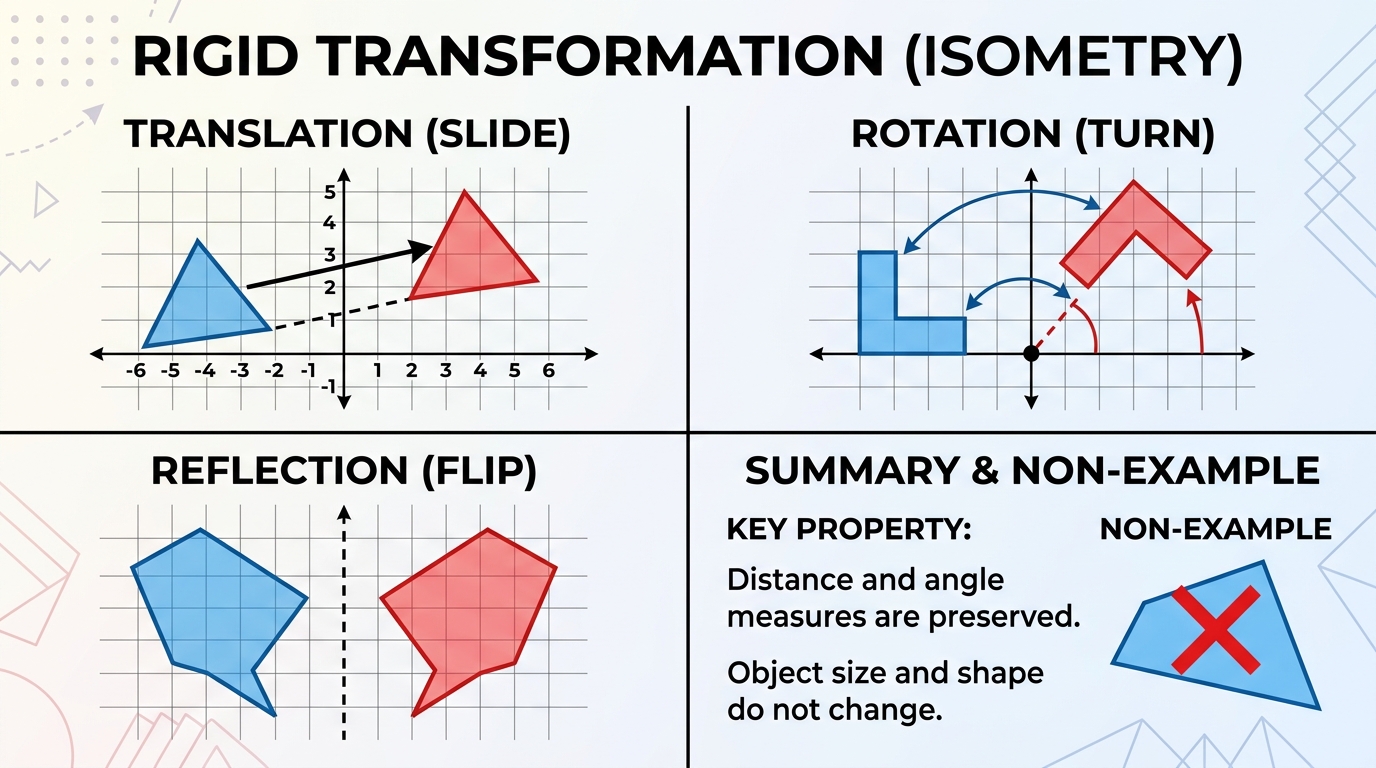
- A rigid transformation moves a shape without changing its size or shape. Every side length and every angle stays the same.
- There are three basic rigid transformations: translation (slide), reflection (flip), and rotation (turn). Any combination of them is also rigid.
- Dilation is the one that isn’t rigid, because it stretches or shrinks the shape.
- On a coordinate grid each move has a rule. For example, reflecting over the x-axis sends (x, y) to (x, -y), and a 90° counterclockwise turn about the origin sends (x, y) to (-y, x).
- If one figure can land exactly on another using only rigid transformations, the two figures are congruent.
A rigid transformation is a move that changes where a shape is, or which way it faces, without changing its size or shape. Distances and angle measures are preserved, so the image is an exact copy of the original. The three rigid transformations are translations, reflections, and rotations.
You’ll also see the word isometry, which means the same thing (“iso” means equal, “metry” means measure). Below we’ll cover each type, the coordinate rules 8th graders are expected to use, worked examples on a real triangle, and the mistakes that cost the most points.
The three rigid transformations
| Transformation | Plain words | What you need to describe it | Flips orientation? |
|---|---|---|---|
| Translation | Slide | How far left or right, and how far up or down | No |
| Reflection | Flip | The line you flip over (the line of reflection) | Yes |
| Rotation | Turn | The center point, the angle, and the direction | No |
“Flips orientation” is worth a second look. Label a triangle’s corners A, B, C going clockwise. After a translation or rotation, A’, B’, C’ still go clockwise. After a reflection they go counterclockwise, like your right hand turning into a left hand in a mirror. The shape is still congruent, just mirrored.
A glide reflection is a reflection followed by a translation along the same line. Footprints in sand are the classic picture. It counts as rigid because it’s built from two rigid moves.
Rigid transformation rules on the coordinate plane
In 8th grade and high school geometry, most problems give you points on a grid. These are the rules to know. Rotations are about the origin, and counterclockwise is the default direction unless the problem says otherwise.
| Move | Rule | Example with (3, 2) |
|---|---|---|
| Translate a right, b up | (x, y) → (x + a, y + b) | a = 4, b = 1: (7, 3) |
| Reflect over the x-axis | (x, y) → (x, -y) | (3, -2) |
| Reflect over the y-axis | (x, y) → (-x, y) | (-3, 2) |
| Reflect over y = x | (x, y) → (y, x) | (2, 3) |
| Rotate 90° counterclockwise | (x, y) → (-y, x) | (-2, 3) |
| Rotate 180° | (x, y) → (-x, -y) | (-3, -2) |
| Rotate 270° counterclockwise (90° clockwise) | (x, y) → (y, -x) | (2, -3) |
A memory hook for reflections: the coordinate that changes sign is the one that isn’t named. Reflecting over the x-axis keeps x and flips the sign of y.
Worked examples on one triangle
We’ll use triangle ABC with A(1, 2), B(4, 2), and C(1, 6). It’s a right triangle with the right angle at A. Side AB is 3 units, side AC is 4 units, and side BC is 5 units (a 3, 4, 5 right triangle). After each move, we’ll check that those lengths survive.
Example 1: translation
Translate triangle ABC 3 units left and 1 unit up. Left means subtract from x. Up means add to y.
A(1, 2) → A'(1 – 3, 2 + 1) = A'(-2, 3)
B(4, 2) → B'(4 – 3, 2 + 1) = B'(1, 3)
C(1, 6) → C'(1 – 3, 6 + 1) = C'(-2, 7)
Check: A’B’ runs from x = -2 to x = 1, which is 3 units. A’C’ runs from y = 3 to y = 7, which is 4 units. Same triangle, new spot.
Example 2: reflection over the x-axis
Keep x, change the sign of y.
A(1, 2) → A'(1, -2)
B(4, 2) → B'(4, -2)
C(1, 6) → C'(1, -6)
The triangle now points down instead of up. A’B’ is still 3 and A’C’ is still 4. Notice the orientation flipped: the triangle is a mirror image.
Example 3: rotation of 90° counterclockwise about the origin
Use (x, y) → (-y, x). Swap the coordinates, then make the new first number negative.
A(1, 2) → A'(-2, 1)
B(4, 2) → B'(-2, 4)
C(1, 6) → C'(-6, 1)
Check: A’B’ runs from y = 1 to y = 4, which is 3 units. A’C’ runs from x = -2 to x = -6, which is 4 units. The legs that were horizontal and vertical have traded directions, which is what a quarter turn should do.
Example 4: why dilation is not rigid
Dilate triangle ABC by a scale factor of 2 from the origin: (x, y) → (2x, 2y). You get A'(2, 4), B'(8, 4), and C'(2, 12). Now A’B’ is 6 units and A’C’ is 8 units. The angles match, but the sides doubled. The new triangle is similar to the original, not congruent, so dilation isn’t a rigid transformation.
Combining rigid transformations
You can chain rigid transformations, and the result is still rigid. But the order usually matters. Take the point (2, 3):
Reflect over the x-axis, then translate up 4: (2, 3) → (2, -3) → (2, 1)
Translate up 4, then reflect over the x-axis: (2, 3) → (2, 7) → (2, -7)
Same two moves, different final points. When a problem lists a sequence, do the moves in the order given.
This is also how congruence gets defined in 8th grade and beyond: two figures are congruent if a sequence of rigid transformations maps one exactly onto the other. When a test asks “describe a sequence of transformations that shows these triangles are congruent,” it wants something like “reflect over the y-axis, then translate 2 units down.”
Common mistakes with rigid transformations
- Mixing up the axes on reflections. Reflecting over the x-axis changes the y-coordinate. Kids often flip the x instead because the x is in the name.
- Turning the wrong way. A positive rotation angle means counterclockwise. A 90° clockwise turn uses the 270° rule, (x, y) → (y, -x).
- Dropping a negative sign. Rotating (-3, 5) by 180° gives (3, -5). Sign slips cause more wrong answers here than anything conceptual.
- Translating in the wrong direction. Left and down mean subtract. A kid who adds 3 for “3 left” lands 6 units away from the right answer.
- Calling dilation rigid. The shape looks the same, so it feels rigid. It isn’t, because the size changes.
- Moving only one point. Every vertex has to move by the same rule. Plot all of them and connect the dots.
Practice problems
- Is a dilation with a scale factor of 3 a rigid transformation?
- Translate the point (5, -2) 4 units left and 6 units up.
- Reflect the point (-3, 7) over the y-axis.
- Reflect the point (-3, 7) over the x-axis.
- Rotate the point (4, 1) 90° counterclockwise about the origin.
- Rotate the point (4, 1) 180° about the origin.
- Reflect (2, 5) over the x-axis, then translate the result 3 units right.
- A segment has endpoints (0, 0) and (6, 8), so it’s 10 units long. Reflect it over the line y = x. What are the new endpoints, and how long is the new segment?
Answers
- No. It changes side lengths, so the image is similar but not congruent.
- (5 – 4, -2 + 6) = (1, 4)
- (3, 7)
- (-3, -7)
- (-1, 4)
- (-4, -1)
- (2, 5) → (2, -5) → (5, -5)
- (0, 0) and (8, 6). Still 10 units, because reflection is rigid.
If your child is stuck on rigid transformations
Transformations are formally taught in 8th grade, but the hard part is rarely the idea of a slide or a flip. Kids usually get tripped up by skills from earlier grades that the problems assume:
- Plotting points in all four quadrants of the coordinate plane (introduced in 5th grade for the first quadrant and 6th grade for all four).
- Working with negative numbers, especially adding and subtracting them.
- Measuring and reasoning about angles, which starts in 4th grade.
If your child can describe a rotation in words but misses every coordinate problem, the geometry is probably fine and the gap is in number sense or graphing. Math Skills By Grade Level: What Your Child Should Know lays out where the building blocks come from, and Is My Child Behind In Math? 12 Signs By Grade Level covers the warning signs to watch for later on. For how to test for the missing skill directly, see Mind The Gap: A Parent’s Guide To Math Assessment For Kids.
Frequently asked questions
What is a rigid transformation in simple terms?
It’s a way to move a shape that keeps it exactly the same size and shape. You can slide it, flip it, or turn it, but you can’t stretch it, shrink it, or bend it.
What are the 3 types of rigid transformations?
Translation, reflection, and rotation. A glide reflection is sometimes listed as a fourth, but it’s a reflection and a translation done together.
What is a non-rigid transformation?
Any transformation that changes size or shape. Dilation is the one kids see most. Stretching a shape in only one direction is another example.
Is a rigid transformation the same as an isometry?
Yes. Both words describe a transformation that keeps all distances the same. Textbooks use them interchangeably.
Do rigid transformations preserve orientation?
Translations and rotations do. Reflections reverse it, which is why a reflected shape looks mirrored even though every length and angle matches.
Find the actual gap
When a kid misses transformation problems, the fix depends on the cause. It might be the geometry, or it might be negative numbers or graphing from two grades back. Math Anon begins with a short adaptive assessment that sorts that out and gives you a written report showing which skills are missing.
Then your child practices those skills for about 20 minutes a day, and you get a progress update every week. The $49 assessment is credited back in full on your first month. Start the assessment, or check pricing first.





