
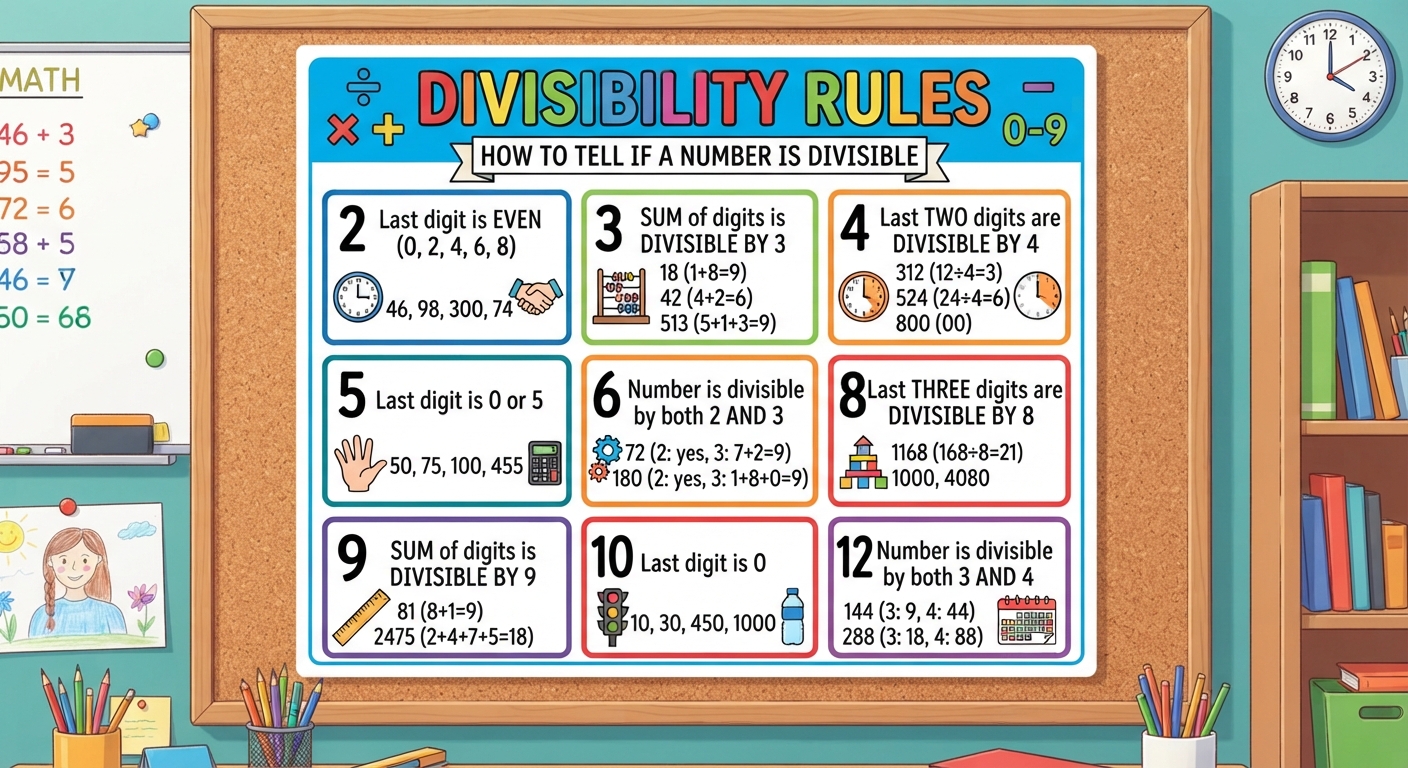
Divisibility Rules 2 Through 12 (Including 7)
The short version
- Divisibility rules are shortcuts that tell you whether one whole number divides evenly into another, with no remainder, without doing long division.
- The fast ones: 2 (last digit even), 5 (ends in 0 or 5), 10 (ends in 0), 3 (digit sum divisible by 3) and 9 (digit sum divisible by 9).
- For 4, check the last two digits. For 8, check the last three. For 6, the number must pass the rules for 2 and 3. For 12, it must pass 3 and 4.
- The rule for 7: double the last digit and subtract it from the rest of the number. If the result is a multiple of 7 (including 0), so is the original. 364 works because 36 – 8 = 28.
- The rule for 11: alternately subtract and add the digits. If you get 0 or a multiple of 11, the number is divisible by 11.
Divisibility rules let you tell whether a number can be divided evenly by 2, 3, 4 and so on just by looking at its digits. For example, 4,518 is divisible by 9 because its digits add to 4 + 5 + 1 + 8 = 18, and 18 is divisible by 9. Kids use these rules to find factors, simplify fractions and spot prime numbers quickly.
Below is a chart of the divisibility rules from 2 through 12, a closer look at the tricky rules for 7 and 11, why the rules work, and practice with answers.
Divisibility rules chart: 2 through 12
| Divisible by | Rule | Example |
|---|---|---|
| 2 | The last digit is even (0, 2, 4, 6 or 8). | 3,578 ends in 8, so yes. |
| 3 | The sum of the digits is divisible by 3. | 4,518: 4 + 5 + 1 + 8 = 18, so yes. |
| 4 | The last two digits form a number divisible by 4. | 7,316: 16 ÷ 4 = 4, so yes. |
| 5 | The last digit is 0 or 5. | 3,285 ends in 5, so yes. |
| 6 | It’s divisible by both 2 and 3. | 1,254 is even and 1 + 2 + 5 + 4 = 12, so yes. |
| 7 | Double the last digit and subtract it from the rest. The result is divisible by 7. | 364: 36 – 8 = 28, so yes. |
| 8 | The last three digits form a number divisible by 8. | 25,136: 136 ÷ 8 = 17, so yes. |
| 9 | The sum of the digits is divisible by 9. | 4,518: digit sum 18, so yes. |
| 10 | The last digit is 0. | 6,470 ends in 0, so yes. |
| 11 | Alternately subtract and add the digits. The result is 0 or divisible by 11. | 2,728: 2 – 7 + 2 – 8 = -11, so yes. |
| 12 | It’s divisible by both 3 and 4. | 5,412: last two digits 12, digit sum 12, so yes. |
The divisibility rule for 7, step by step
Seven is the rule most adults never learned. For numbers under a few hundred, knowing your multiples of 7 is often faster, but for bigger numbers this works well:
- Cut off the last digit.
- Double it.
- Subtract that from the number that’s left.
- If the answer is 0 or a multiple of 7 (positive or negative), the original number is divisible by 7. If the answer is still big, repeat.
Example 1: 364
Last digit: 4. Double it: 8.
Rest of the number: 36.
36 – 8 = 28
28 = 7 × 4, so 364 is divisible by 7. (364 ÷ 7 = 52.)
Example 2: 1,183 (two rounds)
Round 1: last digit 3, doubled is 6. 118 – 6 = 112.
112 is still big, so go again.
Round 2: last digit 2, doubled is 4. 11 – 4 = 7.
7 is a multiple of 7, so 1,183 is divisible by 7. (1,183 ÷ 7 = 169.)
Example 3: 523 (a no)
Last digit 3, doubled is 6. 52 – 6 = 46.
46 isn’t a multiple of 7 (7 × 6 = 42 and 7 × 7 = 49).
So 523 isn’t divisible by 7. It leaves a remainder of 5.
Why the 7 rule works
Write the number as 10a + b, where b is the last digit and a is everything in front of it. For 364, a = 36 and b = 4. The rule asks about a – 2b. Multiply that by 10 and you get 10a – 20b, which equals (10a + b) – 21b. Since 21b is always a multiple of 7, the original number and 10 × (a – 2b) differ by a multiple of 7. So if one is a multiple of 7, the other is too, and because 10 has no factor of 7, a – 2b must be a multiple of 7 as well.
The divisibility rule for 11
Go through the digits from left to right, alternating minus and plus signs between them. If the result is 0 or a multiple of 11, the number is divisible by 11.
2,728: 2 – 7 + 2 – 8 = -11. That’s a multiple of 11, so yes. (2,728 ÷ 11 = 248.)
3,927: 3 – 9 + 2 – 7 = -11. Yes again. (3,927 ÷ 11 = 357.)
It doesn’t matter whether you start from the left or the right. You might get 11 instead of -11, but the answer to “is it divisible?” is the same.
Why the other rules work
None of these rules are magic, and kids remember them better when they see the reason.
- 2, 5 and 10: every ten is divisible by 2, 5 and 10, so only the ones digit can cause a remainder.
- 4 and 8: 100 is divisible by 4 (100 ÷ 4 = 25), so only the last two digits matter. 1,000 is divisible by 8 (1,000 ÷ 8 = 125), so only the last three matter.
- 3 and 9: each place value is a multiple of 9 plus 1 (10 = 9 + 1, 100 = 99 + 1, and so on). So a number leaves the same remainder when divided by 9 or 3 as its digit sum does.
- 6 and 12: 6 = 2 × 3 and 12 = 3 × 4, and in each pair the two numbers share no common factor. A number divisible by both parts is divisible by the product.
Where kids use divisibility rules
Simplifying fractions. In 84/126, both numbers are even, both have digit sums divisible by 3 (12 and 9), and both pass the 7 test. So you can divide by 2 × 3 × 7 = 42: 84 ÷ 42 = 2 and 126 ÷ 42 = 3, giving 2/3.
Checking for primes. 91 looks prime, but the 7 rule catches it: 9 – 2 = 7. So 91 = 7 × 13.
Common mistakes with divisibility rules
- Using only the last digit for 4. 14 ends in 4, but 14 ÷ 4 leaves a remainder. You need the last two digits.
- Checking only one part for 6 or 12. 26 is even but fails the 3 test, so it’s not divisible by 6.
- Using 2 and 6 for 12. That pair doesn’t work because 2 and 6 share a factor. 18 is divisible by 2 and 6 but not by 12. Use 3 and 4.
- Forgetting to double in the 7 rule. Subtracting the last digit itself gives wrong answers.
- Treating a negative result as a no. In the 7 and 11 rules, -7, -11 and 0 all count as yes.
Practice problems
- Is 3,285 divisible by 5? By 3? By 9?
- Is 7,134 divisible by 4?
- Is 5,016 divisible by 8?
- Is 2,346 divisible by 6?
- Is 406 divisible by 7?
- Is 2,401 divisible by 7? What about 5,213?
- Is 3,927 divisible by 11?
- Is 8,736 divisible by 12?
Answers
- Yes to all three. It ends in 5, and 3 + 2 + 8 + 5 = 18, which is divisible by both 3 and 9. (3,285 ÷ 9 = 365.)
- No. The last two digits, 34, aren’t divisible by 4 (34 ÷ 4 = 8 remainder 2).
- Yes. The last three digits are 016, and 16 ÷ 8 = 2. (5,016 ÷ 8 = 627.)
- Yes. It’s even, and 2 + 3 + 4 + 6 = 15, which is divisible by 3. (2,346 ÷ 6 = 391.)
- Yes. 40 – 12 = 28, a multiple of 7. (406 ÷ 7 = 58.)
- 2,401: 240 – 2 = 238, then 23 – 16 = 7, so yes (2,401 ÷ 7 = 343). 5,213: 521 – 6 = 515, then 51 – 10 = 41, so no.
- Yes. 3 – 9 + 2 – 7 = -11. (3,927 ÷ 11 = 357.)
- Yes. The last two digits, 36, are divisible by 4, and 8 + 7 + 3 + 6 = 24 is divisible by 3. (8,736 ÷ 12 = 728.)
If your kid is stuck on divisibility rules
A kid who memorizes these rules but still gets them wrong is usually missing something underneath. The rule for 4 is useless if they don’t know 36 is a multiple of 4. The digit sum trick falls apart if adding four digits in their head is hard. And the 7 rule needs quick subtraction and solid multiples of 7. Place value matters too: kids have to see that “the last two digits” of 7,316 means 16, not 1 and 6.
Factors and multiples are usually a fourth grade skill, and our guide to math skills by grade level shows where they sit. If multiplication facts are the weak spot, short daily review works better than a long weekend session, which is the argument in why 20 minutes a day beats a 90 minute session. And if you’re not sure where things broke down, these signs by grade level are a useful first check.
Frequently asked questions
What are the divisibility rules?
They’re shortcuts for testing whether a whole number divides evenly by another, like 2, 3, 4, 5, 6, 7, 8, 9, 10, 11 or 12, by looking at its digits instead of doing the division.
What is the divisibility rule for 7?
Double the last digit and subtract it from the rest of the number. If the result is 0 or a multiple of 7, the original number is divisible by 7. Repeat for big numbers.
What is the divisibility rule for 11?
Alternately subtract and add the digits. If the result is 0 or a multiple of 11, the number is divisible by 11. For 2,728, 2 – 7 + 2 – 8 = -11, so it is.
Why do divisibility rules work?
They all come from place value. For example, 100 is divisible by 4, so only the last two digits can affect divisibility by 4, and every place value is one more than a multiple of 9, which is why the digit sum test works for 3 and 9.
What grade learns divisibility rules?
Kids start working with factors and multiples around fourth grade. Many schools teach the full set of divisibility rules in fifth or sixth grade, often right before simplifying fractions and prime factorization.
Find the actual gap
Divisibility rules are easy once multiplication facts and place value are solid, and frustrating when they aren’t. Math Anon’s short adaptive assessment finds which of those building blocks your kid is missing and sends you a written report on it.
After that, your kid gets about 20 minutes of focused practice each day on exactly those skills, with a progress report for you every week. The assessment is $49, credited back in full toward the first month. Start the assessment or compare pricing.





