
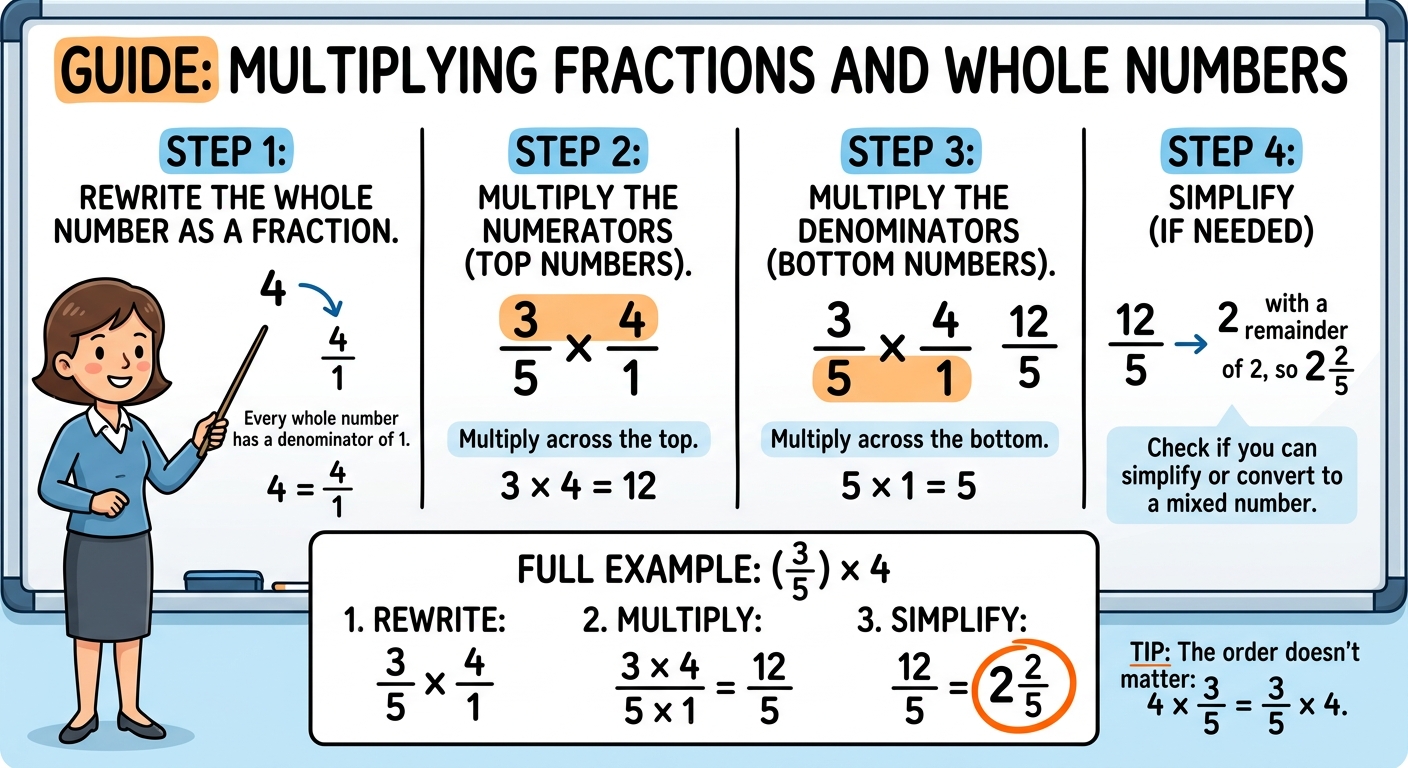
How To Multiply Fractions With Whole Numbers
The short version
- To multiply a fraction by a whole number, multiply the whole number by the numerator (top) and keep the denominator (bottom). Then simplify. Example: 4 × 2/3 = 8/3 = 2 2/3.
- If it helps, write the whole number as a fraction over 1 first: 4 = 4/1. Then multiply top by top and bottom by bottom.
- Look for a shortcut before you multiply. If the whole number and the denominator share a factor, divide it out first: 5/6 × 18 becomes 5 × 3 = 15.
- For a mixed number, turn it into an improper fraction first: 2 1/4 × 3 = 9/4 × 3 = 27/4 = 6 3/4.
- Multiplying by a fraction less than 1 gives a smaller answer. Use that to check your work.
To multiply fractions with whole numbers, multiply the whole number by the fraction’s numerator, keep the same denominator, and simplify. So 3 × 2/5 = 6/5, which is 1 1/5. The denominator doesn’t change because you’re counting more of the same size piece.
Kids learn this in fourth and fifth grade, and it comes back constantly: in recipes, in “what is 3/4 of 20” questions, in percents and in algebra. Below you’ll find why the rule works, the “of” method, a canceling shortcut, mixed numbers, word problems, and practice with answers.
Why the rule works
Multiplication is repeated addition, and that’s true for fractions too. 3 × 2/5 means three groups of 2/5:
2/5 + 2/5 + 2/5 = 6/5
You’re adding fifths, so the answer is still in fifths. Only the count of fifths changes: 3 groups of 2 fifths is 6 fifths. That’s why the whole number multiplies the numerator and leaves the denominator alone.
A picture helps kids who are new to this. Draw three bars, each split into 5 equal parts, and shade 2 parts in each. Count the shaded parts: 6 fifths, which is one full bar plus 1/5 more.
How to multiply fractions with whole numbers, step by step
- Write the whole number over 1 (optional, but it keeps things tidy).
- Multiply the numerators.
- Multiply the denominators. With a whole number over 1, the denominator stays the same.
- Simplify, and change an improper fraction to a mixed number if your teacher asks for one.
Example 1: basic
4 × 2/3
4/1 × 2/3 = (4 × 2)/(1 × 3) = 8/3
8 ÷ 3 = 2 remainder 2, so 8/3 = 2 2/3
Example 2: answer that simplifies
6 × 3/10
6 × 3 = 18, so 18/10
Divide top and bottom by 2: 9/5 = 1 4/5
The “of” method: fraction of a number
In word problems, “of” means multiply. “3/4 of 20” is 3/4 × 20. When the whole number divides evenly by the denominator, there’s a faster way to think about it:
- Divide the whole number by the denominator to find one part.
- Multiply by the numerator to get the parts you want.
Example 3: 3/4 of 20
20 ÷ 4 = 5 (that’s 1/4 of 20)
5 × 3 = 15, so 3/4 of 20 = 15
Same answer as the standard way: 3 × 20 = 60, and 60/4 = 15. The “of” method just keeps the numbers small, which makes it great for mental math.
Shortcut: simplify before you multiply
If the whole number and the denominator share a factor, divide both by it first. This is often called canceling, and it saves you from reducing a big fraction at the end.
Example 4: 5/6 × 18
18 and 6 share a factor of 6: 18 ÷ 6 = 3 and 6 ÷ 6 = 1
5/1 × 3 = 15
Check without the shortcut: 5 × 18 = 90, and 90/6 = 15.
Example 5: 7/12 × 8
8 and 12 share a factor of 4: 8 ÷ 4 = 2 and 12 ÷ 4 = 3
7/3 × 2 = 14/3 = 4 2/3
Check: 7 × 8 = 56, and 56/12 reduces to 14/3.
You can only cancel between a numerator and a denominator. Never cancel two numerators with each other.
Multiplying mixed numbers by whole numbers
A mixed number has a whole part and a fraction part, like 2 1/4. Change it to an improper fraction first.
Example 6: 2 1/4 × 3
2 1/4 = (2 × 4 + 1)/4 = 9/4
9/4 × 3 = 27/4
27 ÷ 4 = 6 remainder 3, so the answer is 6 3/4
There’s also a mental math route using the distributive property: 3 × 2 = 6 and 3 × 1/4 = 3/4, so the total is 6 3/4. Both ways match.
Example 7: a word problem
A cookie recipe needs 3/4 cup of flour. You’re making 6 batches. How much flour do you need?
6 × 3/4 = 18/4
Simplify: 18/4 = 9/2 = 4 1/2 cups
Will the answer be bigger or smaller?
| You multiply a whole number by… | The answer is… | Example |
|---|---|---|
| A fraction less than 1 | Smaller than the whole number | 12 × 2/3 = 8 |
| A fraction equal to 1 | The same | 12 × 4/4 = 12 |
| A fraction greater than 1 | Bigger than the whole number | 12 × 5/3 = 20 |
This is a quick sense check. If a kid gets 3/4 × 20 = 80, the table tells them something went wrong, since the answer has to be less than 20.
Common mistakes
- Multiplying the top and the bottom by the whole number. 4 × 2/3 is not 8/12. That’s just 2/3 in disguise. Only the numerator gets multiplied.
- Multiplying the denominator instead of the numerator. 4 × 2/3 is not 2/12. Four groups of something should be more, not less.
- Multiplying only the whole part of a mixed number. 2 1/4 × 3 is not 6 1/4. The 1/4 has to be multiplied by 3 too.
- Wrong mixed number conversion. 2 1/4 is (2 × 4 + 1)/4 = 9/4. Kids sometimes write 3/4 (adding 2 + 1) or 8/4.
- Leaving the answer unsimplified. 18/4 is correct but most teachers want 4 1/2 or 9/2.
Practice problems
- 5 × 1/4
- 3 × 2/7
- 2/3 × 9
- What is 3/8 of 24?
- 6 × 5/9 (try canceling first)
- 4 × 2 1/3
- There are 30 students in a class, and 2/5 of them ride the bus. How many ride the bus?
- Each shelf board is 3 1/2 feet long. How many feet of wood do 5 boards use?
Answers
- 5/4 = 1 1/4
- 6/7
- 18/3 = 6 (or 9 ÷ 3 = 3, then 3 × 2 = 6)
- 24 ÷ 8 = 3, then 3 × 3 = 9
- 6 and 9 share a 3: 2 × 5/3 = 10/3 = 3 1/3
- 2 1/3 = 7/3, so 4 × 7/3 = 28/3 = 9 1/3
- 30 ÷ 5 = 6, then 6 × 2 = 12 students
- 3 1/2 = 7/2, so 5 × 7/2 = 35/2 = 17 1/2 feet
If your kid is stuck on this
When a fourth or fifth grader can’t multiply fractions with whole numbers, the missing piece usually comes from earlier:
- Multiplication facts. If 6 × 3 or 35 ÷ 2 takes a long time, the fraction step gets buried under the arithmetic.
- What a fraction means. A kid who sees 2/3 as “two numbers” instead of “2 pieces that are each 1/3” won’t see why the bottom stays put.
- Equivalent fractions and simplifying, which third and fourth grade build.
This matters more than it seems. We’ve written about how struggling with algebra often traces straight back to fourth grade fractions. Our math skills by grade level guide lays out the fraction skills for grades 3 to 5, and if this is one of several topics that aren’t sticking, check these signs your child is behind in math. Short, regular practice helps fractions stick far better than one long session; here’s why 20 minutes a day works.
Frequently asked questions
How do you multiply fractions with whole numbers?
Multiply the whole number by the numerator, keep the denominator, then simplify. For example, 5 × 3/8 = 15/8 = 1 7/8.
Do you multiply the denominator by the whole number?
No. Write the whole number over 1 and you’ll see why: the denominator gets multiplied by 1, so it stays the same.
How do you multiply a mixed number by a whole number?
Turn the mixed number into an improper fraction, multiply, and simplify. 1 2/3 × 4 = 5/3 × 4 = 20/3 = 6 2/3.
Why does multiplying by a fraction make the answer smaller?
A fraction less than 1 means “part of.” Taking part of 12 has to give less than 12. If the fraction is bigger than 1, like 5/3, the answer gets bigger.
What grade learns to multiply fractions by whole numbers?
Fourth grade, in most U.S. schools following the Common Core standards. Fifth grade extends it to multiplying a fraction by a fraction and to mixed numbers.
Find the actual gap
Fraction trouble is easy to see and hard to diagnose. Is it multiplication facts, the meaning of a fraction or simplifying? Math Anon begins with a short adaptive assessment that tests each of those skills and sends you a written report of what’s missing.
Your child then gets about 20 minutes a day of practice on exactly those skills, and you get weekly progress reports. The $49 assessment is credited back in full on your first month. Start the assessment, or see pricing.





