
Length Vs Width Vs Height: Which Side Is Which?
The short version
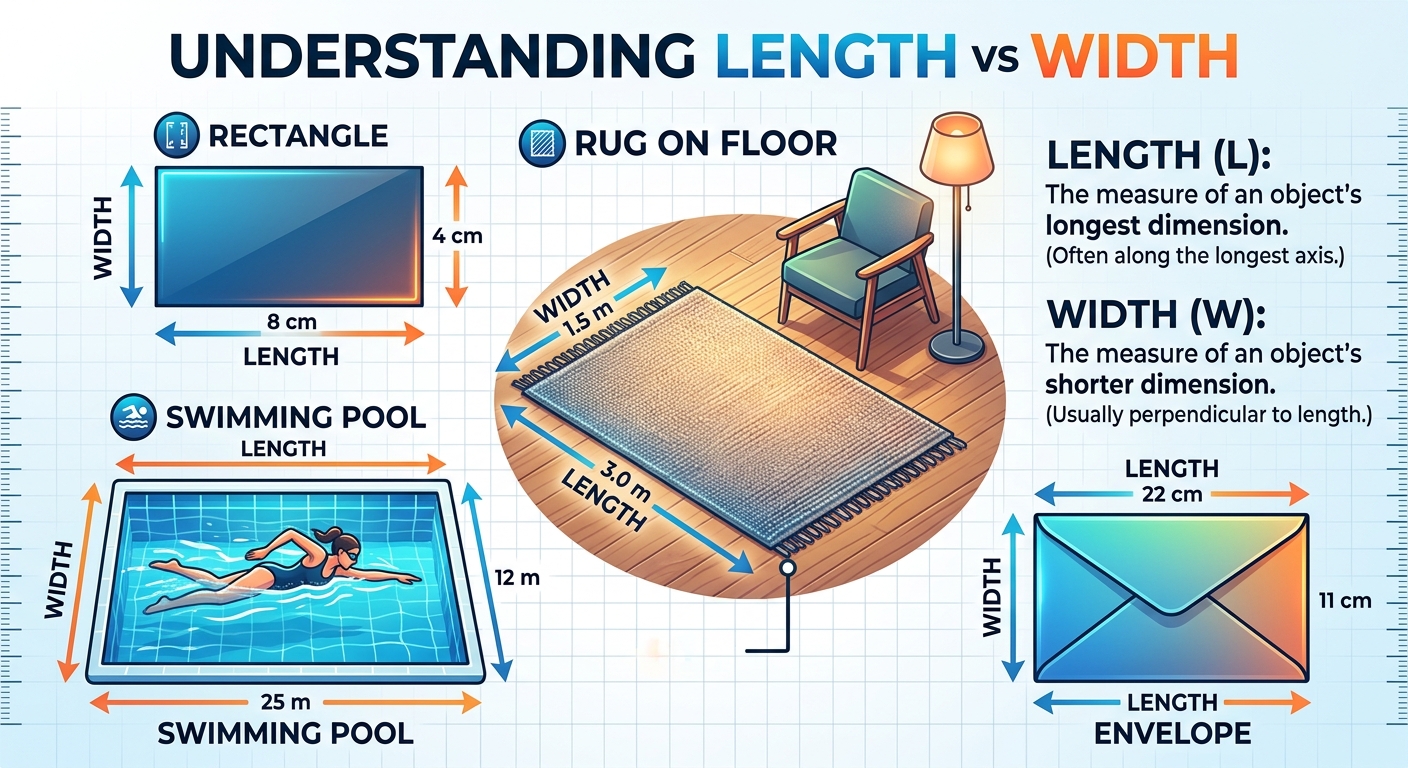
- Length is usually the longer side of a rectangle, and width is the shorter side. Height is how tall something is, measured straight up from the base.
- A flat shape only has two dimensions (length and width). A solid like a box adds a third: height.
- Box sizes are usually written L × W × H: length first, then width, then height. Always check the label, because windows, frames and furniture often use other orders.
- For area and volume, the labels don’t change the answer. 8 × 3 and 3 × 8 are both 24.
- Kids who mix these up are usually fine on the multiplication. The real snag is picturing which side is which, and that’s fixed by labeling a sketch.
Length vs width comes down to this: length is the longer side of a rectangle and width is the shorter side, measured across. Height is the third dimension, the distance from the bottom of an object to its top. So a table that’s 6 feet long, 3 feet wide and 30 inches tall has a length of 6 feet, a width of 3 feet and a height of 30 inches.
That’s the classroom rule. Real life is messier: some products list width first, and tipping a shape on its side can swap its labels. Below we cover both, plus how length vs width plays into area, perimeter and volume.
Length vs width: the basic rule
Picture a rectangle sitting flat on a page. It has two pairs of sides. In most textbooks:
- Length (L or l) is the longer pair of sides.
- Width (W or w) is the shorter pair. Think “how wide is it across?”
If you’re asking “which is length and which is width?”, start there. Longer side is length. Shorter side is width. A 10 cm by 4 cm rectangle has length 10 cm and width 4 cm.
Two small wrinkles. First, some teachers call the horizontal side the length and the vertical side the width (or height) no matter which is longer. If your child’s worksheet labels the sides on a diagram, the diagram wins. Second, a square has four equal sides, so length and width are the same number. A 5 in square has length 5 in and width 5 in, and nobody’s wrong about which is which.
Where does height come in?
Height measures how tall something is, straight up and down. On a flat drawing of a rectangle you’ll sometimes see the vertical side called height, especially once kids start working with triangles and parallelograms (base × height). On a solid object, height is its own separate measurement. A shoebox has a length along the long side of the bottom, a width across the short side of the bottom, and a height from the floor to the lid.
| Dimension | What it measures | Symbol | Example (a shoebox) |
|---|---|---|---|
| Length | The longer side of the base | L or l | 13 in |
| Width | The shorter side of the base, side to side | W or w | 8 in |
| Height | Bottom to top, straight up | H or h | 5 in |
The L × W × H order (and when it changes)
When you see three numbers like 12 × 9 × 4 on a box, the usual order is length × width × height. Shipping carriers, moving boxes and most math problems follow this. So a 12 × 9 × 4 box is 12 inches long, 9 inches wide and 4 inches tall.
Outside math class, the order isn’t locked in. A few common patterns:
- Windows and picture frames are often listed width × height, since they hang on a wall and “length” doesn’t mean much there.
- Furniture is often listed W × D × H, where D is depth (front to back). A dresser’s “width” is the long side you see from the front.
- Rugs are usually listed shorter side first, like 5 × 8 or 8 × 10.
- TV screens are sold by the diagonal, which is neither length nor width.
The takeaway for kids: if a label says what order it uses, trust the label. If it doesn’t, the math convention is L × W × H.
How the labels feed into formulas
Length, width and height matter because they plug into the three formulas kids use most in grades 3 to 6. Here they are with worked numbers.
Area of a rectangle: A = L × W
A rectangle is 14 m long and 6 m wide. What’s its area?
A = L × W
A = 14 × 6
A = 84 square meters
Area is always in square units because you’re counting how many 1 × 1 squares cover the shape.
Perimeter of a rectangle: P = 2L + 2W
Same rectangle, 14 m by 6 m. Perimeter is the distance around the edge.
P = 2 × 14 + 2 × 6
P = 28 + 12
P = 40 meters
You’ll also see this written P = 2(L + W). That gives 2 × 20 = 40, the same answer.
Volume of a box: V = L × W × H
A box is 12 in long, 9 in wide and 4 in tall.
V = L × W × H
V = 12 × 9 × 4
V = 108 × 4
V = 432 cubic inches
Volume uses cubic units because you’re counting 1 × 1 × 1 cubes that fill the box.
What happens if you tip the box over?
Say a box is 10 in long, 4 in wide and 6 in tall. Stand it on its end and the 10 in side becomes the height. The labels move around, but the volume doesn’t: 10 × 4 × 6 = 240 cubic inches either way. Order doesn’t change a product.
Solving for a missing side
Tests love to flip the formula around. A rectangle has an area of 45 square feet and a length of 9 feet. What’s the width?
A = L × W
45 = 9 × W
W = 45 ÷ 9
W = 5 feet
And for a box: a box holds 180 cubic cm, with length 10 cm and width 6 cm. How tall is it?
180 = 10 × 6 × H
180 = 60 × H
H = 180 ÷ 60
H = 3 cm
Common mistakes with length, width and height
- Adding when they should multiply. A kid who writes 20 for the area of a 14 × 6 rectangle added the sides. That’s half the perimeter, and it’s the most common slip we see.
- Using only two sides for perimeter. For a 14 × 6 rectangle, writing 14 + 6 = 20 instead of 40 forgets that each side appears twice.
- Wrong units. Area in plain “meters” or volume in “square inches” costs points. Area is squared, volume is cubed, length is plain.
- Freezing on labels. Some kids won’t start a problem until they’re sure which side is “the” length. For area and volume it doesn’t matter. Tell them to write the numbers down and multiply.
- Mixing units. A box that’s 2 ft long and 8 in wide has to be converted first. 2 ft = 24 in, so the base is 24 × 8 = 192 square inches.
Practice problems
- A rectangle measures 12 cm by 5 cm. Which number is the length and which is the width?
- Find the area of a rectangle with length 9 in and width 6 in.
- Find the perimeter of the same 9 in by 6 in rectangle.
- A box is 8 cm long, 5 cm wide and 3 cm tall. What’s its volume?
- A rug is 5 ft by 8 ft. What’s its area, and how much trim would go around the edge?
- A rectangle has an area of 72 square meters and a length of 12 meters. What’s the width?
- A garden bed has a perimeter of 50 m and a length of 15 m. What’s the width?
- A box holds 180 cubic inches. It’s 10 in long and 6 in wide. How tall is it?
Answers
- Length = 12 cm (the longer side), width = 5 cm.
- 9 × 6 = 54 square inches.
- 2 × 9 + 2 × 6 = 18 + 12 = 30 inches.
- 8 × 5 × 3 = 40 × 3 = 120 cubic cm.
- Area: 5 × 8 = 40 square feet. Trim: 2 × 5 + 2 × 8 = 10 + 16 = 26 feet.
- 72 ÷ 12 = 6 meters.
- Two lengths use 2 × 15 = 30 m. That leaves 50 – 30 = 20 m for the two widths, so each width is 20 ÷ 2 = 10 m.
- 10 × 6 = 60, and 180 ÷ 60 = 3 inches.
If your child keeps mixing these up
Trouble with length vs width is rarely the real problem. When a child gets area and perimeter questions wrong, the gap is usually one of these earlier skills:
- Multiplication facts. If 14 × 6 takes two minutes, there’s no attention left for the geometry. Fact fluency is a grade 3 and 4 skill, and our guide to math skills by grade level shows where it’s expected.
- What area actually means. Kids who memorized “length times width” without ever counting squares on grid paper can’t tell area from perimeter under pressure.
- Division as the inverse of multiplication. Missing-side problems (45 = 9 × W) are really division problems. If those stall, that’s the gap.
If you’re seeing this plus trouble in other topics, our list of signs your child is behind in math can help you sort out whether it’s one weak spot or several. And short, regular practice fixes this kind of thing faster than a long weekend cram, which is why we recommend 20 minutes a day.
Frequently asked questions
Is length the longer side or the shorter side?
Length is the longer side. Width is the shorter one. If a worksheet labels the sides on a diagram, use its labels instead.
Is length or width first?
In math, length usually comes first: L × W for a rectangle and L × W × H for a box. Products like windows and frames often list width first, so read the label.
Is width horizontal or vertical?
On a flat rectangle drawn on paper, width is usually the shorter side, which can point either way. On a box, width runs side to side across the base, and height is the vertical one.
What’s the difference between length vs width vs height?
Length is the long side, width is the short side across, and height is the distance from bottom to top. Flat shapes use the first two. Solid objects use all three.
Does it matter which side I call length when finding area?
No. Multiplication works in any order, so 7 × 4 and 4 × 7 both give 28. It only matters when a problem asks you to name a specific side.
Find the actual gap
If area, perimeter and volume keep going wrong, the cause is often a skill from a year or two back, like multiplication facts or the idea of square units. Math Anon starts with a short adaptive assessment that pinpoints which skills are missing and gives you a written report on what it found.
From there your child gets about 20 minutes of targeted daily practice on exactly those skills, and you get a progress report every week. The assessment is $49, and that’s credited back in full on the first month. Start the assessment or see pricing first.





