
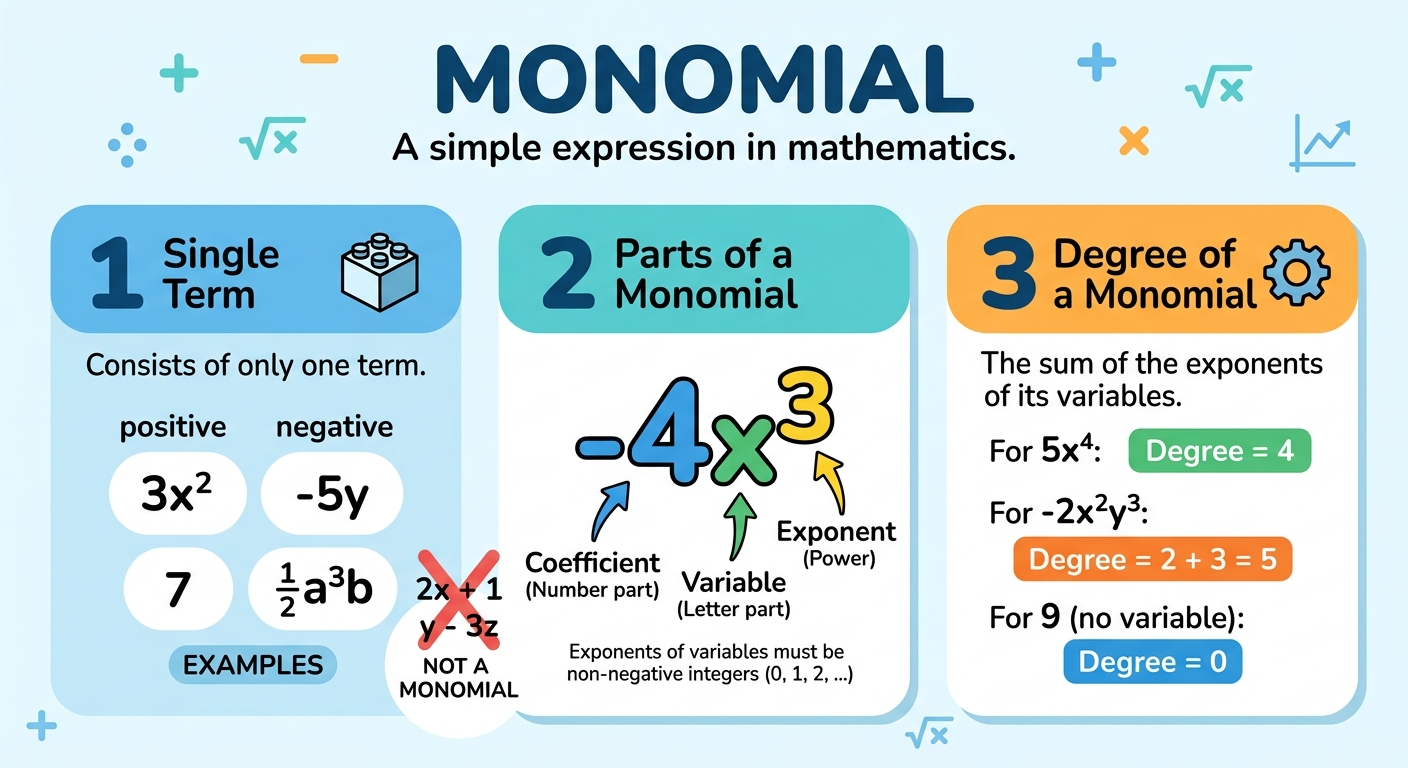
What Is A Monomial? Definition, Examples And Degree
The short version
- A monomial is an algebraic expression with exactly one term: a number, a variable, or numbers and variables multiplied together.
- Examples: 7, x, -5x2, 3xy and ½a3b. Non-examples: x + 2 (two terms), 4/x (variable in a denominator) and x-2 (negative exponent).
- The exponents on the variables have to be whole numbers: 0, 1, 2, 3 and so on.
- The degree of a monomial is the sum of its variable exponents, so 4x2y3 has degree 5.
A monomial is a single term in algebra: a number, a variable, or a product of numbers and variables where every exponent is a whole number. So 8, y, -3x2 and 6ab4 are all monomials. The moment you add or subtract a second term, like 6ab4 + 1, it stops being a monomial and becomes a binomial.
The word breaks down neatly: “mono” means one and “nomial” means term. Below we cover the parts of a monomial, a quick test for spotting one, how to find its degree, how to multiply and divide monomials, and a practice set with answers.
The parts of a monomial
Take the monomial -7x3y2. It has three parts:
- Coefficient: the number in front, -7. The sign belongs to the coefficient.
- Variables: the letters, x and y.
- Exponents: the small raised numbers, 3 on x and 2 on y.
When no coefficient is written, it’s 1. So x4 has a coefficient of 1, and -x4 has a coefficient of -1. When no exponent is written on a variable, it’s 1, so 5x means 5x1.
How to tell if something is a monomial
Run through these checks. If any answer is no, it isn’t a monomial.
- Is it one term? No + or – signs separating pieces. (A minus sign in front of the coefficient is fine.)
- Is every exponent on a variable a whole number (0, 1, 2, 3…)?
- Are all variables in the numerator? No dividing by a variable.
- Are variables only in the base, never in the exponent? 2x fails this one.
| Expression | Monomial? | Why |
|---|---|---|
| 12 | Yes | A constant is a single term with no variable. |
| -5x2 | Yes | One term; the coefficient is -5. |
| 3xy | Yes | Numbers and variables multiplied together. |
| x/4 | Yes | Same as ¼x. Dividing by a number is fine. |
| 4/x | No | A variable in the denominator is the same as x-1. |
| x-2 | No | Negative exponent. |
| √x | No | A square root means an exponent of ½. |
| x + 2 | No | Two terms, so it’s a binomial. |
| 2x | No | The variable is in the exponent. |
The x/4 and 4/x pair is the one kids mix up most. Dividing by a number just gives you a fraction coefficient. Dividing by a variable breaks the rule.
Monomial vs binomial vs trinomial vs polynomial
These names count terms. Each term in a larger expression is itself a monomial.
| Name | Number of terms | Example |
|---|---|---|
| Monomial | 1 | 9x3 |
| Binomial | 2 | 9x3 – 4 |
| Trinomial | 3 | x2 + 5x + 6 |
| Polynomial | 1 or more | 2x4 – x3 + 7x – 1 |
Polynomial is the umbrella word. A monomial is a polynomial with one term, a binomial is a polynomial with two, and so on. Count terms only after simplifying: 3x + 5x looks like two terms, but it combines to 8x, which is a monomial.
The degree of a monomial
To find the degree, add the exponents on all the variables. Ignore the coefficient.
6x4 has degree 4.
-2a3b5 has degree 3 + 5 = 8.
xyz has degree 1 + 1 + 1 = 3.
11 has degree 0, because there’s no variable (you can think of it as 11x0).
Degree matters later when kids put polynomials in standard form (highest degree first) and when they classify polynomials as linear, quadratic or cubic.
Multiplying, dividing and adding monomials
Multiplying
Multiply the coefficients. For each variable, add the exponents.
(3x2)(4x5) = (3 × 4)x2+5 = 12x7
(-2ab2)(5a3b) = -10a4b3
The product of two monomials is always another monomial.
Dividing
Divide the coefficients. For each variable, subtract the exponents.
12x5y3 ÷ 4x2y = (12 ÷ 4)x5-2y3-1 = 3x3y2
Dividing can leave a variable in the denominator, like x2 ÷ x5 = 1/x3, and then the result isn’t a monomial.
Raising to a power
Raise the coefficient to the power and multiply each exponent by it.
(2x3)2 = 22x3×2 = 4x6
Adding and subtracting
You can only combine monomials that are like terms: same variables with the same exponents. Add the coefficients and leave the exponents alone.
4x2 + 7x2 = 11x2
4x2 + 7x can’t be combined. It stays as a binomial.
Common mistakes with monomials
- Thinking a plain number isn’t a monomial. 12 counts. So does -1.
- Treating the minus sign as a second term. -5x is one term with a coefficient of -5.
- Adding exponents when adding terms. x2 + x2 is 2x2, not x4. Exponents only add when you multiply.
- Multiplying exponents when multiplying terms. x2 · x3 is x5, not x6. Exponents multiply only when a power is raised to another power.
- Counting the coefficient in the degree. 9x2 has degree 2, not 11.
- Calling 4/x a monomial because it “looks like one term.” The variable in the denominator rules it out.
Practice problems
- Is 9y a monomial?
- Is 4x + 1 a monomial?
- Is 6/x a monomial?
- What’s the coefficient of -x3y?
- What’s the degree of -3a2b4?
- Multiply: (5a2)(-2a3b)
- Divide: 18m6n2 ÷ 6m2n
- Simplify 2x2y + 5x2y – x2y. Is the answer a monomial?
Answers
- Yes. One term, coefficient 9, exponent 1.
- No. Two terms, so it’s a binomial.
- No. The variable is in the denominator.
- -1
- 2 + 4 = 6
- 5 × -2 = -10, a2+3 = a5, so -10a5b
- 18 ÷ 6 = 3, m6-2 = m4, n2-1 = n, so 3m4n
- 2 + 5 – 1 = 6, so 6x2y. Yes, it’s a monomial.
If your child is stuck on monomials
Monomials are usually a first-week topic in pre-algebra or Algebra 1, and the idea itself is small. When kids get stuck, it’s almost always on something they were supposed to bring with them.
The usual suspects are exponents (what x3 actually means, and why you add exponents when multiplying), operations with negative numbers (5 × -2), and fractions as coefficients. If “½x” makes your child freeze, that’s a fraction gap, and it’ll keep causing trouble all through algebra. We explain that pattern in Struggling With Algebra? The Real Problem Is Usually Fourth Grade Fractions.
A short daily review of these older skills does more than one long cram session before a test, for reasons we go into in Why 20 Minutes A Day Beats A 90-Minute Tutoring Session. And if you’re seeing trouble across several topics, Is My Child Behind In Math? 12 Signs By Grade Level can help you decide whether it’s a pattern.
Frequently asked questions
Is a constant a monomial?
Yes. A number by itself, like 7 or -20, is a monomial with degree 0.
Can a monomial have more than one variable?
Yes. 3xy, a2b2 and -8pqr are all monomials. What matters is that the variables are multiplied, not added.
Can a monomial have a negative exponent?
No. A negative exponent means the variable is really in the denominator, so x-3 isn’t a monomial. The coefficient can be negative, though.
What is the degree of a monomial?
It’s the sum of the exponents on its variables. For 5x2y3z, that’s 2 + 3 + 1 = 6.
What’s the difference between a monomial and a polynomial?
A monomial has exactly one term. A polynomial can have one term or many. Every monomial is a polynomial, but x2 + 1 is a polynomial that isn’t a monomial.
Find the actual gap
If algebra homework keeps stalling on things like exponents or negative coefficients, the fix is usually an earlier skill, and it’s faster to find it than to guess. Math Anon starts with a short adaptive assessment and gives you a written report showing exactly which skills your child is missing.
After that, your child works on those skills for about 20 minutes a day, and you get a weekly progress report so you can see what’s closing. The assessment is $49, credited in full toward your first month. Start the assessment or look over pricing.





