
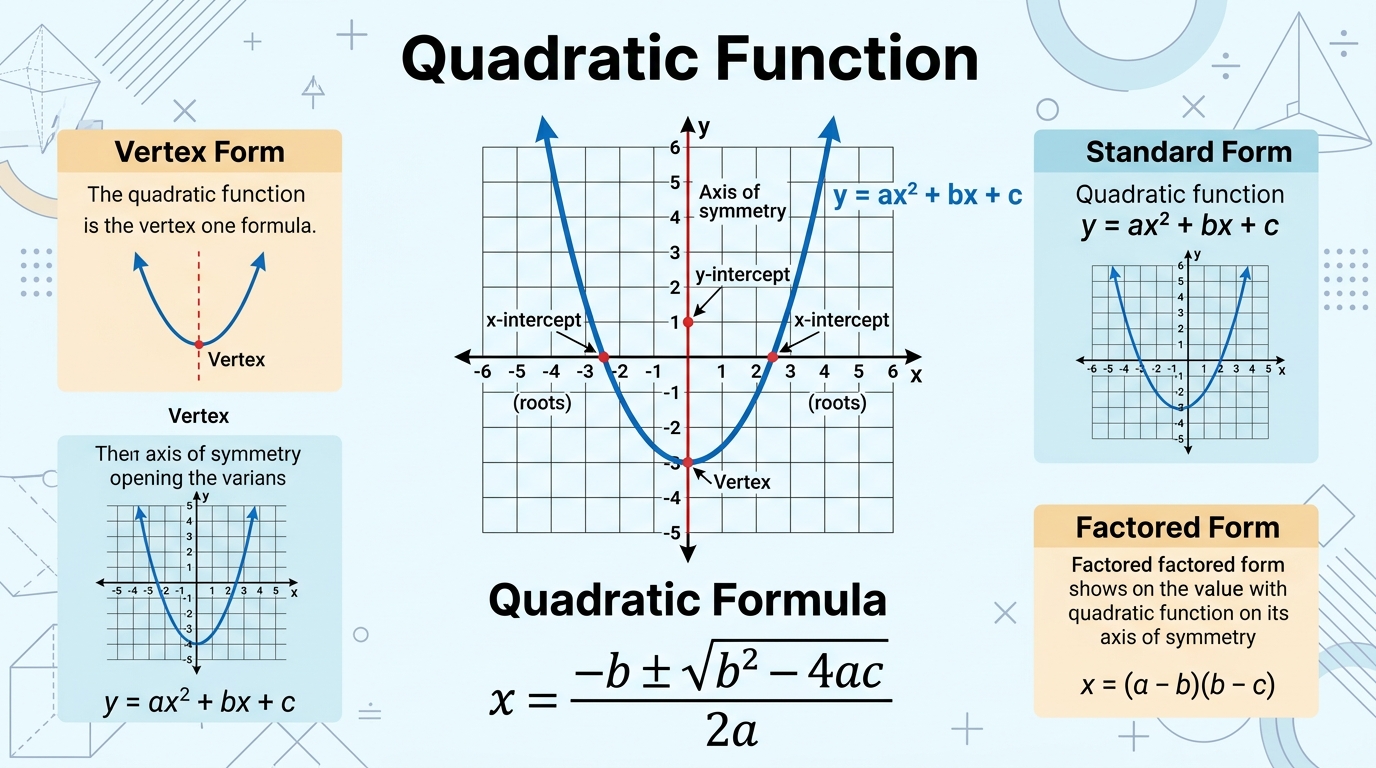
Quadratic Function: Definition, Graph, Vertex And Zeros
The short version
- A quadratic function is any function that can be written as f(x) = ax² + bx + c, where a isn’t zero. The highest power of x is 2.
- Its graph is a U-shaped curve called a parabola. It opens up when a is positive and down when a is negative.
- The turning point is the vertex. Its x-coordinate is x = -b/(2a), and the y-intercept is always c.
- The zeros (where the graph crosses the x-axis) come from factoring, the quadratic formula, or the graph. There can be two, one, or none.
A quadratic function is a function whose highest power of x is 2, written in standard form as f(x) = ax² + bx + c with a ≠ 0. Graph one and you get a parabola: a symmetric U shape that either opens upward and has a lowest point, or opens downward and has a highest point.
That’s the definition. The rest of this guide shows how to actually work with one: spotting a quadratic, reading its three forms, finding the vertex and zeros, graphing it by hand, and solving a real word problem. Practice problems with answers are near the end.
What is a quadratic function?
“Quadratic” comes from the Latin word for square, because the defining feature is the x² term. Each letter in f(x) = ax² + bx + c has a job:
- a controls the direction and width. Positive a opens up, negative a opens down. The bigger |a| is, the narrower the U.
- b works with a to shift the parabola left or right.
- c is the y-intercept, where the graph crosses the y-axis.
b and c can be zero. a can’t, because without the x² term you’re left with a line.
Is it a quadratic function?
| Function | Quadratic? | Why |
|---|---|---|
| y = 3x² | Yes | a = 3, b = 0, c = 0 |
| y = 5 – x² | Yes | a = -1, b = 0, c = 5 |
| y = (x + 1)(x – 3) | Yes | Multiplies out to x² – 2x – 3 |
| y = 2x + 7 | No | Highest power is 1 (linear) |
| y = x³ – x | No | Highest power is 3 (cubic) |
| y = 1/x² | No | x is in the denominator |
The three forms of a quadratic function
The same parabola can be written three ways. Each one makes a different feature easy to read.
| Form | Looks like | Easy to read |
|---|---|---|
| Standard | y = ax² + bx + c | y-intercept (c) |
| Vertex | y = a(x – h)² + k | Vertex at (h, k) |
| Factored | y = a(x – r)(x – s) | Zeros at x = r and x = s |
Here’s one function in all three forms:
Standard: y = x² – 4x – 5
Vertex: y = (x – 2)² – 9
Factored: y = (x – 5)(x + 1)
Check the vertex form: (x – 2)² – 9 = x² – 4x + 4 – 9 = x² – 4x – 5. Same function.
Watch the signs in vertex and factored form. y = (x + 3)² + 1 has its vertex at (-3, 1), because x + 3 is the same as x – (-3).
How to graph a quadratic function by hand
Let’s graph f(x) = x² – 4x – 5, where a = 1, b = -4, c = -5.
Step 1: Direction. a = 1 is positive, so the parabola opens up and the vertex is a minimum.
Step 2: Vertex.
x = -b/(2a) = -(-4)/(2 × 1) = 4/2 = 2
f(2) = 2² – 4(2) – 5 = 4 – 8 – 5 = -9
Vertex: (2, -9). The axis of symmetry is the vertical line x = 2.
Step 3: y-intercept. f(0) = -5, so the graph crosses at (0, -5).
Step 4: Zeros.
x² – 4x – 5 = 0
(x – 5)(x + 1) = 0
x = 5 or x = -1
Step 5: Table and plot. Use points on both sides of the vertex.
| x | f(x) = x² – 4x – 5 |
|---|---|
| -1 | 0 |
| 0 | -5 |
| 1 | -8 |
| 2 | -9 |
| 3 | -8 |
| 4 | -5 |
| 5 | 0 |
See the mirror pattern around x = 2? That symmetry is a built-in check. If your values don’t mirror, something’s off.
Finding the zeros of a quadratic function
The zeros (also called roots, solutions, or x-intercepts) are the x-values where f(x) = 0. There are three main ways to find them.
Factoring
Works when the numbers cooperate. Solve x² + x – 12 = 0.
Find two numbers that multiply to -12 and add to 1: 4 and -3.
(x + 4)(x – 3) = 0
x = -4 or x = 3
The quadratic formula
Works every time: x = (-b ± √(b² – 4ac)) / (2a). Solve 2x² + 3x – 2 = 0, where a = 2, b = 3, c = -2.
b² – 4ac = 9 – 4(2)(-2) = 9 + 16 = 25
x = (-3 ± 5) / 4
x = 2/4 = 1/2 or x = -8/4 = -2
The discriminant tells you how many zeros
The part under the square root, b² – 4ac, is the discriminant.
| b² – 4ac | Number of real zeros | What the graph does |
|---|---|---|
| Positive | 2 | Crosses the x-axis twice |
| Zero | 1 | Vertex touches the x-axis |
| Negative | 0 | Never touches the x-axis |
A real-world quadratic function
A ball is thrown straight up from the ground at 64 feet per second. Its height in feet after t seconds is h(t) = -16t² + 64t.
How high does it go? a = -16 is negative, so the vertex is a maximum.
t = -b/(2a) = -64/(2 × -16) = -64/-32 = 2 seconds
h(2) = -16(4) + 64(2) = -64 + 128 = 64 feet
When does it land?
-16t² + 64t = 0
-16t(t – 4) = 0
t = 0 (the throw) or t = 4 seconds (the landing)
Anything that goes up and comes back down under gravity, like a basketball shot or a water fountain’s arc, follows this kind of curve. So do many “maximize the area” and “maximize the profit” problems.
Common mistakes
- Dropping the negative in -b/(2a). For f(x) = x² – 4x – 5, b is -4, so -b is +4. Kids who skip that sign put the vertex at x = -2.
- Squaring negatives wrong. (-3)² = 9, but -3² = -9. When plugging x = -3 into x², use parentheses, especially on a calculator.
- Misreading vertex form. y = (x + 3)² – 2 has vertex (-3, -2), not (3, -2).
- Only dividing part of the formula by 2a. The whole numerator, -b ± √(b² – 4ac), goes over 2a.
- Setting up the zeros wrong. (x – 5)(x + 1) = 0 gives x = 5 and x = -1. Each sign flips.
Practice problems
- Is y = 4 – 3x² a quadratic function? If so, name a, b and c.
- Does f(x) = -x² + 6x open up or down?
- What is the y-intercept of f(x) = 2x² – 5x + 7?
- Find the vertex of f(x) = x² + 6x + 5.
- Find the zeros of f(x) = x² – x – 12.
- For y = 2(x – 1)² + 3, give the vertex, then rewrite it in standard form.
- How many real zeros does x² + 2x + 5 have? Use the discriminant.
- A ball’s height is h(t) = -16t² + 32t + 48 feet. Find its maximum height and when it hits the ground.
Answers
- Yes. a = -3, b = 0, c = 4.
- Down, because a = -1 is negative.
- (0, 7)
- x = -6/(2 × 1) = -3, and f(-3) = 9 – 18 + 5 = -4. Vertex: (-3, -4).
- (x – 4)(x + 3) = 0, so x = 4 or x = -3.
- Vertex (1, 3). Standard form: 2(x² – 2x + 1) + 3 = 2x² – 4x + 5.
- b² – 4ac = 4 – 20 = -16. Negative, so there are no real zeros.
- Vertex at t = -32/(2 × -16) = 1 second, h(1) = -16 + 32 + 48 = 64 feet. It lands when -16(t² – 2t – 3) = 0, which is -16(t – 3)(t + 1) = 0, so t = 3 seconds.
If your kid is stuck on quadratic functions
Quadratics sit near the top of a tall stack of skills, so trouble here usually starts lower down. Missing the vertex because of a sign slip points to integer operations. Getting stuck on factoring often means multiplication facts aren’t automatic, since factoring is really “what two numbers multiply to this and add to that?” Freezing on the quadratic formula often traces back to order of operations or fractions.
We break down that pattern in Struggling With Algebra? The Real Problem Is Usually Fourth Grade Fractions. If quadratics are also where the stress shows up (avoiding homework, “I’m just bad at math”), our piece on math anxiety in children is worth a read. And our guide to math assessment explains how to find which lower skill is causing the trouble.
Frequently asked questions
What is a quadratic function in simple terms?
It’s a function where x gets squared and no higher power appears. Its graph is a U-shaped parabola.
What’s the difference between a quadratic function and a quadratic equation?
A quadratic function, like f(x) = x² – 4, describes a whole curve of inputs and outputs. A quadratic equation, like x² – 4 = 0, asks for the specific x-values that make it true. Solving the equation finds the function’s zeros.
How can you tell a quadratic function from a table?
With evenly spaced x-values, look at the second differences of the y-values. For x² – 4x – 5 at x = 0 to 4, the y-values are -5, -8, -9, -8, -5. First differences: -3, -1, 1, 3. Second differences: 2, 2, 2. Constant second differences mean it’s quadratic.
Can a quadratic function have no x-intercepts?
Yes. If the discriminant b² – 4ac is negative, the parabola never touches the x-axis. y = x² + 1 is an example.
What is the vertex of a quadratic function?
It’s the turning point of the parabola: the lowest point if it opens up, the highest if it opens down. Find its x-coordinate with x = -b/(2a).
Find the actual gap
When quadratics fall apart, the cause is usually a skill from years earlier, like negative numbers, multiplication facts, or fractions. Math Anon starts with a short adaptive assessment that finds exactly which of those building blocks are missing and gives you a written report on it.
After that, your kid practices about 20 minutes a day on those specific skills, and you get a weekly progress report. The assessment is $49, fully credited toward your first month. Start the assessment or look over pricing.
Related reading
- Struggling With Algebra? The Real Problem Is Usually Fourth Grade Fractions
- Mind The Gap: A Parent’s Guide To Math Assessment For Kids
- Math Anxiety In Children: What It Looks Like And What Helps
- Why 20 Minutes A Day Beats A 90-Minute Tutoring Session
- Arithmetic Sequence Formula: Find Any Term And The Sum
- What Is A Monomial? Definition, Examples And Degree





