
The Inverse Property Of Addition And Multiplication
The short version
- erty
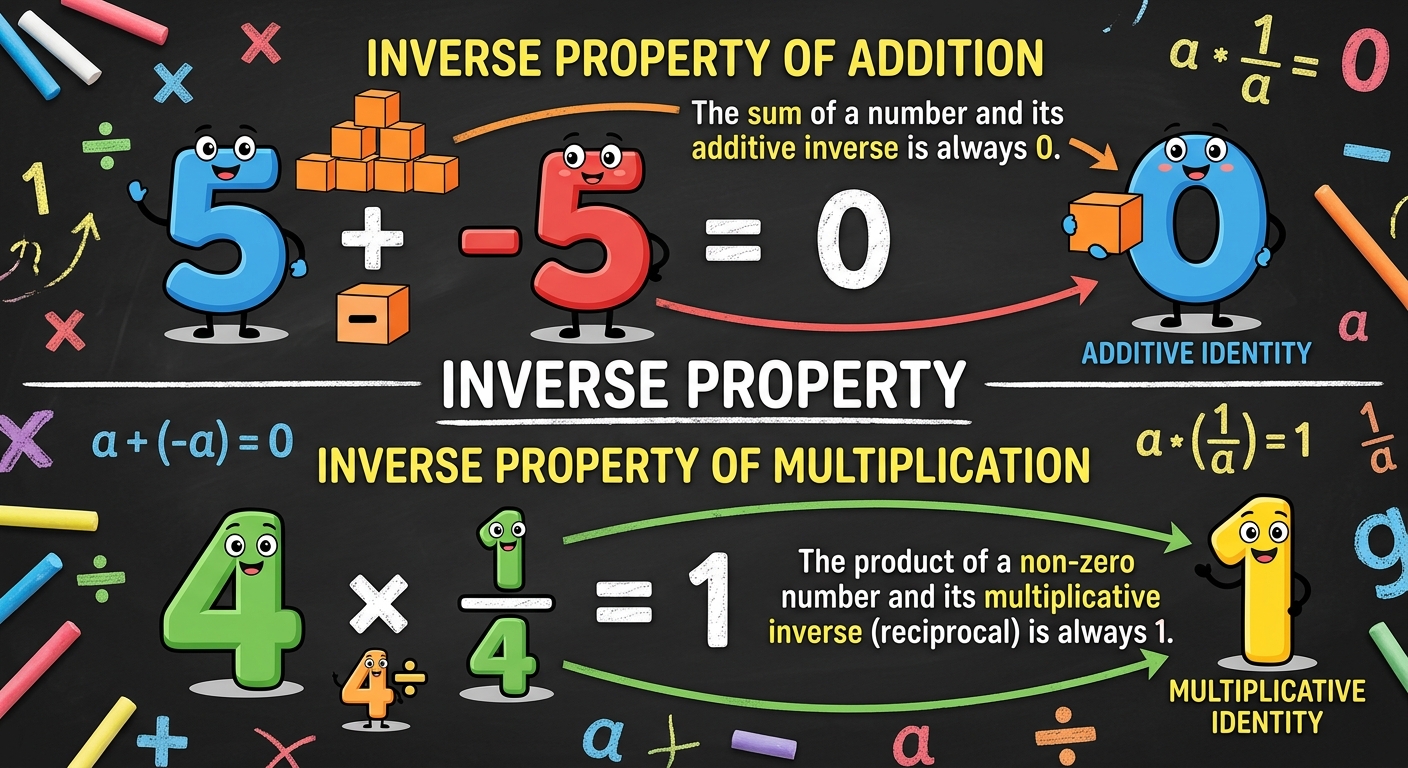
The inverse property says that when you combine a number with its inverse, you get the identity number for that operation. Under addition, a number plus its opposite equals 0: a + (-a) = 0. Under multiplication, a number times its reciprocal equals 1: a × 1/a = 1, as long as a isn’t 0.
That’s two rules sharing one name, which is where a lot of the confusion starts. Below we’ll separate them, show how to find each kind of inverse (including for fractions, mixed numbers, decimals, and negatives), and show where the property quietly does the work when your kid solves an equation or divides fractions.
The inverse property of addition
Every number has an additive inverse, also called its opposite. It’s the same distance from 0 on the number line, on the other side. Add a number to its opposite and you always land on 0.
15 + (-15) = 0
-2.6 + 2.6 = 0
3/7 + (-3/7) = 0
0 + 0 = 0
To find the additive inverse, change the sign. That’s the whole rule. The opposite of 15 is -15, the opposite of -2.6 is 2.6, and 0 is its own opposite.
A real-world way to picture it: you owe $20 (-20) and then earn $20 (+20). You’re back to 0.
The inverse property of multiplication
Every number except 0 has a multiplicative inverse, also called its reciprocal. Multiply a number by its reciprocal and you always get 1.
5 × 1/5 = 1
2/3 × 3/2 = 6/6 = 1
-4 × (-1/4) = 1
The quick way to find a reciprocal is to write the number as a fraction and flip it. Here’s how that plays out for different kinds of numbers:
| Number | Write as a fraction | Reciprocal | Check |
|---|---|---|---|
| 6 | 6/1 | 1/6 | 6 × 1/6 = 1 |
| 3/8 | 3/8 | 8/3 | 3/8 × 8/3 = 24/24 = 1 |
| 2 1/2 | 5/2 | 2/5 | 5/2 × 2/5 = 10/10 = 1 |
| 0.25 | 1/4 | 4 | 0.25 × 4 = 1 |
| -5/6 | -5/6 | -6/5 | -5/6 × (-6/5) = 30/30 = 1 |
| 0 | 0/1 | None | 0 × anything = 0, never 1 |
Two rows deserve a closer look. For a mixed number like 2 1/2, you have to convert to an improper fraction first. Flipping just the 1/2 part gives 2 2/1, which is wrong. And for a negative number, the reciprocal stays negative, because a negative times a positive is negative and could never equal 1.
Inverse property vs. identity property
These two get mixed up constantly, partly because they appear on the same worksheet. The identity property is about doing nothing. The inverse property is about undoing.
| Property | Addition | Multiplication | What it does |
|---|---|---|---|
| Identity | a + 0 = a | a × 1 = a | Leaves the number unchanged |
| Inverse | a + (-a) = 0 | a × 1/a = 1 | Cancels the number to reach the identity |
A quick test on a worksheet: if the answer is the same number you started with, it’s identity. If the answer is 0 (for addition) or 1 (for multiplication), and the two numbers were opposites or reciprocals, it’s the inverse property.
So 9 + 0 = 9 is the identity property of addition, 9 + (-9) = 0 is the inverse property of addition, and 9 × 1/9 = 1 is the inverse property of multiplication.
How the inverse property solves equations
Every time your child “gets x by itself,” they’re using the inverse property. Each step cancels a number by combining it with its inverse, which leaves the identity (0 or 1) behind and makes it vanish.
Example 1: using the additive inverse
x + 9 = 23
x + 9 + (-9) = 23 + (-9)
x + 0 = 14
x = 14
The 9 and -9 cancel to 0 (inverse property), and x + 0 is just x (identity property).
Example 2: using the multiplicative inverse
3/4 × x = 12
4/3 × 3/4 × x = 4/3 × 12
1 × x = 48/3
x = 16
Check: 3/4 × 16 = 48/4 = 12.
Example 3: a negative coefficient
-5x = 35
(-1/5) × (-5x) = (-1/5) × 35
x = -7
Check: -5 × (-7) = 35. If your kid multiplied by positive 1/5 here, they’d get -x = 7 and often forget to finish.
Example 4: dividing fractions
The “keep, change, flip” trick for dividing fractions is the inverse property with a nickname. Dividing by a number is the same as multiplying by its reciprocal:
2/3 ÷ 4/5 = 2/3 × 5/4 = 10/12 = 5/6
Check: 5/6 × 4/5 = 20/30 = 2/3. It works.
Common mistakes with the inverse property
- Mixing up opposite and reciprocal. The additive inverse of 4 is -4. The multiplicative inverse of 4 is 1/4. Ask which operation the problem is about before answering.
- Changing the sign when flipping. The reciprocal of -3/7 is -7/3. Kids often write 7/3 because “inverse” sounds like “opposite.”
- Flipping only part of a mixed number. Convert 3 1/3 to 10/3 first, then flip to 3/10.
- Giving 0 a reciprocal. 1/0 isn’t a number. Zero is the one value with no multiplicative inverse.
- Labeling identity as inverse. 7 × 1 = 7 is identity. 7 × 1/7 = 1 is inverse. The answer being 1 is the giveaway for the second one.
- Using the inverse on one side only. In equations, whatever you add or multiply on one side has to happen on the other.
Practice problems
- What is the additive inverse of 12?
- What is the additive inverse of -3/5?
- What is the multiplicative inverse of 7?
- What is the multiplicative inverse of -2/9?
- What is the multiplicative inverse of 1 3/4?
- What is the multiplicative inverse of 0.2?
- Name the property: (a) 6 + (-6) = 0 (b) 6 + 0 = 6 (c) 6 × 1/6 = 1
- Solve using a multiplicative inverse: 2/5 × x = 8
Answers
- -12
- 3/5
- 1/7
- -9/2
- 1 3/4 = 7/4, so the reciprocal is 4/7.
- 0.2 = 1/5, so the reciprocal is 5.
- (a) inverse property of addition (b) identity property of addition (c) inverse property of multiplication
- Multiply both sides by 5/2: x = 8 × 5/2 = 40/2 = 20. Check: 2/5 × 20 = 40/5 = 8.
If your child is stuck on the inverse property
The inverse property gets its formal name in 6th or 7th grade, but it rests on two earlier skills. The additive side needs a solid feel for negative numbers and the number line. The multiplicative side needs fractions, which kids build in 3rd through 5th grade. When a kid can recite “a number times its reciprocal is 1” and still can’t find the reciprocal of 2 1/2, the gap is in fractions.
That same fraction gap tends to show up again, bigger, when equations start. We explain why in Struggling With Algebra? The Real Problem Is Usually Fourth Grade Fractions. To see which fraction skills are expected at each grade, look at Math Skills By Grade Level: What Your Child Should Know. And if you’re not sure whether this is a one-off or a pattern, Is My Child Behind In Math? 12 Signs By Grade Level can help you tell.
Frequently asked questions
What is the inverse property in math?
It’s the rule that a number combined with its inverse gives the identity. For addition, a + (-a) = 0. For multiplication, a × 1/a = 1, for any a that isn’t 0.
What is an example of the inverse property of addition?
11 + (-11) = 0. Any number plus its opposite works, including fractions and decimals, like 0.4 + (-0.4) = 0.
What is an example of the inverse property of multiplication?
3/10 × 10/3 = 30/30 = 1. Any nonzero number times its reciprocal works.
Why doesn’t zero have a multiplicative inverse?
A multiplicative inverse has to multiply with the number to make 1. Zero times any number is 0, so no partner exists. That’s the same reason division by zero is undefined.
Is the inverse property the same as inverse operations?
They’re related. Inverse operations are pairs that undo each other, like addition and subtraction. The inverse property is about inverse numbers. Subtracting 9 is the same as adding the additive inverse of 9, so the two ideas meet whenever you solve an equation.
Find the actual gap
If reciprocals, negatives, or equation steps keep going wrong, a report card won’t tell you which one is the root cause. Math Anon starts with a short adaptive assessment that tracks the problem back to the exact skills your child is missing and puts the results in a written report.
After that, your child works on those skills for about 20 minutes a day, and you get a weekly progress report so you can see what’s closing. The assessment costs $49, fully credited toward your first month. Start the assessment or read about pricing.





