
What Does Cubed Mean In Math? Cube Numbers 1 To 12
The short version
- Cubed means a number multiplied by itself three times. 4 cubed is written 4³ and equals 4 × 4 × 4 = 64.
- The little raised 3 is an exponent. It tells you how many copies of the number to multiply, so 4³ is never 4 × 3.
- The first twelve cube numbers are 1, 8, 27, 64, 125, 216, 343, 512, 729, 1,000, 1,331 and 1,728.
- A negative number cubed stays negative: (-3)³ = -27. That’s a big difference from squaring.
- The cube root undoes cubing. The cube root of 64 is 4, because 4 × 4 × 4 = 64.
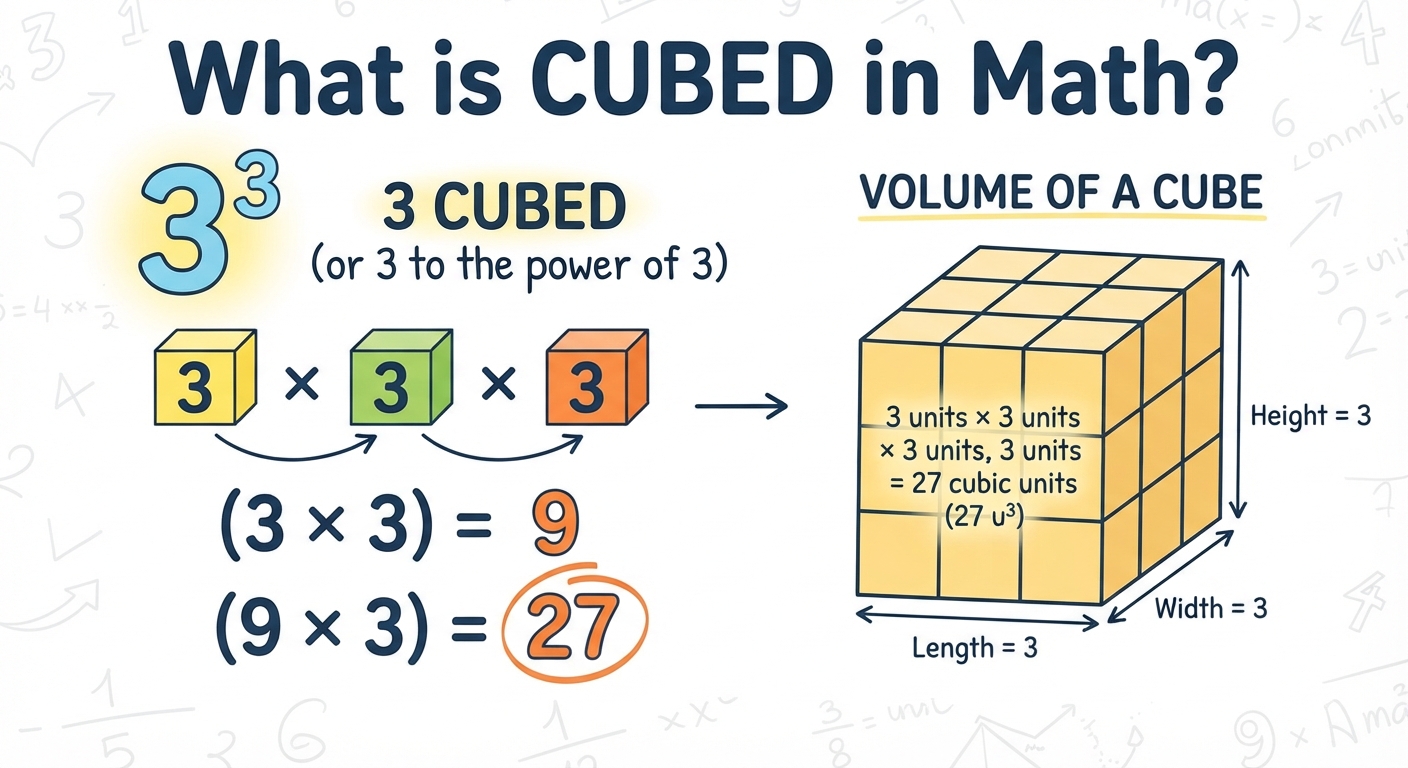
In math, cubed means a number is multiplied by itself three times. You write it with a small 3 up and to the right, so 5 cubed is 5³, which means 5 × 5 × 5 = 125. Cubing a number is the same thing as raising it to the third power.
The name comes from geometry. A cube that’s 5 units long, 5 units wide and 5 units tall holds 5 × 5 × 5 = 125 unit blocks. That’s why volume is measured in cubic units, like cm³ or ft³. Below you’ll find a chart of cubed numbers from 1 to 12, how to handle negatives, fractions and decimals, how cube roots work, and a set of practice problems with answers.
What cubed means, step by step
When you see a number with a raised 3, like 6³, the bottom number is the base and the raised 3 is the exponent (or power). You read 6³ as “six cubed” or “six to the third power.” To find the value, write the base three times and multiply.
Example: 6 cubed
6³ = 6 × 6 × 6
6 × 6 = 36
36 × 6 = 216
So 6³ = 216.
It helps to do it in two steps. Square the number first, then multiply that answer by the number one more time. Most kids already know 6 × 6 = 36, so the only new work is 36 × 6.
Example: 12 cubed
12 × 12 = 144
144 × 12 = 1,440 + 288 = 1,728
So 12³ = 1,728.
Why it’s called cubed
Picture a stack of sugar cubes arranged into one big cube, 3 cubes on each edge. The bottom layer is 3 by 3, which is 9 cubes. Stack 3 of those layers and you have 9 × 3 = 27 cubes. That’s 3³. The same picture works for any whole number, which is why kids often meet cubed numbers in fifth grade volume lessons before they see exponents in algebra.
Cubed numbers chart from 1 to 12
These are worth recognizing on sight. Kids don’t need to memorize all twelve, but knowing 1³ through 5³ and 10³ makes cube roots and estimating much faster.
| Number | Written as | Multiplication | Cubed value |
|---|---|---|---|
| 1 | 1³ | 1 × 1 × 1 | 1 |
| 2 | 2³ | 2 × 2 × 2 | 8 |
| 3 | 3³ | 3 × 3 × 3 | 27 |
| 4 | 4³ | 4 × 4 × 4 | 64 |
| 5 | 5³ | 5 × 5 × 5 | 125 |
| 6 | 6³ | 6 × 6 × 6 | 216 |
| 7 | 7³ | 7 × 7 × 7 | 343 |
| 8 | 8³ | 8 × 8 × 8 | 512 |
| 9 | 9³ | 9 × 9 × 9 | 729 |
| 10 | 10³ | 10 × 10 × 10 | 1,000 |
| 11 | 11³ | 11 × 11 × 11 | 1,331 |
| 12 | 12³ | 12 × 12 × 12 | 1,728 |
A pattern to notice: cube numbers grow fast. Going from 10 to 11 only adds 1 to the base, but the cube jumps by 331. That fast growth is why a small change in the side of a box makes a big change in how much it holds.
Cubing negatives, fractions and decimals
Negative numbers
A negative times a negative is positive, and then that positive times one more negative is negative again. So a negative number cubed always comes out negative.
(-4)³ = (-4) × (-4) × (-4)
(-4) × (-4) = 16
16 × (-4) = -64
So (-4)³ = -64.
This is the opposite of squaring, where (-4)² = 16 is positive. It’s also why a cube root of a negative number exists: the cube root of -64 is -4.
Fractions
Cube the top and cube the bottom.
(2/3)³ = (2 × 2 × 2) / (3 × 3 × 3) = 8/27
Notice the answer is smaller than 2/3. Cubing a number between 0 and 1 always makes it smaller, which surprises a lot of kids who expect powers to make things bigger.
Decimals
Multiply as if there’s no decimal point, then count decimal places. Each factor of 0.2 has one decimal place, so three factors give three places.
0.2³ = 0.2 × 0.2 × 0.2
2 × 2 × 2 = 8
Three decimal places: 0.008
Variables
In algebra, x³ means x × x × x. If x = 3, then x³ = 27. Watch the parentheses: (2x)³ means 2x × 2x × 2x, which is 8x³. Without parentheses, 2x³ means 2 × x³, and only the x gets cubed. When x = 3, (2x)³ = 6³ = 216, while 2x³ = 2 × 27 = 54.
Cube roots: cubing in reverse
The cube root asks, “What number cubed gives me this?” The symbol is ∛. Since 7³ = 343, the cube root of 343 is 7, written ∛343 = 7.
Example: Find ∛125.
Which number times itself three times makes 125?
5 × 5 = 25, and 25 × 5 = 125
So ∛125 = 5.
Example: Estimate ∛200.
5³ = 125 and 6³ = 216
200 sits between them, much closer to 216
So ∛200 is a little less than 6 (about 5.85).
Every number has exactly one real cube root, including negatives: ∛(-27) = -3 because (-3)³ = -27.
Where cubed numbers show up
The biggest one is volume. The volume of a cube is side × side × side, or s³. A cube-shaped box with 4-inch sides holds 4³ = 64 cubic inches.
Cubes also explain a fact that trips people up. If you double the side of a cube, the volume doesn’t double. It goes up 8 times, because 2³ = 8. A 3 cm cube holds 27 cm³, and a 6 cm cube holds 216 cm³, which is 27 × 8.
Later on, cubed terms show up in algebra (x³ in polynomials), in the formula for the volume of a sphere (4/3 × π × r³) and in science formulas where something depends on a length cubed.
Common mistakes with cubed numbers
- Multiplying by 3. The classic error is 4³ = 12. The exponent counts how many 4s get multiplied together, so it’s 4 × 4 × 4 = 64. A kid who writes 12 is reading the exponent as a regular factor.
- Stopping at two factors. Writing 5³ = 25 means they squared instead of cubed. Have them say “three fives” out loud and count the factors on paper.
- Losing the negative sign. (-2)³ is -8, not 8. Three negative factors leave the answer negative.
- Cubing a sum piece by piece. (1 + 2)³ is 3³ = 27. Cubing each part and adding, 1 + 8 = 9, gives the wrong answer. Do what’s inside the parentheses first.
- Mixing up cube root and dividing by 3. ∛27 = 3, but 27 ÷ 3 = 9. Those are different questions.
- Wrong units. A volume answer in cm instead of cm³ loses points on most tests, even when the number is right.
Practice problems
- What is 3 cubed?
- What is 10³?
- Find (-5)³.
- Find (1/2)³.
- Find 0.3³.
- What is ∛512?
- A cube has a volume of 1,331 cm³. How long is each side?
- A cube has 6-inch sides. If each side is doubled to 12 inches, how many times larger is the new volume?
Answers
- 27, because 3 × 3 × 3 = 27.
- 1,000, because 10 × 10 × 10 = 1,000.
- -125. First (-5) × (-5) = 25, then 25 × (-5) = -125.
- 1/8, because (1 × 1 × 1) / (2 × 2 × 2) = 1/8.
- 0.027. 3 × 3 × 3 = 27, and three factors with one decimal place each give three decimal places.
- 8, because 8 × 8 × 8 = 512.
- 11 cm, because 11 × 11 × 11 = 1,331.
- 8 times larger. The old volume is 6³ = 216 cubic inches, the new one is 12³ = 1,728 cubic inches, and 1,728 ÷ 216 = 8.
If your child is stuck on cubed numbers
When a kid can’t cube numbers, the exponent usually isn’t the real problem. Cubing is just multiplication done twice in a row, so slow or shaky multiplication facts show up here first. If 7 × 7 takes a long time, 49 × 7 feels impossible, and the kid decides “exponents are hard” when the gap is really third grade facts. Our guide to math skills by grade level shows where those facts are supposed to land.
The other usual culprits are multiplying fractions and decimals (for problems like (2/3)³ or 0.2³) and integer sign rules (for negatives). Fraction trouble in particular tends to follow kids into algebra, which we cover in Struggling With Algebra? The Real Problem Is Usually Fourth Grade Fractions. If you’re seeing the same kind of stuck across several topics, these signs by grade level can help you tell a one-off from a pattern.
Frequently asked questions
What does cubed mean in math?
It means multiplying a number by itself three times. 2 cubed is 2 × 2 × 2 = 8. You write it with an exponent of 3, like 2³.
Is cubed the same as to the power of 3?
Yes. “Cubed,” “to the third power” and “to the power of 3” all mean the same thing. On a calculator you’ll often use the ^ key, typing 2^3.
What is the difference between squared and cubed?
Squared uses the number twice (4² = 4 × 4 = 16) and matches the area of a square. Cubed uses it three times (4³ = 4 × 4 × 4 = 64) and matches the volume of a cube.
Can a cubed number be negative?
Yes. Any negative number cubed is negative, like (-3)³ = -27. That’s different from squaring, where the answer is never negative for real numbers.
What are cube numbers?
Cube numbers (also called perfect cubes) are the results of cubing whole numbers: 1, 8, 27, 64, 125 and so on. 100 isn’t a perfect cube, since 4³ = 64 and 5³ = 125 skip right past it.
How do you find a cube root?
Ask which number, multiplied by itself three times, gives the number you have. For perfect cubes, the chart above does the job. For others, find the two perfect cubes it falls between to estimate, or use the ∛ key on a calculator.
Find the actual gap
If exponents keep going wrong, it’s worth finding out which earlier skill is behind it before piling on more worksheets. Math Anon starts with a short adaptive assessment that zeroes in on the exact skills your child is missing and gives you a written report of what it found.
From there your child gets about 20 minutes a day of practice aimed only at those gaps, and you get a progress report every week. The assessment is $49, and that’s credited back in full on your first month. Start the assessment or see pricing.





