
What Are Irrational Numbers? Definition And Examples
The short version
- Irrational numbers can’t be written as a fraction of two integers, and their decimals run forever without ever settling into a repeating pattern.
- The famous ones are π, e, and the square root of any number that isn’t a perfect square, like √2 and √7.
- A decimal that stops (0.75) or repeats (0.666…) is rational, not irrational.
- √36 is rational because it equals 6. Only roots of non-perfect squares are irrational.
- 22/7 is a fraction, so it’s rational. It’s a close approximation of π, not π itself.
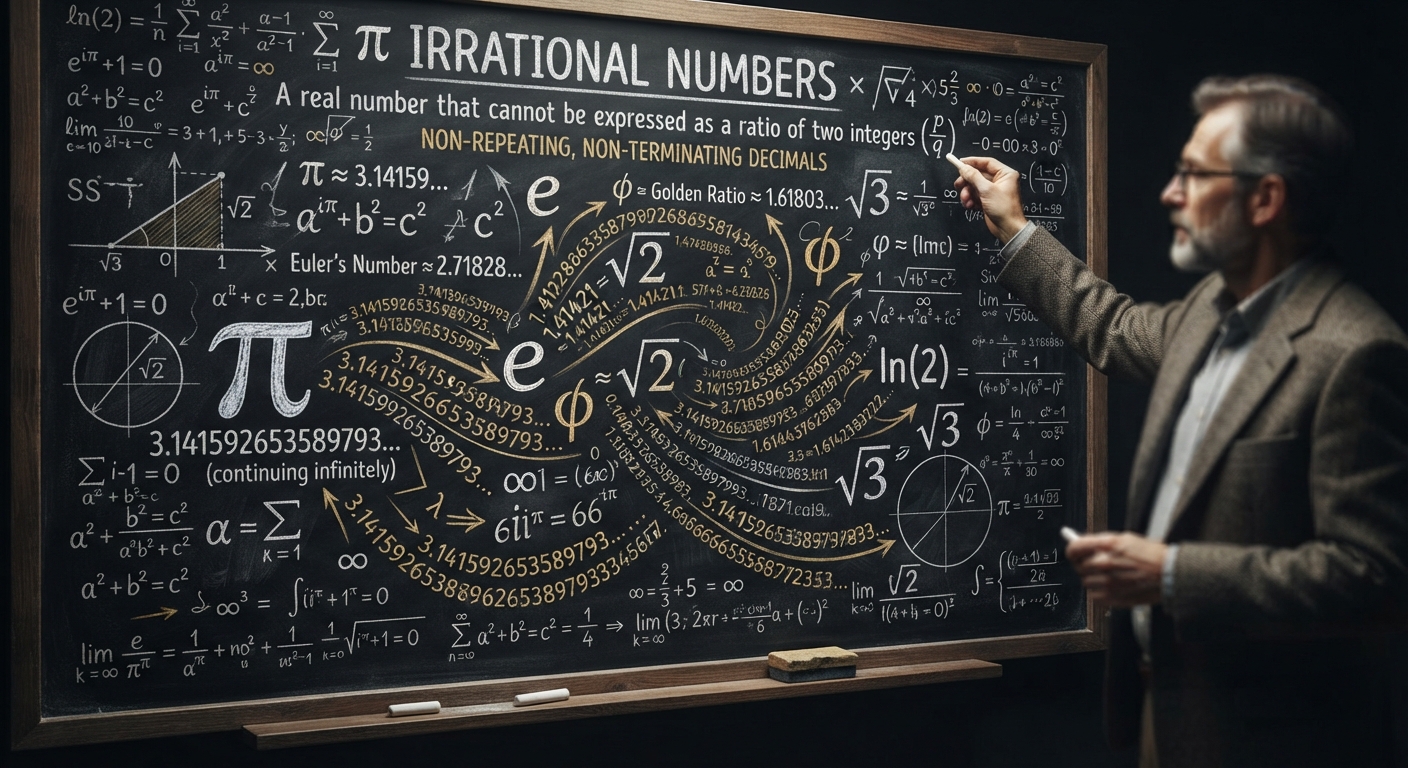
Irrational numbers are numbers that cannot be written as a fraction with an integer on top and an integer on the bottom. Written as decimals, they never end and never fall into a repeating block of digits. π = 3.14159265… and √2 = 1.41421356… are the two you’ll meet most.
That second half of the definition is where kids lose points. “Never ends” isn’t enough on its own, because 0.333… never ends either and it’s perfectly rational. What makes a number irrational is that the digits never end and never repeat. Below we go through how to spot one in a lineup, the short list of irrational numbers worth knowing, why √2 can’t be a fraction, the usual mistakes, and practice problems with answers.
What makes a number irrational
There are two ways to state the same test, and it helps to know both because textbooks switch between them.
The fraction test. If you can write the number as a/b where a and b are integers and b isn’t zero, it’s rational. If no such fraction exists, it’s irrational. That’s where the name comes from: no ratio.
The decimal test. Write the number as a decimal and look at what the digits do. There are three possible endings, and only one of them means irrational.
| What the decimal does | Example | Rational or irrational |
|---|---|---|
| Stops after some digits | 0.75, 3.2, -8.125 | Rational |
| Runs forever, repeating a block | 0.333…, 0.142857142857… | Rational |
| Runs forever with no repeating block | 3.14159265…, 1.41421356… | Irrational |
The repeating block can be one digit or a hundred digits. It can start late, as in 0.58333… All of those are rational. Irrational numbers never settle down at all.
The irrational numbers worth knowing by name
| Number | Value | Where it comes from |
|---|---|---|
| π (pi) | 3.14159265… | Any circle’s circumference divided by its diameter. |
| √2 | 1.41421356… | The diagonal of a square with sides of 1. |
| √3 | 1.73205080… | Shows up in equilateral triangles and 30-60-90 triangles. |
| e | 2.71828182… | The growth constant behind compound interest and natural logs. |
| φ (phi) | 1.61803398… | The golden ratio, equal to (1 + √5) ÷ 2. |
Beyond those, there are infinitely many more. The square root of any positive integer that isn’t a perfect square is irrational: √5, √7, √10, √11, and so on forever. So are the cube roots of non-perfect cubes, like the cube root of 9.
Here’s the part that surprises students. Irrational numbers are far more common than rational ones. If you could pick a random point on the number line, you’d land on an irrational number essentially every time. The tidy fractions are the rare ones.
How to tell if a number is irrational
Work through these in order and almost every homework problem falls out in seconds.
1. Is it written as a fraction of two integers, or can you get it there? If yes, it’s rational. 5/8, -3, 0 and 6.25 all pass this.
2. Is it a decimal that stops or repeats? Rational.
3. Is it a square root? Check whether the number under the root is a perfect square. If it is, simplify and you get a rational number. If it isn’t, the root is irrational.
4. Is it π, e, or one of those multiplied or added to a rational number? Still irrational. Dividing π by 2 or adding 3 to √5 doesn’t clean anything up.
Sorting practice, worked out
| Number | Irrational? | Reason |
|---|---|---|
| 0.5 | No | It stops, and it equals 1/2. |
| 0.666… | No | Repeating 6, which is 2/3. |
| √81 | No | 81 is a perfect square, so this is 9. |
| √7 | Yes | 7 isn’t a perfect square. About 2.6457… |
| -√11 | Yes | Negatives can be irrational too. About -3.3166… |
| √(4/9) | No | Top and bottom are both perfect squares, so it’s 2/3. |
| π ÷ 2 | Yes | About 1.5707… Dividing by an integer doesn’t make it a fraction. |
| 0.123456789101112… | Yes | The digits keep counting up, so no block ever repeats. |
Estimating an irrational number
Tests often ask which two integers an irrational root falls between. Use the perfect squares on either side.
Where does √30 sit?
25 < 30 < 36
√25 = 5 and √36 = 6
So √30 is between 5 and 6. Since 30 is closer to 36 than to 25, the answer is closer to 6. The calculator says 5.477.
Why √2 cannot be a fraction
This is one of the oldest proofs in mathematics, and a motivated eighth grader can follow it.
Suppose √2 could be written as a fraction a/b in lowest terms, so a and b share no common factors.
Square both sides: 2 = a² ÷ b², which rearranges to a² = 2b².
That means a² is even. Only even numbers have even squares, so a must be even. Write a = 2k.
Substitute back: (2k)² = 2b², so 4k² = 2b², so b² = 2k². By the same reasoning, b is even too.
But if a and b are both even, they share a factor of 2, and we said the fraction was in lowest terms. The assumption breaks. No such fraction exists, so √2 is irrational.
Common mistakes with irrational numbers
Calling 22/7 irrational. It’s a fraction of two integers, so it’s rational by definition. It equals 3.142857142857…, a repeating decimal that’s close to π but not equal to it.
Treating 3.14 as π. 3.14 stops, so it’s rational. It’s a rounded stand-in for π, and on a test the two aren’t interchangeable.
Assuming every square root is irrational. √100, √0.25 and √(9/16) are all rational, equal to 10, 0.5 and 3/4.
Forgetting the “never repeats” half. Kids see “0.818181…” running off the page and call it irrational. The block 81 repeats, so it’s rational. It equals 9/11.
Thinking irrational numbers can’t be located on a number line. Every irrational number has an exact spot. √2 is the length of the diagonal of a one-by-one square, and you can draw that.
Assuming two irrationals always make a third. √2 × √2 = 2, which is rational. So is π minus π. Combining irrational numbers can land you right back on a whole number.
Practice problems
1. Which of these are irrational? 7/8, √36, √10, 0.75, π, 2.131313…
2. Is √49 rational or irrational? Why?
3. Is 0.101001000100001… rational or irrational? Explain what the digits are doing.
4. √30 falls between which two consecutive integers?
5. Is 3 + √2 rational or irrational?
6. Compute √3 × √3. Is the answer rational or irrational?
7. Is 22/7 an irrational number? Say why in one sentence.
8. Order these from least to greatest: √2, 1.5, π, 3, √10
Answers
1. Irrational: √10 and π. The rest are rational, since 7/8 is a fraction, √36 = 6, 0.75 stops, and 2.131313… repeats the block 13.
2. Rational. 49 is a perfect square, so √49 = 7.
3. Irrational. There’s one more zero between each pair of ones every time, so the digits never end and never repeat a fixed block.
4. Between 5 and 6, because 25 < 30 < 36.
5. Irrational. Adding a rational number to an irrational one always leaves it irrational.
6. √3 × √3 = 3, which is rational.
7. No. It’s a ratio of the integers 22 and 7, so it’s rational. It just happens to be close to π.
8. √2 (about 1.414), 1.5, 3, π (about 3.142), √10 (about 3.162).
What it means if your kid is stuck on irrational numbers
This topic lands in eighth grade, and it’s a sorting job more than a calculation job. When a kid can’t sort, the missing piece is almost never the word “irrational.”
Usually it’s perfect squares. A student who doesn’t know 1, 4, 9, 16, 25, 36, 49, 64, 81, 100, 121 and 144 on sight has no way to judge √56 quickly, so every problem turns into guessing. That’s a third and fourth grade multiplication gap wearing an eighth grade costume.
The other common hole is converting fractions to decimals. If a kid can’t turn 5/11 into 0.4545… by dividing, “does this repeat?” is an unanswerable question. Both gaps keep causing trouble later, since the same fraction and division skills drive most of the trouble students have in algebra.
If you want to see where the floor actually gave way, the signs a child is behind in math sorts the warning signals by grade, and math skills by grade level lists the elementary work that should be solid before any of this shows up.
Frequently asked questions
Is pi an irrational number?
Yes. π is irrational, which was proven in 1761. Its decimal expansion never ends and never repeats, so no fraction equals it exactly. 22/7 and 3.14 are useful approximations, and both are rational.
Is 0 an irrational number?
No. Zero is rational, because it can be written as 0/1. Every integer is rational for the same reason.
Can an irrational number be negative?
Yes. -√2 and -π are both irrational. The sign has nothing to do with it. What matters is whether the number can be written as a ratio of integers.
Are all square roots irrational numbers?
No. The square root of a perfect square is a whole number, so √64 = 8 is rational. Roots of fractions made from perfect squares are rational too, like √(25/49) = 5/7. Only roots of non-perfect squares are irrational.
What grade do students learn about irrational numbers?
Eighth grade in most state standards. Students learn to tell rational from irrational, estimate the value of an irrational root, and place irrational numbers on a number line. The idea then gets used all through algebra and geometry, especially with the Pythagorean theorem and circles.
Can you add two irrational numbers and get a rational one?
Yes. √5 + (-√5) = 0, and (2 + π) + (2 – π) = 4. The irrational parts can cancel. That’s why there’s no general rule saying irrational plus irrational stays irrational.
Find the actual gap
When a unit like this one goes badly, the useful question isn’t “how do we drill irrational numbers.” It’s which earlier skill is making the sorting slow. Math Anon opens with a short adaptive assessment that pinpoints the missing skills, including ones from several grades back, and you get a written report of exactly what it found.
After that your child works about 20 minutes a day on practice aimed at those specific holes, and we send you a progress report each week. The assessment costs $49, and we credit all of it back on your first month. Start the assessment, or check the pricing first.





