
Place Value Charts, Expanded Form And Examples
The short version
- Place value is what a digit is worth because of where it sits in a number. The 4 in 40 is worth forty. The 4 in 4,000 is worth four thousand.
- Every place is 10 times the place to its right: ones, tens, hundreds, thousands, ten thousands, hundred thousands, millions.
- Expanded form splits a number into the value of each digit. 4,827 = 4,000 + 800 + 20 + 7.
- To compare two numbers, line them up and scan left to right. The first place where the digits differ settles it.
- Zero holds a place open. Without the 0 in 5,062 you’d have 562, a completely different number.
Place value is the value a digit has because of its position in a number. A 7 by itself is seven, but a 7 in the hundreds place is worth 700, and a 7 in the ten thousands place is worth 70,000. Same digit, different job. Our number system is base ten, so each place going left is worth ten times the one before it.
That idea sits under most of elementary math: reading big numbers, carrying and borrowing, comparing, rounding and decimals. Below you’ll find the chart, expanded form, comparing, rounding, a short look at decimals, the mistakes kids make most, and practice with answers.
What place value actually means
Write the number 333. Three identical digits, three different values. Reading right to left: 3 ones, 3 tens, 3 hundreds. So the number is really 300 + 30 + 3.
The ten times rule is the engine. Ten ones make one ten. Ten tens make one hundred. Ten hundreds make one thousand. That’s also why the 7 in 7,000 is worth exactly 10 times the 7 in 700, and 100 times the 7 in 70.
The place value chart
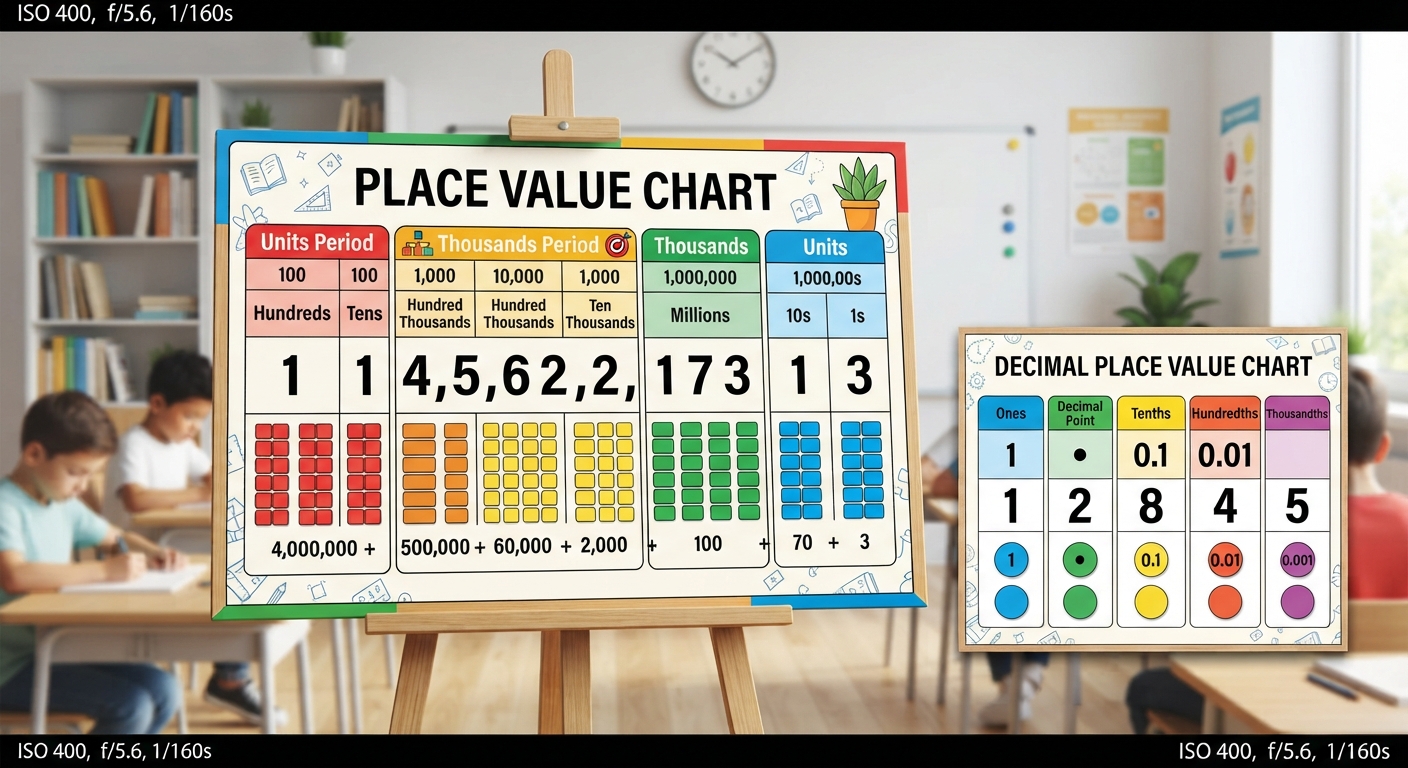
Here are the whole number places, biggest on the left. Notice how the names repeat in groups of three: ones, tens, hundreds, then thousands, ten thousands, hundred thousands, then millions and up. Commas in a written number mark those groups.
| Place | One digit there is worth | Digit in 4,827,163 | Value of that digit |
|---|---|---|---|
| Millions | 1,000,000 | 4 | 4,000,000 |
| Hundred thousands | 100,000 | 8 | 800,000 |
| Ten thousands | 10,000 | 2 | 20,000 |
| Thousands | 1,000 | 7 | 7,000 |
| Hundreds | 100 | 1 | 100 |
| Tens | 10 | 6 | 60 |
| Ones | 1 | 3 | 3 |
Add those values and you get the number back: 4,000,000 + 800,000 + 20,000 + 7,000 + 100 + 60 + 3 = 4,827,163.
Reading a big number out loud
Use the commas. Read each group of three as if it were its own small number, then say the group’s name.
4,827,163
Group 1: 4, say “four million”
Group 2: 827, say “eight hundred twenty-seven thousand”
Group 3: 163, say “one hundred sixty-three”
Out loud: four million, eight hundred twenty-seven thousand, one hundred sixty-three.
Expanded form
Expanded form writes a number as the sum of what each digit is worth. It’s the clearest proof that a kid understands place value, because you can’t fake it by reading digits off a page.
4,827
4 thousands = 4,000
8 hundreds = 800
2 tens = 20
7 ones = 7
Expanded form: 4,000 + 800 + 20 + 7
Zeros drop out of the sum because they add nothing. 5,206 is 5,000 + 200 + 0 + 6, and most teachers want that written as 5,000 + 200 + 6. The zero still matters in the number itself; it just contributes nothing to the total.
| Standard form | Word form | Expanded form |
|---|---|---|
| 362 | three hundred sixty-two | 300 + 60 + 2 |
| 5,206 | five thousand, two hundred six | 5,000 + 200 + 6 |
| 43,052 | forty-three thousand, fifty-two | 40,000 + 3,000 + 50 + 2 |
| 700,009 | seven hundred thousand, nine | 700,000 + 9 |
Going backward from expanded form to standard form is the better exercise. Given 40,000 + 3,000 + 50 + 2, a kid has to notice there are no hundreds and put a 0 in that slot: 43,052. Kids who write 4,352 haven’t got it yet.
Comparing and ordering numbers
Place value gives you a rule that always works. Line the numbers up by their right edges, count the digits, and compare from the left.
Step 1: more digits wins. 12,400 beats 9,999 because it reaches the ten thousands place.
Step 2: same number of digits, so compare the leftmost place. If those match, move one place right. Keep going until the digits differ.
4,619 versus 4,691
Thousands: 4 and 4, tie.
Hundreds: 6 and 6, tie.
Tens: 1 and 9. Nine tens beats one ten.
So 4,691 > 4,619.
Ordering a list works the same way. Put 30,902, 3,920, 30,290 and 39,002 from least to greatest: 3,920 has only four digits so it’s smallest, then 30,290 and 30,902 both start with 30, and the third digit (2 versus 9) separates them, and 39,002 is largest. Least to greatest: 3,920, 30,290, 30,902, 39,002.
Rounding uses place value too
Rounding asks which nearby “round” number a value is closest to, and the place you round to decides the answer. Find the digit in that place, then look at the single digit just to its right. If it’s 5 or more, round up. If it’s 4 or less, keep the digit and fill everything to the right with zeros.
Round 26,481 to the nearest thousand.
Thousands digit: 6
Digit to its right (hundreds): 4, so round down.
Answer: 26,000
Round 47,650 to the nearest thousand.
Thousands digit: 7
Digit to its right: 6, so round up.
Answer: 48,000
Round 26,481 to the nearest hundred instead and you get 26,500, because the tens digit is 8. Same number, different place, different answer.
Place value after the decimal point
The pattern keeps going to the right of the decimal point, except now each place is one tenth of the place before it: tenths, hundredths, thousandths. There’s no “oneths” place, because the ones place is already there on the left of the point.
3.469
3 ones = 3
4 tenths = 0.4
6 hundredths = 0.06
9 thousandths = 0.009
Expanded: 3 + 0.4 + 0.06 + 0.009 = 3.469
This is why 0.7 is bigger than 0.25 even though 25 looks like a bigger number than 7. Seven tenths sits in a heavier place than two tenths. Compare decimals the same way you compare whole numbers: start at the left and move right.
Common place value mistakes
Saying the digit instead of its value. Asked what the 3 in 5,382 is worth, a kid says “three.” The digit is 3; the value is 300. Ask for the value every time and the habit sticks.
Dropping a zero. Writing four hundred thousand, nine as 4,009 or 400,9 instead of 400,009. Zeros are placeholders and they have to be counted, not skipped.
Counting places from the wrong side. Whole number places are read from the right, starting at the ones. Decimal places are read from the point, going right. Kids who start counting from the left of a long number land in the wrong slot.
Comparing by length after a decimal point. 0.5 is greater than 0.4999, even though the second number has more digits. Longer does not mean larger once you’re past the point.
Practice problems
- In 5,382, what is the value of the 3?
- Which digit is in the ten thousands place in 749,015?
- Write 6,409 in expanded form.
- Write 40,000 + 3,000 + 50 + 2 in standard form.
- Which is greater, 7,214 or 7,241?
- Round 26,481 to the nearest thousand.
- In 4,844, the value of the 4 in the thousands place is how many times the value of the 4 in the tens place?
- Put these in order from least to greatest: 30,902, 3,920, 30,290, 39,002.
Answers
- 300. The 3 sits in the hundreds place, so it’s worth 3 × 100.
- 4. Reading from the right: 5 ones, 1 ten, 0 hundreds, 9 thousands, 4 ten thousands, 7 hundred thousands.
- 6,000 + 400 + 9. The 0 in the tens place adds nothing to the sum.
- 43,052. There are no hundreds listed, so a 0 goes in the hundreds place.
- 7,241. The thousands and hundreds match, and in the tens place 4 beats 1.
- 26,000. The hundreds digit is 4, so the thousands digit stays at 6.
- 100 times. 4,000 ÷ 40 = 100.
- 3,920, 30,290, 30,902, 39,002.
If your child is stuck on place value
When place value wobbles, the symptom usually shows up somewhere else. A fourth grader who can’t line up a multi-digit subtraction, a fifth grader who says 0.25 is bigger than 0.7, a sixth grader who multiplies by 10 by adding a zero without knowing why: all of those trace back to the same gap. The arithmetic looks broken, but the idea underneath it is what’s missing.
Go back further than feels necessary. Bundling and unbundling is the root skill: ten ones become one ten, one hundred breaks into ten tens. Base ten blocks, coins, or drawing sticks and dots all work. A kid who can physically trade ten of something for one of the next thing stops guessing when they borrow across a zero.
It also helps to know what’s normally expected at each age. Our guide to math skills by grade level lays out where place value should be by the end of third, fourth and fifth grade, and Is My Child Behind In Math? lists the warning signs that a gap has opened up. If homework is turning into tears, math anxiety is often the second problem sitting on top of the first, and it’s worth treating both.
Frequently asked questions
What is the difference between place and place value?
The place is the position, like “the hundreds place.” The place value is what the digit sitting there is worth. In 5,382, the 3 is in the hundreds place and its place value is 300. Some textbooks also use “face value” for the digit itself, which is just 3.
What is the place value of 0 in a number?
Zero’s value is always zero, but its job is to hold a place open so the other digits stay where they belong. In 5,062 the 0 keeps the 5 in the thousands place. Take it out and you get 562.
What grade do kids learn place value?
It starts in kindergarten and first grade with tens and ones, grows to hundreds and thousands in second and third, reaches hundred thousands and beyond plus the ten times relationship in fourth, and extends to decimals through thousandths in fifth. It gets reused constantly after that.
How do I explain place value to a child at home?
Use something they can move. Coins work well: pennies are ones, dimes are tens, dollars are hundreds. Ask them to trade ten pennies for a dime and ten dimes for a dollar. Then write a number and have them build it. The trading is the whole concept.
Find the actual gap
Place value problems are rarely about place value alone by the time a parent notices them. Something earlier came loose and the errors surfaced later. Guessing at which skill it was costs weeks. Math Anon starts with a short adaptive assessment that works out exactly which skills are missing, then sends you a written report in plain English saying what it found and where to start.
After that it’s about 20 minutes of targeted daily practice aimed straight at those gaps, with a progress report every week so you can see what’s closing. The assessment is $49 and we credit the whole thing back on your first month. Start the assessment or look at the pricing first.





