
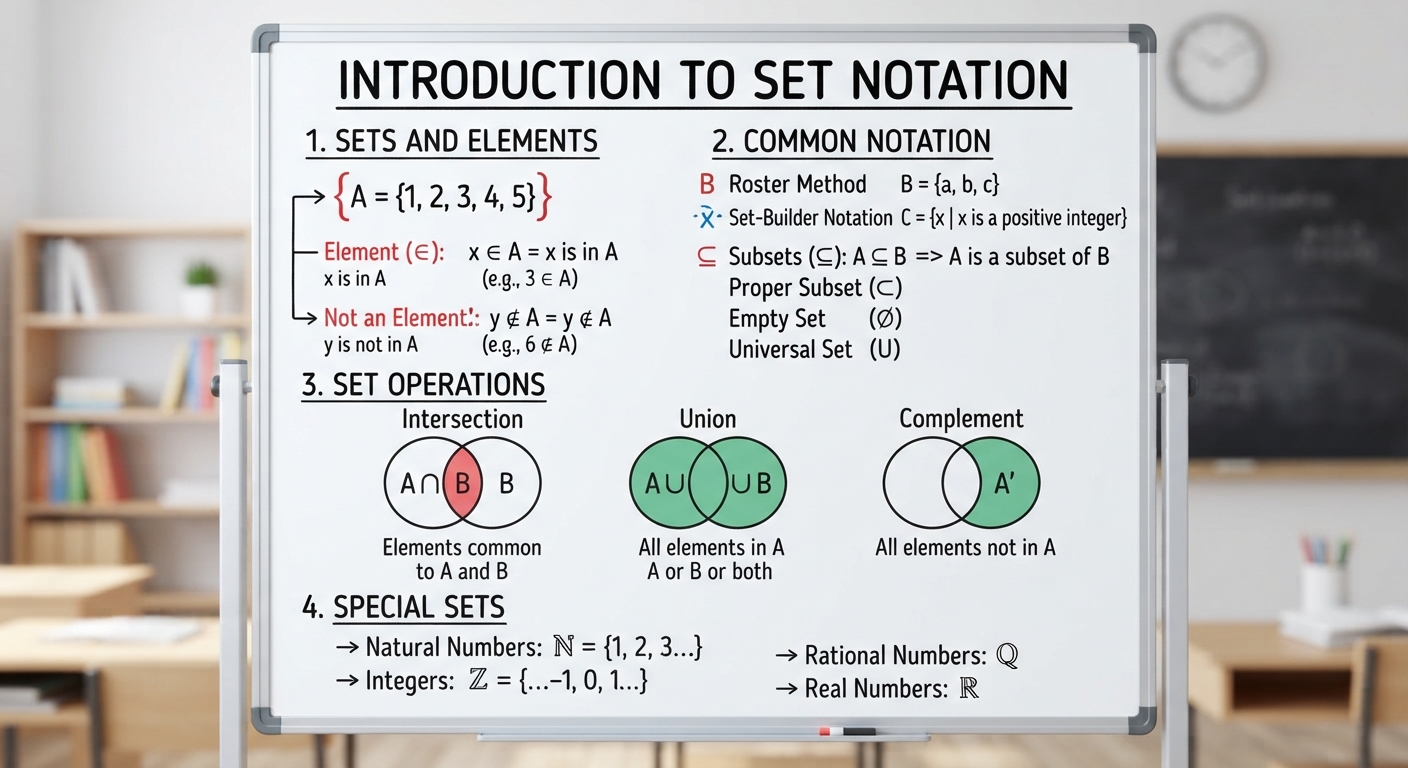
Set Notation: Symbols, Examples And Practice
The short version
- Set notation is the shorthand for writing a collection of things. Curly braces hold the members: A = {2, 4, 6, 8}.
- Roster form lists every member. Set builder form states the rule instead: {x | x is an even number between 0 and 10}.
- Union (∪) means everything in either set. Intersection (∩) means only what’s in both. If A = {1, 2, 3} and B = {3, 4}, then A ∪ B = {1, 2, 3, 4} and A ∩ B = {3}.
- ∈ means “is a member of” and ∉ means “is not.” Order and repeats don’t matter: {1, 2, 2, 3} is the same set as {3, 2, 1}.
- The empty set is written ∅ or { }, never {∅}, which is a set holding one thing.
Set notation is the standard way to write down a group of objects in math. You put the members inside curly braces, separated by commas, and give the whole group a capital letter for a name. So the set of odd numbers under 10 gets written A = {1, 3, 5, 7, 9}, and from there a handful of symbols let you say things like “5 is in A” or “what do A and B have in common” without writing a sentence.
The objects inside a set are called elements or members, and they can be numbers, letters, shapes or names. Below you’ll find the symbol table, both ways of writing a set, how union and intersection work, the mistakes that cost points on tests, and practice with answers.
The set notation symbols
This table covers almost everything you’ll meet in middle school and early high school. Read the “means” column as the words you’d say out loud.
| Symbol | Name | What it means |
|---|---|---|
| { } | Braces | Hold the elements of a set: {1, 2, 3} |
| ∈ | Element of | 3 ∈ {1, 2, 3} reads “3 is in the set” |
| ∉ | Not an element of | 5 ∉ {1, 2, 3} |
| ∅ | Empty set | A set with nothing in it, also written { } |
| ∪ | Union | Everything in either set, or both |
| ∩ | Intersection | Only what appears in both sets |
| ⊆ | Subset | Every element of the first set is in the second |
| ⊂ | Proper subset | A subset that isn’t the whole set |
| | | Such that | The divider in set builder form, sometimes written : |
| n(A) | Cardinality | How many elements A has, also written |A| |
| U | Universal set | Everything under discussion in that problem |
| A’ | Complement | Everything in U that is not in A |
Roster form and set builder form
There are two ways to write the same set, and textbooks switch between them without much warning.
Roster form
List the members, separated by commas, inside braces. B = {red, blue, yellow}. For a long or endless list you use three dots: the counting numbers are {1, 2, 3, 4, …} and the even numbers from 2 to 100 are {2, 4, 6, …, 100}.
Two rules trip kids up. Order doesn’t matter: {1, 2, 3} equals {3, 1, 2}. Repeats don’t count: {a, b, b, c} is {a, b, c}.
Set builder form
Instead of listing members, you describe the rule they follow. The shape is {variable | condition}, read as “the set of all x such that …”
{x | x is an even number and 0 < x < 10}
Read: the set of all x such that x is even and x is between 0 and 10
In roster form: {2, 4, 6, 8}
{x | x ∈ Z, -2 ≤ x ≤ 3}
Read: all integers x from -2 to 3
In roster form: {-2, -1, 0, 1, 2, 3}
Set builder form earns its keep when a list is infinite or just long. You can’t roster every real number bigger than 5, but {x | x > 5} says it.
Union, intersection and difference
These three operations are where set notation starts doing work. Use A = {1, 2, 3, 4, 5} and B = {4, 5, 6, 7} for all of them.
Union, A ∪ B. Everything that shows up in either set. Write out A, then add anything from B that isn’t already there.
A ∪ B = {1, 2, 3, 4, 5, 6, 7}
The 4 and 5 appear once, because repeats don’t count.
Intersection, A ∩ B. Only the elements in both sets at once. Go through A and keep anything that also appears in B.
A ∩ B = {4, 5}
Difference, A – B. What’s left in A after you remove anything that’s also in B.
A – B = {1, 2, 3}
B – A = {6, 7}
Notice those two answers are different. Subtraction of sets doesn’t flip.
A hook that holds up: the ∪ of union looks like a cup that catches everything, and ∩ points down at the small overlap. Sets that share nothing are called disjoint, and their intersection is ∅.
Subsets, the empty set and complements
A ⊆ B means every element of A is also in B. So {2, 4} ⊆ {1, 2, 3, 4, 5}. Every set is a subset of itself, and the empty set is a subset of every set, which sounds like a trick but follows from the definition: there’s no element of ∅ sitting outside B, so the condition holds.
Counting subsets has a tidy formula. A set with n elements has 2 to the power of n subsets, counting the empty set and the whole set. So {p, q, r} has 2 × 2 × 2 = 8 subsets.
The complement needs a universal set first. If U = {1, 2, 3, 4, 5, 6, 7, 8, 9, 10} and A = {1, 2, 3, 4, 5}, then A’ = {6, 7, 8, 9, 10}. Change U and A’ changes with it, which is why a problem that asks for a complement always tells you U.
The number sets you’ll see named
| Symbol | Set | Examples |
|---|---|---|
| N | Natural or counting numbers | 1, 2, 3, 4, … |
| W | Whole numbers | 0, 1, 2, 3, … |
| Z | Integers | …, -2, -1, 0, 1, 2, … |
| Q | Rational numbers | 1/2, -3, 0.75, 0.333… |
| R | Real numbers | everything on the number line |
These turn up inside set builder form constantly: {x | x ∈ N, x < 5} is {1, 2, 3, 4}. Swap N for Z and the same line becomes infinite.
Common set notation mistakes
Mixing up ∪ and ∩. This is the single most common error, and it costs a whole answer. Union is bigger, intersection is smaller. If your intersection came out larger than either original set, something went wrong.
Writing {∅} for the empty set. The empty set is ∅ or { }. Writing {∅} gives you a set containing one thing, so its cardinality is 1, not 0.
Treating a set like an ordered list. {1, 2, 3} and {3, 2, 1} are the same set. Ordered pairs use round brackets for exactly this reason, and (1, 2) is not (2, 1).
Forgetting the universal set on a complement problem. A’ has no meaning on its own. Find U first, then take everything in U that isn’t in A.
Practice problems
- Write the set of vowels in the English alphabet in roster form.
- A = {2, 4, 6, 8, 10} and B = {1, 2, 3, 4, 5}. Find A ∩ B.
- Using the same A and B, find A ∪ B.
- True or false: 7 ∈ {1, 3, 5, 7, 9}
- Write {3, 6, 9, 12} in set builder form.
- U = {1, 2, 3, 4, 5, 6, 7, 8} and C = {2, 3, 5, 7}. Find C’.
- How many subsets does {p, q, r} have?
- List the elements of {x | x ∈ Z and -3 < x < 2}.
Answers
- {a, e, i, o, u}
- {2, 4}. Those are the only two numbers in both lists.
- {1, 2, 3, 4, 5, 6, 8, 10}. Every member of either set, each written once.
- True.
- {x | x is a multiple of 3 and 0 < x ≤ 12}. Writing it as {3n | n ∈ N, n ≤ 4} is also correct.
- {1, 4, 6, 8}. Those are the members of U that aren’t in C.
- 8, because 2 to the power of 3 is 8. They are ∅, {p}, {q}, {r}, {p, q}, {p, r}, {q, r} and {p, q, r}.
- {-2, -1, 0, 1}. The endpoints -3 and 2 are excluded because the signs are strict.
If your child is stuck on sets
Sets look like a brand new topic, so parents assume the symbols are the problem. Usually they aren’t. A kid who can’t answer {x | x ∈ Z, -2 ≤ x ≤ 3} is stuck on integers and the number line, not on braces. The notation is a wrapper around math they already needed.
Try this at home: before writing anything, have them say the problem out loud in plain English. “The set of all x such that x is an integer between negative two and three.” Usually the sentence comes out fine and the writing follows. When it doesn’t, you’ve found the real gap, and it’s almost always a grade level down.
Sets turn up right when algebra gets serious, which is also when older gaps stop hiding. Our post on struggling with algebra covers why fourth grade fractions are so often the culprit, and Is My Child Behind In Math? lists the signs by grade. If the homework fight has become the main event, math anxiety is worth reading too.
Frequently asked questions
What is a set in math?
A set is a well defined collection of objects. “Well defined” means anyone can tell whether a given thing belongs. The even numbers under 10 form a set. The “good” numbers under 10 do not, because nobody can settle who’s in.
What is the difference between roster form and set builder form?
Roster form lists the actual members inside braces: {2, 4, 6, 8}. Set builder form gives the rule that decides membership: {x | x is even and 0 < x < 10}. Same set, two ways of saying it. Roster is clearer for short sets, builder is the only option for infinite ones.
What does n(A) mean?
It’s the cardinality of A, meaning how many elements it has. If A = {1, 2, 3, 4, 5} then n(A) = 5. Some books write it |A| instead. For the empty set, n(∅) = 0.
What grade do students learn set notation?
Informal work with sorting and groups starts in elementary school. Formal set notation with braces and membership symbols usually lands in sixth to eighth grade, and union, intersection and set builder form come back in algebra and again in probability.
Find the actual gap
If set notation is where your child stalled, the symbols are usually the visible part of something older. We don’t guess at it. Math Anon opens with a short adaptive assessment that keeps adjusting as your child answers, so it lands on the exact skills that are missing rather than the grade they’re in. You get a written report afterward that names them.
From there it’s roughly 20 minutes of daily practice aimed at those specific gaps, plus a weekly progress report so you can watch them close. The assessment costs $49, and we credit all of it back on your first month. Start the assessment, or check the pricing first.
Related reading
- Struggling With Algebra? The Real Problem Is Usually Fourth Grade Fractions
- Is My Child Behind In Math? 12 Signs By Grade Level
- Mind The Gap: A Parent’s Guide To Math Assessment For Kids
- Math Anxiety In Children: What It Looks Like And What Helps
- Why 20 Minutes A Day Beats A 90-Minute Tutoring Session





