
What Is The Mean In Math?
The short version
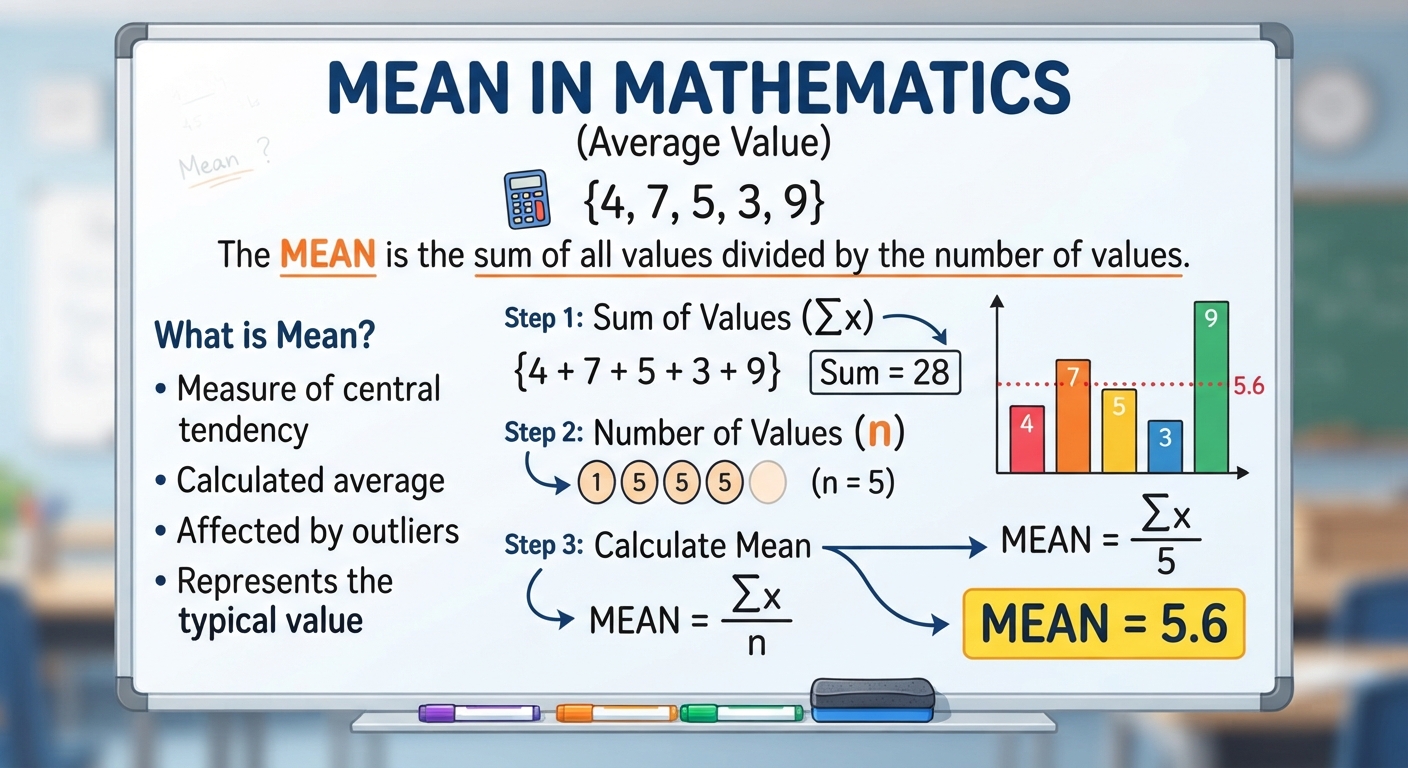
- The mean is the average. Add every value, then divide by how many values there are. For 4, 8 and 6: 4 + 8 + 6 = 18, and 18 ÷ 3 = 6.
- Count every number in the list, including zeros and repeats. Missing one value in the count is the most common way this goes wrong.
- The mean can be a decimal, it can be negative, and it doesn’t have to match any number in the list.
- One extreme value, called an outlier, drags the mean a long way. The median usually describes a lopsided data set better.
- Grades usually use a weighted mean, where tests count for more than homework, so a plain average of your category scores gives the wrong number.
The mean in math is what most people call the average. You add up all the numbers in a set, then divide by how many numbers you added. Five test scores of 84, 91, 78, 95 and 82 add to 430, and 430 ÷ 5 = 86, so the mean score is 86.
That’s the whole procedure. The interesting part is knowing when the mean tells you something useful and when it quietly lies to you, which is the part most homework sheets skip.
How to find the mean in math
Mean = sum of all the values ÷ number of values
Three steps: add, count, divide. Writing the count down before you divide is worth the two seconds, because that’s where the errors live.
Worked example 1: whole numbers
Find the mean of 84, 91, 78, 95 and 82.
Add: 84 + 91 = 175
175 + 78 = 253
253 + 95 = 348
348 + 82 = 430
Count: 5 values
Divide: 430 ÷ 5 = 86
Worked example 2: decimals
A town gets 1.2, 0.8, 2.5 and 0.5 inches of rain over four months. Find the mean monthly rainfall.
Add: 1.2 + 0.8 + 2.5 + 0.5 = 5.0
Count: 4 values
Divide: 5.0 ÷ 4 = 1.25 inches
Notice the mean isn’t one of the four numbers. That’s normal, and it’s not a sign you did something wrong.
Worked example 3: negative numbers
Five morning temperatures: -3, 0, 5, -2 and 10 degrees. Find the mean.
Add left to right: -3 + 0 = -3
-3 + 5 = 2
2 – 2 = 0
0 + 10 = 10
Count: 5 values, and the 0 absolutely counts
Divide: 10 ÷ 5 = 2 degrees
Worked example 4: finding a missing value
Your child has four test scores of 82, 90, 76 and 88. They want a mean of 85 across five tests. What’s the minimum they need on the last one?
Work backward from the total. To average 85 over 5 tests, the sum has to be 85 × 5 = 425.
Current sum: 82 + 90 + 76 + 88 = 336
Needed: 425 – 336 = 89
This reversed version shows up constantly on tests and confuses students who only ever practiced the forward direction.
Mean, median and mode
These three get taught together and mixed up just as often. Take the data set 2, 3, 3, 4, 88.
| Measure | How to find it | Value here |
|---|---|---|
| Mean | Add all five, divide by 5 | 100 ÷ 5 = 20 |
| Median | Sort them, take the middle one | 3 |
| Mode | The value that appears most | 3 |
| Range | Largest minus smallest | 88 – 2 = 86 |
The mean here is 20, and not a single number in the set is anywhere near 20. Four of the five values are under 5. The 88 pulled the mean up by itself, which is exactly what outliers do.
For an even number of values, the median is the mean of the two middle ones. For 4, 6, 9 and 11, the middle two are 6 and 9, so the median is 7.5.
How outliers pull the mean
An outlier is a value far away from the rest. Because the mean shares the total across every value equally, one huge number moves it a long way while the median barely notices.
Start with 5, 6, 7, 8, 9. The mean is 35 ÷ 5 = 7 and the median is 7. They agree, which tells you the data is evenly spread.
Now swap the 9 for a 100: 5, 6, 7, 8, 100. The sum is 126, so the mean jumps to 25.2. The median is still 7. Four of the five values are below 9, so calling 25.2 the typical value would be misleading.
This is why home prices and salaries get reported as medians. A handful of enormous values would make the mean useless as a description of what a normal one costs.
Weighted mean, the version that decides report cards
Most classes don’t treat all work equally. A syllabus might say tests are 60% of the grade, homework 25% and quizzes 15%. A plain average of the three category scores ignores that split.
Say your child has a test average of 80, a homework average of 95 and a quiz average of 70.
Plain average: (80 + 95 + 70) ÷ 3 = 245 ÷ 3 = 81.67
Weighted: 0.60 × 80 = 48
0.25 × 95 = 23.75
0.15 × 70 = 10.50
Add those: 48 + 23.75 + 10.50 = 82.25
Those two answers are close here, but they won’t be when one category is both heavy and weak. Multiply each score by its weight as a decimal, then add the products. The weights should always total 1.
Common mistakes
Dividing by the wrong count. Every value in the list counts, including zeros and repeated numbers. A student who skips the 0 in 7, 7, 8, 10, 0 and divides by 4 gets 8 instead of 6.4.
Counting a repeated value once. In 5, 5, 5, 9 there are four values, not two. Repeats each get their own slot.
Expecting the mean to be one of the numbers. It usually isn’t. A mean of 2.5 children per family is a perfectly fine answer to an arithmetic question.
Mixing up mean and median. The mean needs adding and dividing. The median needs sorting. A student who forgets to sort before picking the middle value gets the median wrong nearly every time.
Averaging averages. If one class of 10 students averages 90 and another of 30 averages 70, the combined average is not 80. It’s (10 × 90 + 30 × 70) ÷ 40 = (900 + 2100) ÷ 40 = 75.
Treating weighted categories as equal. Grade calculators go wrong here more than anywhere else. Check the syllabus for the percentages before doing any math.
Practice problems
1. Find the mean of 4, 8, 6, 10 and 2.
2. Find the mean of 12, 15 and 21.
3. Find the mean of 7, 7, 8, 10 and 0.
4. Find the mean of -4, -1, 3 and 6.
5. Find the mean of 2.5, 3.1 and 4.4. Round to two decimal places.
6. Four test scores are 82, 90, 76 and 88. What score on a fifth test gives a mean of 85?
7. For the data set 3, 4, 4, 5, 44, find the mean and the median. Which one describes the set better?
8. Tests are worth 70% of a grade and homework 30%. A student has a test average of 88 and a homework average of 100. What is the weighted mean?
Answers
1. Sum = 30, count = 5, so the mean is 6.
2. Sum = 48, count = 3, so the mean is 16.
3. Sum = 32, count = 5, so the mean is 6.4. The zero still counts as a value.
4. Sum = 4, count = 4, so the mean is 1.
5. Sum = 10.0, count = 3, so the mean is 3.333…, which rounds to 3.33.
6. The total needed is 85 × 5 = 425. The first four add to 336, so the fifth score must be 89.
7. Sum = 60 and count = 5, so the mean is 12. Sorted, the middle value is 4, so that’s the median. The median describes the set better, because 44 is an outlier and four of the five values are 5 or below.
8. 0.70 × 88 = 61.6 and 0.30 × 100 = 30, so the weighted mean is 91.6.
What it means if your child is stuck on this
Almost nobody gets stuck on the idea of the mean. Add, count, divide is about as clear as math instructions get. When these problems come back wrong, the reason is usually underneath.
If the setup is right and the answer is wrong, it’s addition or division, and the fix is number fact fluency rather than statistics. If long division of a sum like 430 ÷ 5 is a struggle, that’s a fourth or fifth grade skill that needs attention before sixth grade data work will go smoothly. If decimals in the answer cause a freeze, that’s a decimal gap. And if your child can compute a mean perfectly but can’t say which of two averages describes a set better, that’s a reasoning skill, and it’s the one that actually shows up later in algebra and science.
Two places to start: math skills by grade level sets out what should be solid before averages arrive, and 12 signs your child is behind in math helps you sort a real gap from a rough week. If homework has turned into an argument, math anxiety in children is worth reading first.
Frequently asked questions
What is the formula for the mean?
Mean = sum of the values ÷ number of values. Add every number in the set, count how many there are, then divide. That single formula covers the mean in math at every grade level.
Is the mean the same as the average?
In school math, yes. “Average” in everyday speech means the mean. Statisticians use average more loosely, since the median and the mode are also measures of a typical value, which is why the precise word mean is used in class.
What is the difference between mean, median and mode?
The mean is the total shared out evenly. The median is the middle value once the numbers are sorted. The mode is whichever value shows up most often. A set can have one mode, several modes or none.
Can the mean be a decimal or a negative number?
Both. The mean of 7 and 8 is 7.5, and the mean of -6 and -2 is -4. The mean only has to sit somewhere between the smallest and largest values in the set.
What grade do kids learn the mean?
Averages usually appear around fourth or fifth grade informally, then formally in sixth grade alongside median, mode and range. Weighted means and outlier discussions typically land in middle school and get used again in high school statistics.
Why does one big number change the mean so much?
Because the mean divides the total across all the values. Adding 100 to a set of small numbers adds 100 to the total, and that whole increase gets spread over the count. The median ignores it, since it only cares about position, not size.
Find the actual gap
A wrong mean can come from the concept, the addition, the division or the decimals. They look identical on a homework page and they need completely different practice. Math Anon opens with a short adaptive assessment that tells the four apart, then gives you a written report saying which skills to fix and in what order.
From there your child works about 20 minutes a day on exactly those skills, and a weekly progress report shows you what’s closing. Start the assessment for $49, credited back in full on your first month. Details live on the pricing page, and why 20 minutes a day beats a 90 minute session explains why we set it up this way.





